Key Takeaways
- Traditional Chinese medicine has long used common kitchen ingredients as first-line remedies for everyday ailments.
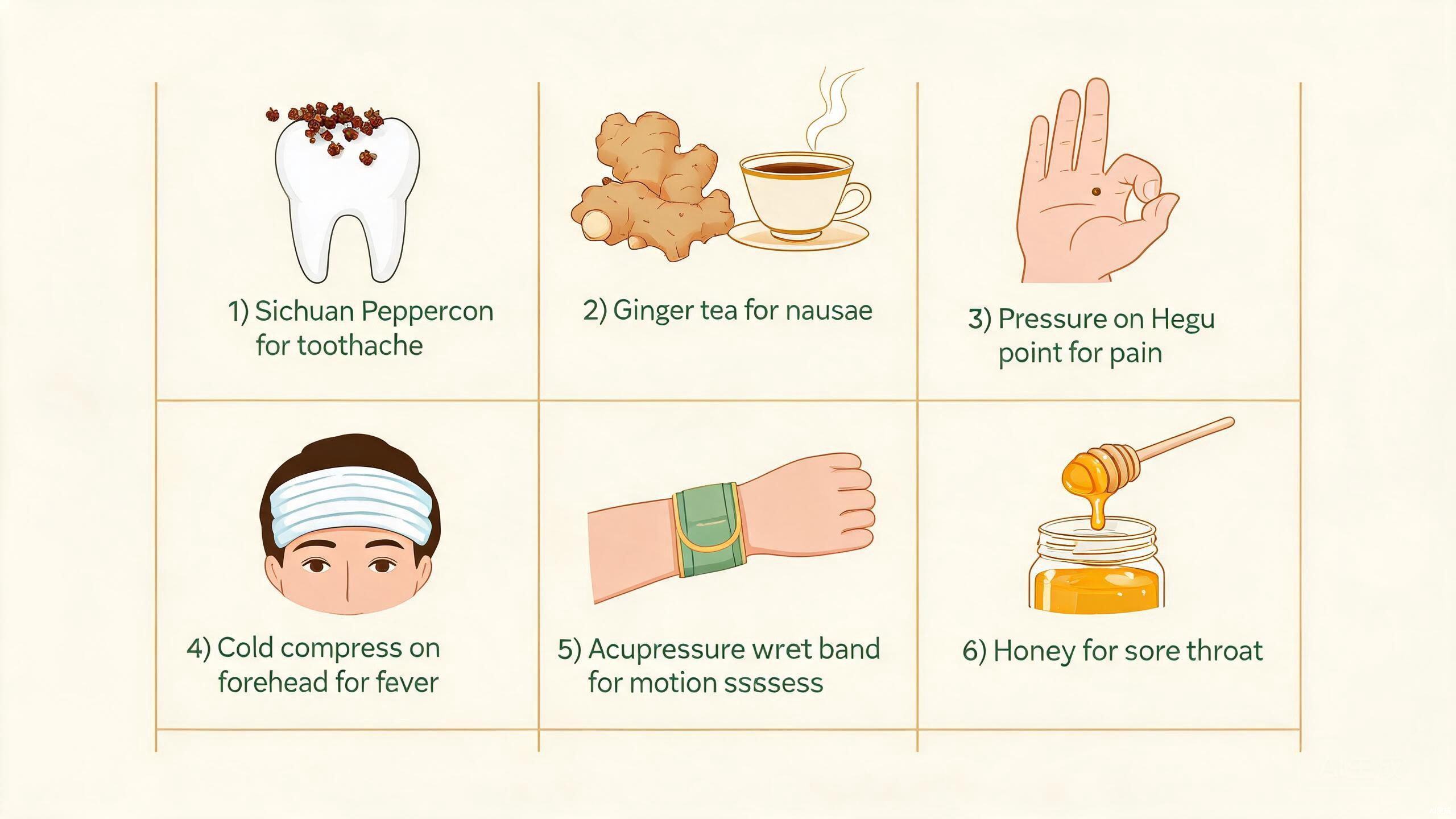
- Each remedy pairs a food-based treatment (like ginger, honey, or Sichuan peppercorn) with an optional acupressure point for combined effect.
- These remedies address 10 common complaints: toothache, hiccups, nosebleed, stiff neck, insect bites, minor burns, motion sickness, leg cramps, eye fatigue, and mouth ulcers.
- Every remedy includes clear guidance on when to stop and when to see a doctor.
- These are for mild, temporary complaints only — persistent or severe symptoms require professional medical care.
This article is for wellness education only and is not medical advice. The remedies described are traditional folk practices for mild, temporary complaints. They are not a substitute for professional medical care. If symptoms are severe, persistent, or worsening, or if you have a medical condition, are pregnant, or take medication, consult your healthcare provider before using any remedy. Never use kitchen remedies for serious injuries, deep wounds, severe burns, or conditions requiring emergency care.
In every traditional Chinese household, the kitchen was the first pharmacy. Long before modern medicine, families relied on the healing properties of common foods and spices to address everyday ailments. Ginger for nausea, honey for burns, Sichuan peppercorn for toothache — these were not random folk beliefs but practical applications of TCM herbal theory adapted to ingredients available at home.
This guide covers 10 of the most useful quick remedies from this tradition. Each one is designed to address a common, mild complaint using ingredients you likely already have in your kitchen. For each remedy, you will find the applicable situation, step-by-step instructions, important precautions, and clear guidance on when to seek medical care instead.
The Kitchen as a TCM Pharmacy
In TCM theory, every food has therapeutic properties — a thermal nature (hot, warm, neutral, cool, cold), a flavor (sweet, sour, bitter, spicy/pungent, salty), and an affinity for specific organs. This means that the ingredients in your kitchen are not just food; they are mild medicines. Ginger is warm and pungent, making it ideal for warming the stomach and stopping nausea. Honey is sweet and neutral, nourishing and moistening. Sichuan peppercorn is warm and spicy, with an analgesic (numbing) effect.
The key principle of kitchen remedies is matching the remedy to the pattern. For example, ginger tea is excellent for a cold-pattern stomachache (nausea with cold hands, clear mucus, aversion to cold) but less appropriate for a heat-pattern stomachache (burning pain, thirst, yellow coating). When in doubt, start with the gentlest remedy and discontinue if symptoms worsen. For a broader introduction to TCM food therapy, see our guide to TCM warming spices.
Toothache Relief: Sichuan Peppercorn and Hegu Point
Best for: Mild to moderate toothache, especially from cold sensitivity or temporary nerve irritation
Remedy 1 — Biting Sichuan Peppercorn: Take 1 to 2 whole dried Sichuan peppercorns (hua jiao) and place them directly on the affected tooth. Bite down gently and hold for 5 to 10 minutes. Sichuan peppercorn contains a natural numbing compound called hydroxy-alpha-sanshool, which produces a tingling, analgesic effect that can temporarily relieve toothache pain. The peppercorn's warming nature in TCM also helps dispel cold from the tooth meridian.
Remedy 2 — Hegu (LI4) Acupressure: While holding the peppercorn, press Hegu (LI4) — the point in the web between the thumb and index finger of the opposite hand — with firm pressure for 2 to 3 minutes. Hegu is the primary distal point for facial and dental pain. See our Hegu guide for exact location.
For a warming compress version, steep 1 tablespoon of Sichuan peppercorns in hot water for 10 minutes, strain, and use the warm liquid as a mouth rinse (do not swallow). The warm, numbing liquid can reach areas that a whole peppercorn cannot.
When to see a dentist: If the pain is severe, accompanied by swelling, fever, or pus, or lasts more than 1 to 2 days, see a dentist promptly. These remedies provide temporary relief only — they do not treat the underlying cause (cavity, infection, abscess).
Hiccups: Sugar Swallow and Cuanzhu Point
Best for: Persistent hiccups lasting more than a few minutes
Remedy 1 — Swallowing Dry Sugar: Place 1 teaspoon of dry granulated sugar on the back of the tongue and swallow it quickly without water. The dry, granular texture stimulates the vagus nerve and interrupts the hiccup reflex. In TCM, hiccups are understood as rebellious stomach qi; the sweet flavor helps harmonize stomach qi and direct it downward.
Remedy 2 — Pressing Cuanzhu (BL2): Press the Cuanzhu point — located at the inner end of the eyebrow, in the depression above the inner corner of the eye — with your thumbs for 30 seconds to 1 minute. Apply firm but comfortable pressure. This point is traditionally used for hiccups and is easily accessible.
When to see a doctor: Hiccups that last more than 48 hours (persistent hiccups) require medical evaluation, as they may indicate an underlying condition affecting the diaphragm, nerves, or central nervous system.
Nosebleed: Pinch and Cold Compress with Shangxing Point
Best for: Common anterior nosebleeds (from dry air, mild trauma, or heat)
Remedy 1 — Pinch Nose with Cold Compress: Sit upright and lean slightly forward (not backward — leaning back causes blood to run down the throat). Pinch the soft part of the nose (the nostrils) firmly between your thumb and index finger for 10 to 15 minutes without releasing. Apply a cold compress or ice pack wrapped in cloth to the bridge of the nose and forehead. The cold constricts blood vessels and helps stop bleeding.
Remedy 2 — Pressing Shangxing (GV23): While pinching, use your other hand to press the Shangxing point — located on the midline of the head, about 1 inch into the hairline from the front hairline border. Press firmly with your index finger for 1 to 2 minutes. In TCM, this point helps cool blood and stop bleeding in the head region.
When to see a doctor: If bleeding does not stop after 20 minutes of continuous pressure, if it is very heavy, if it results from serious trauma, or if nosebleeds occur frequently without clear cause, seek medical care. Frequent unexplained nosebleeds may indicate high blood pressure or a bleeding disorder.
Neck Stiffness (Stiff Neck): Hot Compress and the Neck Stiffness Point
Best for: Waking up with a stiff, painful neck from sleeping in an awkward position
Remedy 1 — Hot Compress: Soak a towel in hot water (as warm as comfortable, not scalding), wring it out, and apply it to the stiff side of the neck for 10 to 15 minutes. Re-warm the towel as needed. In TCM, stiff neck is often caused by wind-cold invading the meridians of the neck; warmth dispels the cold and relaxes the muscles. For enhanced effect, add a few slices of fresh ginger to the hot water before soaking the towel.
Remedy 2 — Pressing the Neck Stiffness Point (Luozhen Point): This is a special extra point located on the back of the hand, in the depression between the second and third metacarpal bones (between the index and middle fingers), about 1 inch from the knuckles. Press firmly with your thumb for 2 to 3 minutes on the hand opposite the stiff side of your neck. This is one of the most effective points for acute stiff neck in TCM. While pressing, slowly rotate your neck in gentle circles.
When to see a doctor: If the stiffness is accompanied by fever, headache, nausea, or numbness/weakness in the arms, seek medical evaluation — these can be signs of meningitis or cervical disc problems. If stiffness persists beyond 3 days, consult a healthcare provider.
Insect Bites: Garlic Paste and Soap Water
Best for: Mild mosquito and insect bites with itching and minor swelling
Remedy 1 — Garlic Paste: Crush 1 to 2 cloves of fresh garlic into a paste. Apply a small amount directly to the bite and hold for 5 to 10 minutes, then wash off. Garlic has natural antimicrobial and anti-inflammatory properties. In TCM, garlic is warm and pungent, and is traditionally used to detoxify insect venom. The slight sting you feel is normal — it indicates the garlic is working.
Remedy 2 — Soap Water Wash: Before applying garlic, wash the bite area thoroughly with alkaline soap and water. Many insect venoms are acidic, and the alkaline soap helps neutralize them, reducing itching and swelling. This is a simple, effective first step for any fresh bite.
Garlic can cause skin irritation or burns if left on too long, especially on sensitive skin. Do a patch test first by applying a tiny amount to the inner forearm. Never leave garlic paste on for more than 15 minutes. If you feel burning beyond mild tingling, wash off immediately. Do not use on broken skin or on children's sensitive skin without diluting the paste with a carrier oil.
When to see a doctor: If you experience difficulty breathing, facial swelling, dizziness, or hives spreading beyond the bite area, seek emergency care — these are signs of allergic reaction (anaphylaxis). If the bite becomes increasingly red, warm, or swollen over several days, it may be infected and requires medical evaluation.
Minor Burns: Cool Water and Honey
Best for: First-degree burns (redness, pain, no blisters) from hot water, steam, or brief contact with a hot surface
Remedy 1 — Cool Water Flush: Immediately hold the burned area under cool (not ice-cold) running water for 15 to 20 minutes. This is the single most important step for any minor burn — it stops the heat from penetrating deeper and dramatically reduces pain and tissue damage. Do not use ice, as it can cause further tissue damage.
Remedy 2 — Honey Application: After cooling, gently pat dry and apply a thin layer of pure honey to the burn. Cover with a clean, non-stick dressing. Honey has natural antibacterial and wound-healing properties. In TCM, honey is sweet, neutral, and moistening, making it ideal for burns that involve heat injury to the skin and fluid loss. Clinical studies have shown honey can promote faster healing of minor burns compared to some conventional dressings.
When to see a doctor: Never use these remedies for second-degree burns (with blisters) or third-degree burns. Seek immediate medical care for burns that: cover a large area, involve the face, hands, feet, groin, or major joints, appear white or charred, or are caused by chemicals or electricity. Do not pop blisters — they protect against infection.
Motion Sickness: Ginger Smell and Chew
Best for: Nausea and dizziness from car, boat, or air travel
Remedy 1 — Smelling Ginger: Cut a fresh slice of ginger and keep it in a small container. When you feel nausea coming on, hold the ginger slice under your nose and breathe deeply for 1 to 2 minutes. The pungent aroma of ginger essential oils has a direct anti-nausea effect through the olfactory system.
Remedy 2 — Chewing Ginger: For stronger effect, place a thin slice of fresh ginger on the tongue and chew slowly, swallowing the juice. Alternatively, prepare ginger candy or ginger tea before travel. In TCM, ginger warms the stomach, descends rebellious qi, and is the premier herb for nausea. For best results, start using ginger 30 minutes before travel begins.
Complementary acupressure: Press Neiguan (PC6) — three finger-widths above the inner wrist crease, between the two tendons — while traveling. This is one of the most clinically studied acupressure points for nausea and motion sickness.
When to see a doctor: Motion sickness is generally benign. However, if nausea and vomiting are severe, persistent beyond travel, or accompanied by other symptoms (fever, severe headache, vision changes), seek medical evaluation.
Leg Cramps: Stretch and Chengshan (BL57)
Best for: Sudden calf muscle cramps, especially at night (nocturnal leg cramps)
Remedy 1 — Stretching: When a cramp strikes, immediately extend the affected leg and flex the foot upward toward the shin (dorsiflexion). Pull the toes gently toward you. Hold the stretch for 30 seconds to 1 minute until the cramp releases. You can also stand and put weight on the affected leg, pressing the heel down.
Remedy 2 — Pressing Chengshan (BL57): Located on the back of the calf, in the center of the muscle belly, roughly midway between the back of the knee and the heel. When you flex the foot, the calf muscle forms a "V" shape — the point is at the bottom of the V. Press firmly with your thumb for 1 to 2 minutes. In TCM, Chengshan relaxes the muscles and tendons of the lower leg and is the primary point for leg cramps.
Prevention: Night cramps may relate to mineral deficiency (magnesium, potassium, calcium), dehydration, or poor circulation. Drink adequate water, stretch calves before bed, and consider a warm ginger foot soak to improve circulation.
When to see a doctor: If leg cramps are frequent, severe, occur during walking (which may indicate poor circulation/claudication), or are accompanied by swelling, redness, or warmth, consult a healthcare provider.
Eye Fatigue: Hot Compress and Jingming (BL1)
Best for: Tired, dry, or aching eyes from prolonged screen use or reading
Remedy 1 — Hot Compress on Eyes: Soak a clean towel in warm water (comfortably warm, not hot), wring it out, and place it over closed eyes for 5 to 10 minutes. The warmth relaxes the eye muscles, stimulates tear production, and improves local blood circulation. For a TCM enhancement, add a few dried chrysanthemum flowers to the warm water — chrysanthemum is the traditional herb for eye health. See our chrysanthemum tea guide for more.
Remedy 2 — Pressing Jingming (BL1): Located in the inner corner of the eye, in the small depression just above the inner canthus (where the upper and lower eyelids meet near the nose). With eyes closed, use your index fingers to press gently upward into this depression for 30 seconds to 1 minute. Use very light pressure — the eye area is delicate. This point nourishes the eyes and is traditionally used for eye strain, dry eyes, and blurred vision.
When to see a doctor: If eye fatigue is accompanied by pain, vision changes, light sensitivity, or discharge, consult an eye doctor. Persistent dry eyes may require medical evaluation and treatment.
Mouth Ulcers: Honey and Salt Water Rinse
Best for: Minor canker sores (aphthous ulcers) inside the mouth
Remedy 1 — Honey Application: Apply a small amount of pure honey directly to the ulcer using a cotton swab. Hold for 2 to 3 minutes, then swallow or rinse. Repeat 2 to 3 times daily. Honey coats the ulcer, reduces pain, and promotes healing through its antibacterial and wound-healing properties. In TCM, mouth ulcers often relate to heart fire or stomach heat; honey's cooling, moistening nature helps soothe the inflamed tissue.
Remedy 2 — Salt Water Rinse: Dissolve 1/2 teaspoon of salt in a cup of warm water. Rinse your mouth for 30 seconds, then spit out. Repeat 3 to 4 times daily, especially after meals. Salt water creates an alkaline environment that inhibits bacterial growth and helps reduce inflammation. The warm rinse also cleans the ulcer area.
Complementary approach: If ulcers are recurrent, consider whether you have a pattern of heart fire (red tongue tip, insomnia, irritability) or stomach heat (bad breath, yellow tongue coating, hunger). Chrysanthemum tea or canker sore remedies may address the underlying pattern.
When to see a doctor: If mouth ulcers are very large, extremely painful, last more than 2 weeks, recur frequently, or are accompanied by fever, consult a healthcare provider. Persistent oral ulcers can sometimes indicate underlying conditions.
When to See a Doctor Instead
While these kitchen remedies can be genuinely helpful for mild, temporary complaints, it is essential to know when they are not appropriate. The following situations always require professional medical care rather than home remedies:
- Severe pain of any kind that is sudden, intense, or worsening
- High fever (above 39°C / 102°F), especially in children, the elderly, or during pregnancy
- Difficulty breathing, chest pain, or signs of allergic reaction (swelling, hives, dizziness)
- Deep wounds, large burns, or broken bones
- Symptoms that persist beyond a few days despite home remedies
- Any symptom during pregnancy that causes concern
- Symptoms in infants and young children that are more than mild
- Recurrent symptoms that keep coming back (they may indicate an underlying condition)
The golden rule: if in doubt, seek medical care. Kitchen remedies are a first step for mild complaints, not a replacement for professional evaluation when something seems wrong.
Frequently Asked Questions
Are these kitchen remedies safe for children?
Most of these remedies are safe for children over age 2, but use extra caution. Reduce quantities, avoid giving honey to children under 1 year (risk of infant botulism), and never apply garlic paste to a child's sensitive skin without dilution. For fever, pain, or any persistent symptom in a child, consult a pediatrician. Children's bodies are more sensitive, so always start with the gentlest approach and discontinue if any irritation occurs.
Can I use these remedies alongside medication?
If you take prescription medications, consult your healthcare provider before using herbal remedies, even kitchen-based ones. Ginger can interact with blood thinners. Garlic can affect blood clotting. Some herbs can alter how medications are metabolized. These remedies are generally safe for people not taking medications, but always inform your doctor about all remedies and supplements you use.
How do I know if a remedy is working?
For acute issues like hiccups or mild nausea, you should notice improvement within 10 to 30 minutes. For toothache or insect bites, relief may come within 15 to 60 minutes. If a symptom does not improve after trying a remedy, or if it worsens, stop the remedy and seek medical care. These remedies are for mild, temporary complaints — persistent or severe symptoms always require professional evaluation.
What TCM remedy ingredients should I keep at home?
A basic TCM kitchen pharmacy includes fresh ginger, dried tangerine peel (chen pi), Sichuan peppercorns, honey, rock sugar, dried red dates (jujubes), goji berries, and salt. With these ingredients, you can address most common mild ailments at home. Add garlic and green onions for colds, and chrysanthemum flowers for heat-clearing tea. Store dried herbs in airtight containers away from light and moisture.
This article is for educational and informational purposes only and is not a substitute for professional medical advice, diagnosis, or treatment. The remedies described are traditional folk practices for mild, temporary complaints and have not been evaluated by the FDA or other regulatory bodies for safety or efficacy. They are not intended to diagnose, treat, cure, or prevent any disease. Always consult a qualified healthcare provider before using any new remedy, especially if you are pregnant, nursing, taking medication, or have a medical condition. Read our full disclaimer →