Key Takeaways
- Facial Gua Sha is a light-pressure scraping technique using a smooth stone tool — fundamentally different from body Gua Sha, which uses firm pressure and may produce redness marks.
- TCM theory holds that the face is a crossroads of meridians; when Qi and Blood circulate freely, the complexion appears radiant and lifted. Stagnation contributes to dullness, puffiness, and tension.
- The correct tool is a flat, polished stone (Bian stone, rose quartz, or jade) with curved edges — always used with facial oil, never on dry skin.
- Strokes move outward and downward toward lymph nodes at the jaw, ears, and sides of the neck. Angle the tool at 15 to 45 degrees with light pressure.
- A consistent routine of 3 to 5 sessions per week, 5 to 10 minutes each, is the sweet spot. Avoid over active acne, broken skin, or recent injectables.
This article is for educational purposes only and is not medical advice. Facial Gua Sha is a traditional wellness practice, not a medical treatment. It is not intended to diagnose, treat, cure, or prevent any disease or medical condition. If you have a skin condition, recent cosmetic procedures, vascular issues, or are pregnant, consult a qualified healthcare provider before beginning. Read our full disclaimer →
If you have spent any time on beauty social media in the past two years, you have likely seen the smooth, heart-shaped stone gliding across a dewy cheekbone. The trend has a name: Chinamaxxing — the enthusiastic adoption of Traditional Chinese Medicine (TCM) beauty practices by Western audiences. At the center of this movement is facial Gua Sha, a technique that has been part of Chinese households for generations and is now appearing on vanities from Los Angeles to London.
But behind the aesthetic appeal lies a sophisticated wellness philosophy. In TCM, the face is not merely skin — it is a map of the body's internal state, traversed by meridians (energy channels) that connect to every major organ system. The principle is simple: when Qi (vital energy) and Blood flow freely, the face appears vibrant, lifted, and clear. When circulation becomes stagnant, the face may look dull, puffy, or tense. Gua Sha is the traditional method for encouraging that free flow.
This guide covers everything you need to begin a safe, effective facial Gua Sha practice at home — the TCM theory, tool selection, a complete step-by-step routine, and the safety rules that protect your skin. For a broader introduction, see our guide to Traditional Chinese Medicine and our Zang-Fu organ systems guide.
The TCM Theory Behind Facial Gua Sha
To practice Gua Sha meaningfully, it helps to understand what TCM says about the face. The face is traversed by six of the twelve primary meridians, including the Stomach channel (which runs across the cheek and jaw), the Large Intestine channel (which traverses the lower face), and the Gallbladder channel (which runs along the temples and brow). Acupressure points such as Cuanzhu (BL2) at the inner brow and Taiyang (EX-HN5) at the temples lie along these pathways.
TCM holds that "where Qi and Blood circulate freely, there is no pain or stagnation." When emotional stress, poor sleep, cold weather, or prolonged screen time cause Qi and Blood to stagnate in the facial tissues, the consequences show up on the face: a dull complexion, under-eye puffiness, a heavy or tense jaw, and a general sense of facial fatigue. Gua Sha — the gentle, repetitive sweeping of a smooth stone across oiled skin — is the traditional method for encouraging circulation, releasing tension, and supporting the body's natural lymphatic drainage.
It is important to distinguish facial Gua Sha from body Gua Sha. Body Gua Sha uses firm pressure to release deep muscle tension and may produce sha — the fine, sand-like redness (petechiae) that gives the technique its name ("scrape sand"). Facial Gua Sha is strictly light-pressure and never produces bruising. The skin of the face is thin, the muscles are delicate, and the goal is gentle stimulation and relaxation.
Choosing Your Gua Sha Tool
The tool is the heart of the practice. A good facial Gua Sha stone is smooth, flat, with rounded edges and a comfortable weight. All of the materials below are widely available on Amazon.
Tool Materials
- Bian stone (砭石): The traditional material, used in TCM for over 2,000 years. A volcanic mineral stone with trace elements and a microcrystalline structure. Slightly warm to the touch with a pleasant weight. Search "Bian stone Gua Sha" on Amazon.
- Rose quartz: The most popular modern choice. Cool, smooth, and visually beautiful. Can be chilled in the refrigerator for a morning depuffing effect. Search "rose quartz Gua Sha tool."
- Jade: The classic image of a Gua Sha stone. Cool and smooth, though quality varies — ensure the surface is perfectly polished with no rough spots. Search "natural jade Gua Sha."
- Stainless steel: Durable, easy to sterilize, and holds temperature well for cold therapy. A hygienic choice.
- Avoid: Plastic tools (too light, rough edges), tools with sharp unpolished edges, and cheap resin imitations sold as "jade."
Tool Shape and Facial Oil
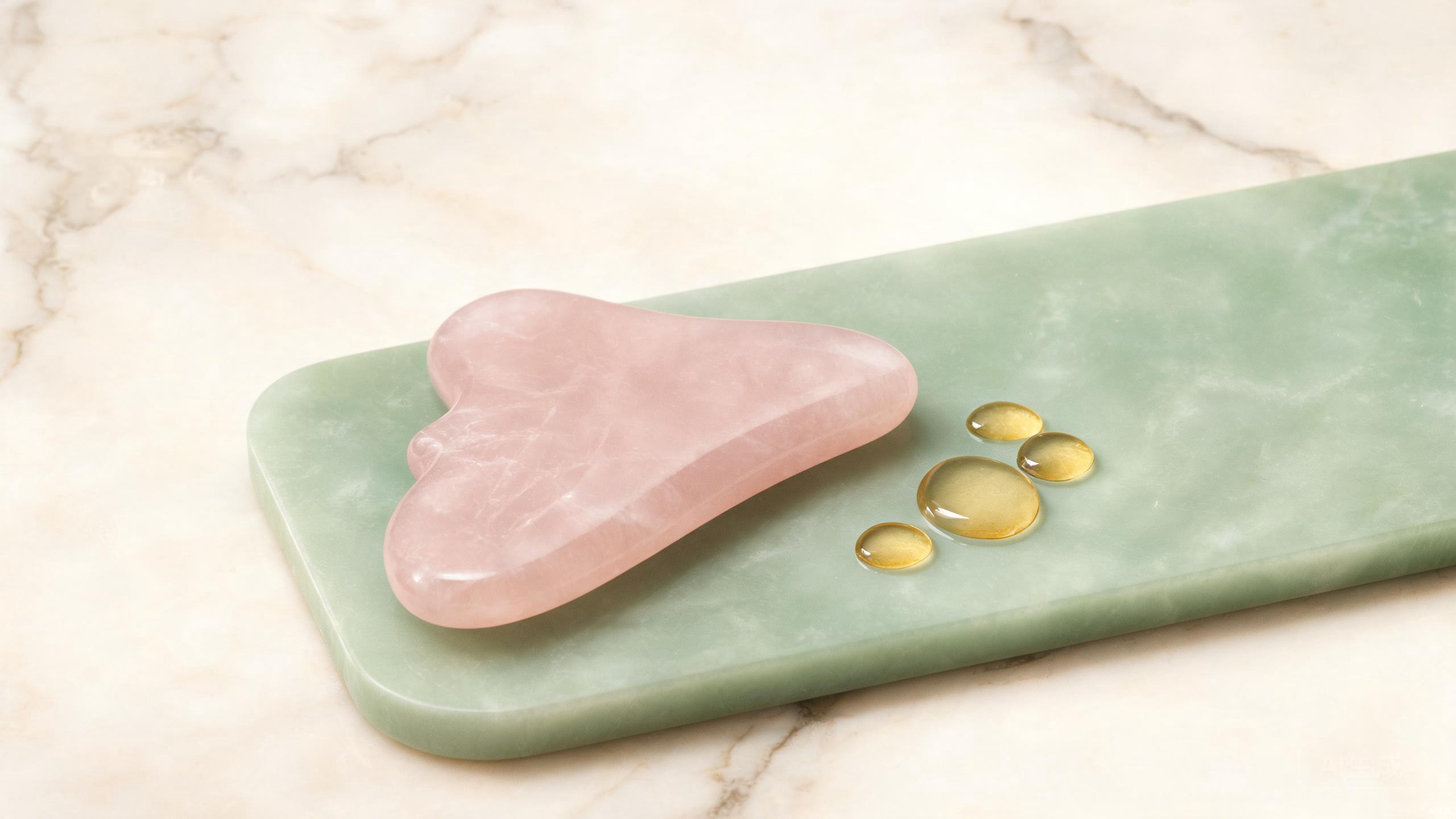
The most versatile shape is the heart-shaped or wing-shaped flat stone with a curved edge for the jawline and cheekbone, a notched edge for the brow bone, and a pointed tip for detailed work around the nose. A single heart-shaped tool covers most facial needs.
Equally important is the facial oil. Never use a Gua Sha stone on dry skin — the friction will tug and irritate. Apply 3 to 5 drops of a lightweight, non-comedogenic oil before each session:
- Jojoba oil — closely matches the skin's natural sebum; ideal for most skin types.
- Squalane oil — lightweight, non-greasy, excellent for oily and combination skin.
- Rosehip seed oil — rich in fatty acids; valued for mature or dry skin.
- Sweet almond oil — gentle and nourishing; suitable for normal to dry skin.
The Complete Step-by-Step Facial Gua Sha Routine
Follow this sequence 3 to 5 times per week. Each session takes 5 to 10 minutes. Always work on clean skin with oil applied.
Step 1: Prepare (1 minute)
Cleanse your face and hands. Apply 3 to 5 drops of facial oil, spreading evenly. Take three slow breaths. In TCM, this settles the Qi and signals the body to shift into a parasympathetic (rest) state.
Step 2: Neck Drainage (1 minute)
Always begin at the neck. Using the long curved edge of the stone, sweep gently downward along the sides of the neck, from below the ear to the collarbone, 5 to 8 strokes per side. This opens the lymphatic pathways so fluid released from the face can drain properly. Skipping this step can worsen puffiness.
Step 3: Jawline and Chin (1 to 2 minutes)
Using the notched edge of the stone, place it at the center of the chin. Sweep outward along the jawline toward the ear, then down the neck to the collarbone. Repeat 5 to 8 strokes per side. This is the area most people notice first — a subtle lifting and de-puffing along the jaw contour.
Step 4: Cheeks (1 to 2 minutes)
Using the flat curved edge, place the stone at the side of the nose. Sweep outward across the cheek toward the ear, then down to the collarbone. Work in three parallel lines: upper cheek (under the eye), middle cheek, and lower cheek (above the jaw). Repeat 3 to 5 strokes per line, per side.
Step 5: Under-Eye Area (30 seconds)
Using the smallest, gentlest edge of the stone (often the notched edge), place it at the inner corner of the eye. Sweep very lightly outward to the temple. Use minimal pressure — the skin here is the thinnest on the body. Repeat 3 strokes per side. This supports the under-eye area; for more on this topic, see our TCM for dark circles guide and Gua Sha for facial puffiness guide.
Step 6: Brow and Forehead (1 minute)
Using the long flat edge, sweep from the center of the forehead outward to the temple, 5 strokes per side. Then, using the notched edge, sweep gently along the brow bone from inner to outer. This releases the tension that builds from squinting and screen time. See our TCM for eye strain guide for complementary practices.
Step 7: Finish (30 seconds)
Do a final sweep down both sides of the neck to the collarbone. Press your warm palms gently over your face for 10 seconds. If desired, gently press the acupressure point Taiyang (EX-HN5) at the temples for 15 seconds per side. See our Gua Sha for face guide for additional technique details.
All strokes move outward and downward — toward the lymph nodes at the ears, jaw, and collarbone. Never sweep inward or upward against lymphatic flow. The tool angle should be 15 to 45 degrees against the skin, not perpendicular. Pressure should be light enough that the stone glides without dragging.
Frequency, Expectations, and Safety
How often? Three to five sessions per week is ideal. Daily is fine for most people, but rest days allow the skin to recover. Consistency over weeks matters far more than the duration of any single session.
When will you see results? Many people notice an immediate glow and slight depuffing after the first session — this is the result of increased microcirculation. Longer-term changes in tone and contour typically become noticeable after 4 to 8 weeks of consistent practice. Individual results vary.
When to avoid facial Gua Sha:
- Over active acne, broken skin, or sunburn
- After recent Botox or fillers — wait at least 2 to 4 weeks and consult your injector
- Over skin infections, cold sores, or unexplained rashes
- If you have a bleeding disorder or take blood-thinning medication — consult your doctor
- During acute illness or fever
For more on complementary facial practices, see our TCM skin wellness guide and our TCM anti-aging foods guide.
Frequently Asked Questions
What is the Chinamaxxing Gua Sha trend?
"Chinamaxxing" refers to the growing trend of Western beauty enthusiasts adopting Traditional Chinese Medicine practices — particularly facial Gua Sha, jade rolling, and acupressure. The appeal lies in TCM's holistic, preventative approach: rather than targeting a single concern, these practices support overall circulation, lymphatic flow, and facial muscle relaxation. Facial Gua Sha uses a smooth, flat stone glided across oiled skin with light pressure to encourage Qi and Blood circulation. It is a traditional wellness practice, not a medical treatment.
Can Gua Sha actually sculpt your face?
Facial Gua Sha does not permanently change bone structure or fat distribution. What it can do, with consistent practice, is reduce fluid retention (puffiness), release tension in the facial muscles (which can subtly change the appearance of the jaw and brow), and improve circulation for a healthier-looking glow. The "sculpting" effect most people describe is largely the result of depuffing and muscle relaxation. Results are temporary and require ongoing maintenance. It is not a substitute for medical or cosmetic procedures.
How often should I do facial Gua Sha?
Three to five times per week, 5 to 10 minutes per session, is the sweet spot for most people. Daily practice is acceptable if your skin tolerates it well, but rest days are beneficial. Over-practicing — especially with too much pressure — can irritate the skin. Consistency over weeks is more important than the length of any single session. Always use facial oil and light pressure.
What is the best Gua Sha stone for beginners?
For beginners, a heart-shaped rose quartz or Bian stone tool is ideal. Rose quartz is smooth, cool, affordable, and widely available on Amazon. Bian stone is the traditional TCM material and carries a pleasant weight. The heart shape offers a curved edge for the jawline, a notched edge for the brow, and a pointed tip for detailed work. Avoid plastic tools, unpolished edges, and cheap resin imitations. Always pair the stone with a lightweight facial oil such as jojoba or squalane.
The Bottom Line
Facial Gua Sha is the cornerstone of the Chinamaxxing beauty movement for good reason: it is a gentle, accessible practice rooted in a sophisticated wellness tradition. By understanding that the face is a crossroads of meridians — and that free-flowing Qi and Blood are the foundation of a radiant complexion — you can approach the practice with intention rather than merely going through the motions. Choose a quality stone, use facial oil, follow the outward-and-downward direction, and practice consistently. The glow that follows is the visible reflection of circulation restored.
But it is a tradition — not a treatment, and not a replacement for dermatological or medical care. If you have a skin condition, recent cosmetic procedures, or vascular concerns, consult a qualified professional before beginning. Used wisely, facial Gua Sha is a beautiful daily ritual that connects modern beauty routines with centuries of TCM wisdom.
This article is for educational and informational purposes only and is not a substitute for professional medical advice, diagnosis, or treatment. Always consult a qualified healthcare provider before beginning any new wellness practice, especially if you are pregnant, nursing, taking medication, or have a medical condition. Read our full disclaimer →