Key Takeaways
- TCM classifies fever into four main types: external pathogenic fever, internal injury fever, yin deficiency fever, and qi deficiency fever.
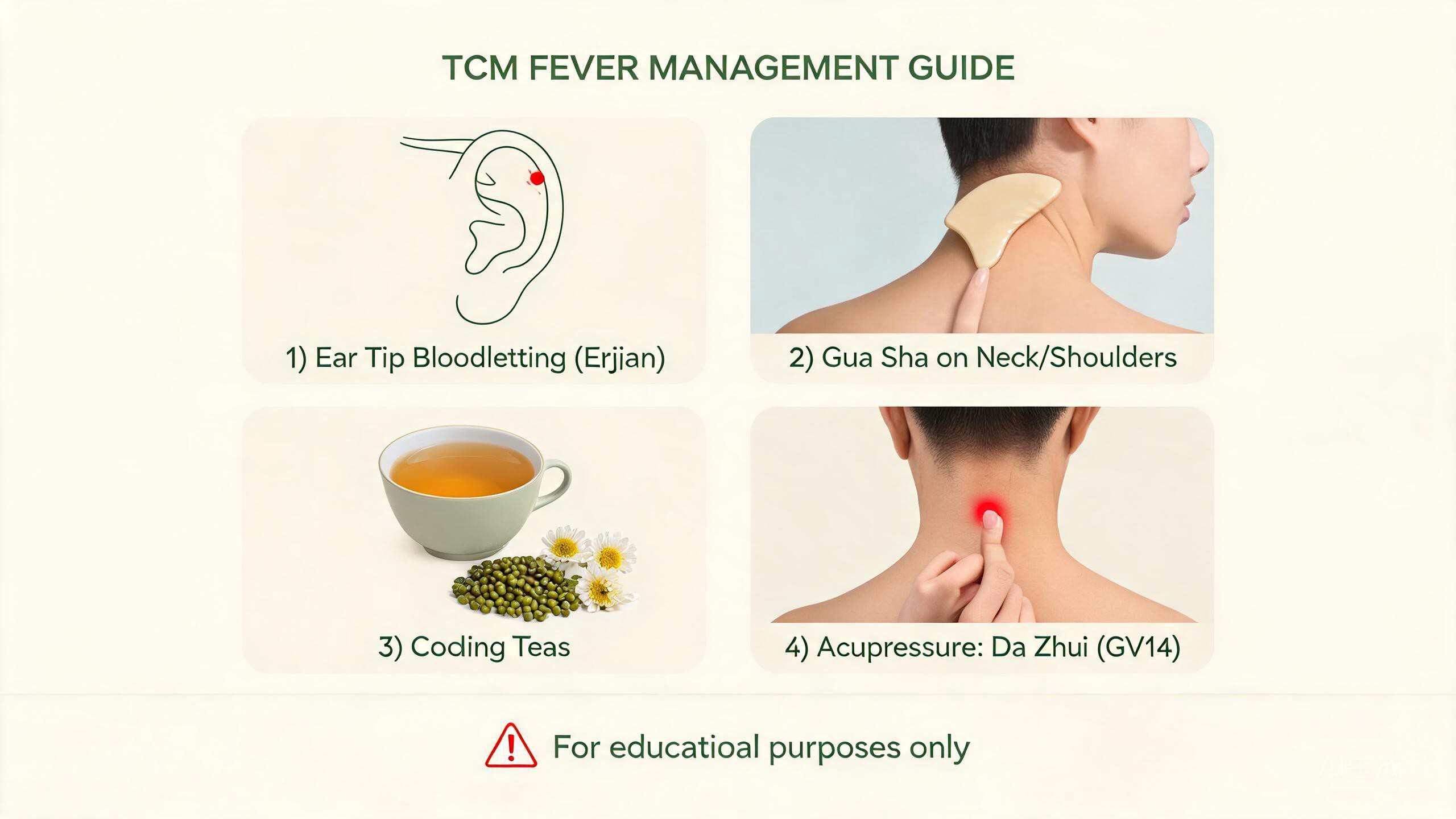
- Gua Sha (scraping) on the back's bladder meridian can help release heat and reduce mild fever.
- Tui Na techniques like opening Tianmen, pushing Kangong, and clearing Tianhe Shui are traditional fever-reduction methods, especially for children.
- Cooling foods — mung bean soup, watermelon juice, and peppermint tea — help clear internal heat from within.
- These methods are only for low-grade fever (below 38.5°C) as supportive care. High fever (39°C / 102°F or above) or persistent fever requires immediate medical attention.
This article is for wellness education only and is not medical advice. The methods described are traditional TCM approaches for low-grade fever support only. High fever (39°C / 102°F or above), persistent fever lasting more than 3 days, fever in infants under 3 months, or fever accompanied by severe symptoms (stiff neck, difficulty breathing, confusion, seizures) requires immediate medical attention. These methods cannot replace professional medical care. Do not delay seeking medical treatment for a serious fever. Always consult your healthcare provider before using any TCM methods, especially for children, during pregnancy, or if you have a medical condition.
Fever is one of the body's most fundamental defense mechanisms. In Western medicine, it is understood as the hypothalamus raising the body's set-point temperature in response to infection or inflammation. In Traditional Chinese Medicine, fever is understood differently — not simply as a number on a thermometer, but as a signal of a specific pattern of imbalance. The nature, timing, and accompanying symptoms of the fever all provide information about what is happening inside the body and how to address it.
This guide explores how TCM understands fever and introduces five traditional approaches to fever management: Gua Sha scraping, Tui Na massage, cooling food therapy, special techniques for children, and an educational introduction to bloodletting therapy. Each method is described with its applicable temperature range, technique, and safety considerations. Throughout, the emphasis remains clear: these methods are for low-grade, supportive care only — high or persistent fever requires medical treatment.
How TCM Understands Fever
In TCM theory, fever is not a single condition but a symptom that can arise from several different patterns. Understanding the pattern determines the treatment approach. The four main categories of fever in TCM are:
| Fever Type | TCM Pattern | Characteristics | Common Context |
|---|---|---|---|
| External Pathogenic Fever | Wind-Heat, Wind-Cold transforming to Heat, Summer-Heat | Sudden onset, high temperature, may accompany chills, sore throat, cough | Common cold, flu, viral infections |
| Internal Injury Fever | Various (food stagnation, qi stagnation, blood stasis generating heat) | Gradual onset, low to moderate fever, chronic or recurring | Chronic digestive issues, stress, post-illness |
| Yin Deficiency Fever | Yin Deficiency with Empty Heat | Low-grade afternoon or evening fever (often called "5 PM fever"), night sweats, dry mouth, hot palms and soles | Chronic illness, menopause, post-viral fatigue, TB (traditionally) |
| Qi Deficiency Fever | Spleen/Qi Deficiency | Low-grade fever that worsens with exertion, fatigue, improved by rest | Chronic fatigue, post-surgery, weakened immunity |
The key distinction is between excess fever (from external pathogens, characterized by high temperature, sudden onset, and a strong pulse) and deficiency fever (from internal weakness, characterized by low-grade, chronic, or recurring fever). Excess fever is addressed by clearing heat and releasing the exterior; deficiency fever is addressed by nourishing yin or tonifying qi. Using heat-clearing methods on a deficiency fever can actually worsen the condition, which is why proper pattern identification matters.
For a deeper understanding of TCM diagnostic patterns, see our tongue diagnosis guide and body self-assessment guide, which help identify accompanying signs.
Gua Sha for Fever: Back Bladder Meridian Scraping
Applicable temperature range: Low to moderate fever (38°C to 38.5°C / 100.4°F to 101.3°F)
Gua Sha ("scraping") is one of the most commonly used home therapies for fever in Chinese families. The technique involves scraping the skin with a smooth-edged tool to produce light bruising called "sha" — small red or purple petechiae that represent the release of heat and toxins from the body's surface. In TCM theory, Gua Sha promotes the flow of qi and blood, releases the exterior, and vents heat.
How to Perform Gua Sha for Fever
- Tools: A smooth Gua Sha board (horn, jade, or ceramic) or a smooth-edged porcelain spoon. Apply Gua Sha oil, sesame oil, or a thin layer of moisturizer to reduce friction.
- Area: The primary area for fever is the back, along the bladder meridian — the two lines of points running parallel to the spine, about 1.5 and 3 cun (finger-widths) lateral to the spinal processes. You can also scrape the sides of the neck and the shoulders.
- Technique: Apply oil to the back. Hold the tool at a 45-degree angle to the skin. Scrape downward along the bladder meridian lines, from the neck to the lower back, using moderate pressure. Each stroke should be 4 to 6 inches long. Repeat each line 20 to 30 times until "sha" appears (red or purple spots).
- Expected result: The appearance of sha (red or purple petechiae) indicates that heat and toxins are being released. The color and density of the sha provide diagnostic information in TCM — bright red suggests heat, dark purple suggests blood stasis. After Gua Sha, the fever often drops by 0.5 to 1°C.
Safety and Precautions
- Do not scrape over broken skin, moles, or wounds.
- Do not use Gua Sha on children under 7, elderly with fragile skin, or people on blood thinners.
- Do not scrape the abdomen during pregnancy or menstruation.
- After Gua Sha, keep the area covered and avoid cold wind or air conditioning for 24 hours.
- The sha marks fade in 3 to 7 days. Do not re-scrape the same area until marks have faded.
- See our complete Gua Sha beginner's guide for detailed technique.
Do not use Gua Sha for high fever (above 38.5°C). If the fever is high, accompanied by severe symptoms, or does not respond to supportive care, seek medical attention immediately. Gua Sha is a supportive measure for low-grade fever only.
Tui Na for Fever: Opening the Gates
Applicable temperature range: Low to moderate fever (38°C to 38.5°C / 100.4°F to 101.3°F)
Tui Na (Chinese therapeutic massage) includes specific techniques for releasing exterior pathogens and reducing fever. The following four techniques are traditionally used together as a fever-reduction sequence. They are especially valued because they are gentle enough for both adults and children.
The Four-Step Fever Tui Na Sequence
1. Opening Tianmen (Kai Tianmen)
Using the thumbs, push upward from the center of the eyebrows (Yintang point) to the hairline, in a straight line along the midline of the forehead. Repeat 100 to 200 times (about 2 to 3 minutes). This technique opens the "heavenly gate," releases the exterior, dispels wind, and calms the mind. It is the starting point of most pediatric fever treatments.
2. Pushing Kangong (Tui Kangong)
Using the thumbs, push outward from the midline of the forehead to the temples, along the eyebrow line. Repeat 50 to 100 times per side. This technique dispels wind-heat from the head region and relieves headache accompanying fever.
3. Rubbing Taiyang (Rou Taiyang)
Using the index or middle fingers, make gentle circular pressing motions on the Taiyang points (the temples, in the depression about 1 finger-width lateral to the outer end of the eyebrow). Rub 50 to 100 circles on each side. This relieves headache, calms the head, and helps reduce fever-related head discomfort.
4. Clearing Tianhe Shui (Qing Tianhe Shui)
This is a pediatric-specific technique but can be used on adults. Using the index and middle fingers, push upward along the inner forearm, from the wrist crease to the elbow crease, on the center line. Push 100 to 300 times (about 3 to 5 minutes). This is the most important Tui Na technique for clearing heat and reducing fever in TCM pediatrics. The upward direction clears heat; the forearm's inner line corresponds to the pericardium meridian.
For children, use a gentle talcum powder or baby oil as a medium to protect the skin. Children's skin is delicate — use much lighter pressure than for adults. The recommended repetition counts for children are: Tianmen 100-200 times, Kangong 50-100 times, Taiyang 50 times, Tianhe Shui 100-300 times. Always warm your hands before beginning.
Safety and Precautions
- Use gentle pressure on children and the elderly.
- Discontinue if the person becomes uncomfortable or agitated.
- Tui Na is supportive — it does not replace medication for high fever.
- Always monitor temperature before, during, and after the session.
Food Therapy for Fever: Cooling from Within
Applicable temperature range: All fever types, as supportive hydration and cooling
In TCM, food is medicine. During fever, the body needs cooling, hydrating foods that clear heat without being so cold that they damage the spleen. The following three foods are the most commonly recommended for fever support:
1. Mung Bean Soup (Lu Dou Tang)
TCM properties: Sweet, cold. Clears heat, eliminates toxins, promotes urination, resolves summer-heat.
How to prepare: Rinse 1/2 cup of dried mung beans. Add to 4 cups of water in a pot. Bring to a boil, then reduce heat and simmer for 20 to 30 minutes until the beans split open. The resulting thin, green-tinted liquid is the therapeutic part — strain and drink it warm or at room temperature. Do not add sugar; the plain soup is most effective for clearing heat. Drink 1 to 2 cups throughout the day.
Best for: External heat fever, summer-heat fever, fever with thirst and irritability. Mung bean soup is the single most recommended cooling food in TCM for fever.
2. Watermelon Juice (Xi Gua Zhi)
TCM properties: Sweet, cold. Clears heat, generates fluids, promotes urination, relieves thirst.
How to prepare: Blend fresh watermelon (including some of the white rind near the skin, which has the strongest cooling properties) into a juice. Drink 1 cup at room temperature. Watermelon is called the "natural white tiger" in TCM — a reference to the classic heat-clearing formula Bai Hu Tang — because of its powerful cooling effect.
Best for: High fever with severe thirst, dry mouth, dark urine, and irritability. Especially appropriate in summer.
3. Peppermint Tea (Bo He Cha)
TCM properties: Pungent, cool. Dispels wind-heat, vents rashes, soothes the throat, clears the head.
How to prepare: Steep 3 to 5 grams of dried peppermint (bo he) in 8 oz of hot water (just off the boil) for 5 minutes. Cover while steeping to trap the volatile oils. Drink warm. Peppermint's cooling, aromatic nature helps release exterior heat through sweating and soothes the throat.
Best for: Early-stage wind-heat fever with sore throat, headache, and slight fever. Peppermint helps vent heat to the surface.
General Dietary Guidelines During Fever
- Hydrate: Drink plenty of warm or room-temperature fluids. Avoid ice-cold drinks, which can shock the stomach and impair digestion.
- Eat light: Consume easily digestible foods like congee (rice porridge), vegetable broth, or steamed vegetables. Avoid heavy, greasy, or spicy foods.
- Avoid dairy and sweets: These can produce phlegm and dampness, complicating recovery.
- See our mung bean congee guide and summer heat-clearing foods for more cooling food options.
Special Methods for Children's Fever
Applicable temperature range: Low-grade fever (38°C to 38.5°C / 100.4°F to 101.3°F). For infants under 3 months, any fever requires immediate medical care.
Children's fevers are one of the most common concerns for parents, and TCM has developed specific, gentle techniques suited to children's delicate constitutions. These methods should be used alongside — not instead of — standard pediatric care.
1. Pushing the Spine (Tui Ji Zhui)
Using the index and middle fingers, push downward along the spine from the base of the skull (the prominent bone at the back of the neck, called Dazhui or GV14) to the tailbone. Push 100 to 200 times. This is the primary pediatric fever-reduction technique in TCM and is gentle enough for babies. The spine line corresponds to the Du Mai (Governing Vessel), and pushing downward clears heat from the body.
2. Rubbing Dazhui (Rou Dazhui)
Dazhui (GV14) is located at the base of the neck, in the depression below the spinous process of the 7th cervical vertebra (the prominent bone you feel when you bend the neck forward). Rub this point with the index or middle finger in circular motions for 1 to 2 minutes. Dazhui is the "meeting point of all yang meridians" and is the most important point for clearing fever in TCM. It is the point where external heat enters the body, and also where it can be released.
3. Warm Water Sponge Bath
Sponge the child with warm (not cold) water, focusing on the neck, armpits, groin, and back — areas where large blood vessels are close to the surface. Use water at about 32 to 34°C (slightly below body temperature). The evaporation cools the body gradually without causing the shivering that cold water produces. Never use alcohol rubs or ice water — these can cause shivering, which actually raises core temperature, and alcohol can be absorbed through the skin.
For children, seek immediate medical care if: the child is under 3 months old with any fever; the fever is above 39°C (102.2°F); the child is unusually drowsy, irritable, or confused; the child has a stiff neck, rash, difficulty breathing, or refuses to drink; or the fever lasts more than 3 days. Febrile seizures (convulsions from rapid temperature rise) require emergency care.
Bloodletting Therapy: An Introduction (Educational Only)
This section is for educational purposes only. Bloodletting must only be performed by a qualified TCM practitioner with sterile technique. Do not attempt this at home.
Bloodletting (ci xue) is a traditional TCM technique in which a small amount of blood is released from specific points to rapidly reduce fever. The most commonly used point for fever is Erjian (ear apex) — the very tip of the ear, folded forward. In clinical practice, the practitioner massages the ear tip to bring blood to the surface, sterilizes the area, pricks it with a sterile single-use lancet, and squeezes out 5 to 10 drops of blood. This is traditionally said to clear heat, reduce fire, and bring down fever rapidly, particularly in cases of high fever with red eyes, sore throat, or headache.
Other points sometimes used for bloodletting in fever include Shixuan (EX-UE10) — the ten fingertips — and Dazhui (GV14). The technique is most commonly used for high fever in children (in a clinical setting) and for fever with delirium or loss of consciousness.
Why This Is Educational Only
- Infection risk: Improper technique can introduce bacteria and cause serious infection.
- Bleeding risk: People with bleeding disorders or on blood-thinning medications should never undergo bloodletting.
- Professional judgment required: Only a licensed practitioner can determine whether bloodletting is appropriate for a specific fever pattern.
- Sterile equipment: Single-use sterile lancets must be used. Household pins or needles are absolutely not acceptable.
If you are interested in bloodletting therapy for fever, consult a licensed acupuncturist or TCM practitioner who is trained and equipped to perform it safely.
When Fever Requires Medical Attention
While the TCM methods described in this guide can provide supportive care for low-grade fever, certain situations always require professional medical evaluation. The following are red flags that should prompt you to seek medical care rather than continuing with home remedies:
| Situation | Action |
|---|---|
| Fever above 39°C (102.2°F) in adults | Seek medical care. Use fever-reducing medication as directed. |
| Any fever in infants under 3 months | Go to emergency immediately. Do not use home remedies. |
| Fever above 38.5°C in children, or fever with lethargy, stiff neck, or rash | Seek immediate medical care. |
| Fever lasting more than 3 days | Consult a healthcare provider for evaluation. |
| Fever with stiff neck, severe headache, sensitivity to light | Emergency — possible meningitis. Seek immediate care. |
| Fever with difficulty breathing or chest pain | Emergency — seek immediate care. |
| Fever with confusion, delirium, or loss of consciousness | Emergency — call emergency services. |
| Fever with seizures (especially in children) | Emergency — seek immediate care. |
| Recurring low-grade fever over weeks | Consult a healthcare provider for evaluation of underlying causes. |
| Fever during pregnancy | Contact your obstetrician promptly. |
The TCM methods in this guide are intended as supportive care for mild, low-grade fever — the kind that accompanies a common cold or minor viral illness. They are not appropriate for high fever, persistent fever, or fever with concerning symptoms. When in doubt, always err on the side of seeking medical care. For related guidance, see our articles on TCM for cold and flu and TCM for cough relief.
Frequently Asked Questions
At what temperature should I seek medical care for a fever?
Seek immediate medical care for a fever of 39 degrees Celsius (102.2 degrees Fahrenheit) or higher in adults, or 38.5 degrees Celsius (101.3 degrees Fahrenheit) or higher in children under 3 months. Also seek care if the fever lasts more than 3 days, is accompanied by stiff neck, severe headache, difficulty breathing, confusion, rash, persistent vomiting, or if it occurs in a person with a weakened immune system. Infants under 3 months with any fever should be seen by a doctor immediately.
Can I combine TCM fever methods with over-the-counter medication?
In general, gentle methods like cool compresses, hydration, and cooling foods can be used alongside standard fever-reducing medication. However, herbal remedies may interact with medications, so consult your healthcare provider before combining them. Gua Sha and Tui Na are physical therapies that generally do not conflict with medication, but avoid aggressive techniques if the person is uncomfortable. Always inform your doctor about all remedies you are using.
Are TCM fever methods safe for children?
Gentle methods like warm sponge baths, cooling foods (mung bean soup, watermelon), and light Tui Na techniques (pushing the spine, rubbing Dazhui) are generally safe for children over 1 year. Gua Sha is not recommended for young children due to skin sensitivity. Bloodletting is strictly for professionals only and should never be attempted at home on children. For any fever in a child under 3 months, seek immediate medical care. For children, always use the gentlest approach and consult a pediatrician.
What is the TCM view on reducing fever vs. letting it run?
In TCM, a mild fever is sometimes seen as the body's wei qi (defensive energy) fighting off an external pathogen, and is not always suppressed immediately. Low-grade fevers (below 38.5 degrees Celsius) may be monitored while supporting the body with hydration and rest. However, TCM also recognizes that high or prolonged fever damages yin and fluids, and should be reduced. The decision depends on the individual, the fever pattern, and accompanying symptoms. Modern medical advice takes precedence: if a fever is high or concerning, reduce it and seek medical care.
This article is for educational and informational purposes only and is not a substitute for professional medical advice, diagnosis, or treatment. The TCM fever management methods described are traditional practices for low-grade fever support only and are not intended to diagnose, treat, cure, or prevent any disease. High fever (39°C / 102°F or above), persistent fever, fever in infants, or fever with severe symptoms requires immediate medical attention. Bloodletting therapy must only be performed by a qualified practitioner. Always consult your healthcare provider before using any TCM methods, especially for children, during pregnancy, or if you have a medical condition. Read our full disclaimer →