Key Takeaways
- In TCM, menopause is a natural transition driven by kidney qi decline, exhaustion of tiangui (reproductive essence), and a shift in yin-yang balance — not a disease.
- Kidney yin deficiency is the most common pattern, associated with hot flashes, night sweats, dry skin, and irritability.
- Six traditional food therapy recipes — from sour jujube seed porridge to lily bulb and white fungus soup — may support nourishment and balance.
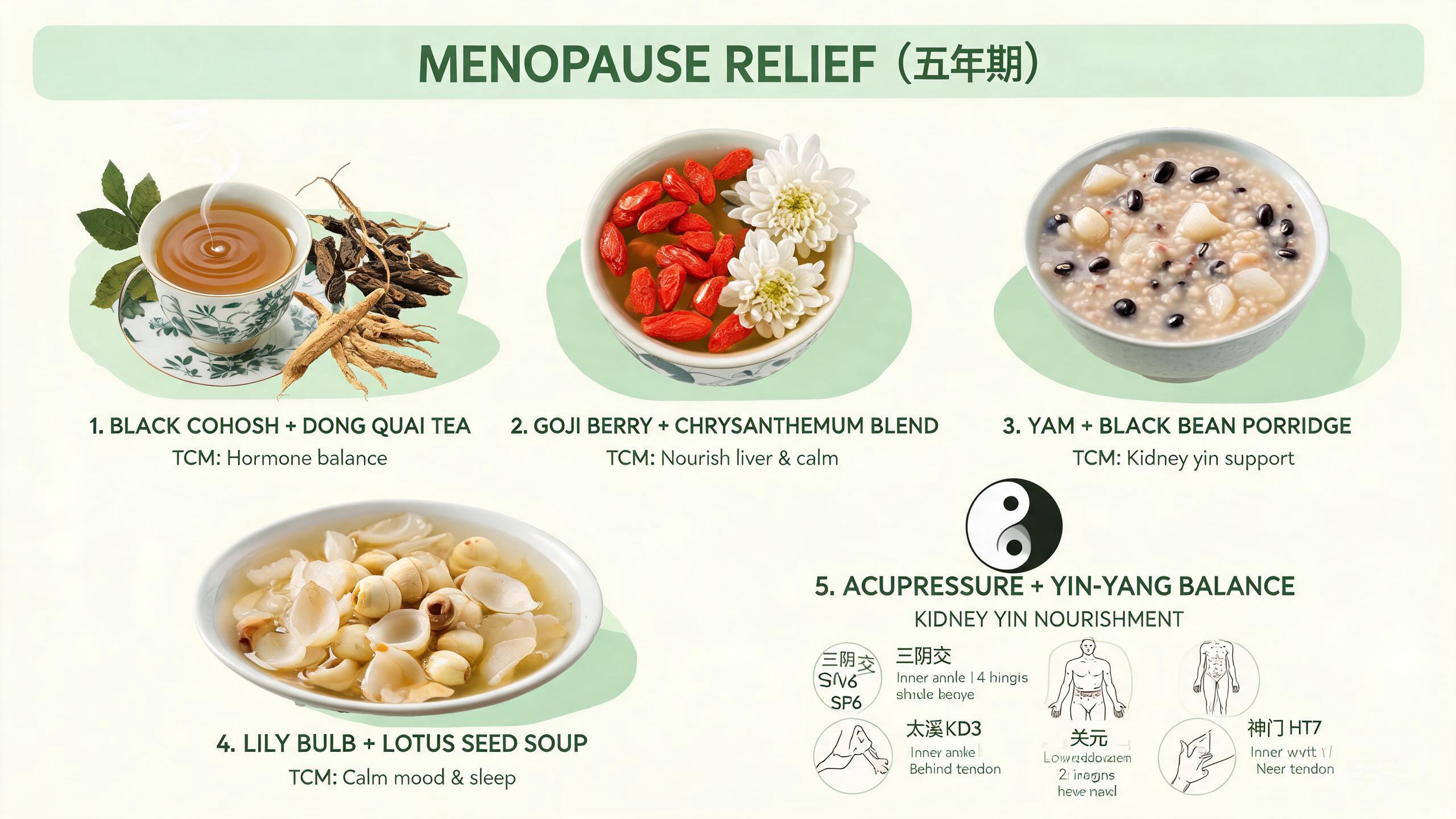
- Three acupressure points — Sanyinjiao (SP6), Taixi (KD3), and Shenmen (HT7) — may support kidney nourishment, calm, and restful sleep.
- Simple lifestyle shifts in emotional regulation, gentle exercise, and diet complement these practices.
This article is for wellness education only and is not medical advice, diagnosis, or treatment. The practices described are complementary wellness approaches, not a replacement for professional care. If you experience severe menopause symptoms, consult your healthcare provider. Some herbs and foods may interact with medications, including hormone therapy. Read our full disclaimer →
The menopause transition brings hot flashes, night sweats, insomnia, mood swings, and dry skin. Many women seek gentler, food-based approaches that work with the body's natural rhythms.
Traditional Chinese Medicine (TCM) has supported women through this transition for over two thousand years. Rather than viewing menopause as a deficiency, TCM sees it as a natural stage of life — a time when kidney essence gradually declines and the balance of yin and yang shifts. The goal is to support the body with nourishing foods, gentle acupressure, and daily habits that promote comfort and equilibrium.
How TCM Understands Menopause
In TCM theory, menopause is not a disease. It is a natural transition described in the Huangdi Neijing (Yellow Emperor's Inner Canon), which states that a woman's reproductive energy follows a seven-year cycle, with tiangui arriving around age 14 and exhausted around age 49. Three concepts form the TCM understanding.
Kidney Qi Decline (Shen Qi Shuai Tui)
In TCM, the kidneys store essence (jing), which governs growth, reproduction, and aging. Kidney essence is finite — inherited at birth and gradually depleted throughout life. As a woman approaches her late forties, kidney qi naturally declines. This is not pathological; it is the expected trajectory of life, though the rate varies by constitution and lifestyle.
Exhaustion of Tiangui (Tian Gui Jie)
Tiangui refers to the reproductive essence responsible for menstruation and fertility. The Su Wen states that at age seven times seven (49), tiangui is exhausted and menstruation ceases. The body must then rebalance itself, producing the signs associated with menopause.
Yin-Yang Imbalance (Yin Yang Shi Heng)
Kidney yin is the cooling, moistening aspect of kidney energy. During menopause, kidney yin tends to decline more rapidly than kidney yang. When yin can no longer restrain yang, the result is deficiency heat — the TCM explanation for hot flashes, night sweats, facial flushing, dry skin, and irritability. In some women, both yin and yang decline together, producing alternating hot and cold sensations with fatigue.
Understanding whether your menopause signs lean toward yin deficiency heat, yang deficiency cold, or a mixture of both is the foundation of TCM support. See our guides to hot vs. cold constitutions and the nine TCM body types.
6 Food Therapy Recipes for Menopause Support
The following six recipes are drawn from traditional Chinese dietary therapy, each addressing a specific aspect of the menopause transition. All ingredients can be found at Western supermarkets, Asian grocery stores, or online retailers such as Amazon and iHerb.
1. Sour Jujube Seed Porridge (Suan Zao Ren Zhou)
TCM nature and flavor: Sweet, sour, neutral. Enters the Heart, Liver, and Gallbladder meridians.
Traditional use: Nourishes the heart, calms the spirit (shen), and supports restful sleep. Sour jujube seeds (suan zao ren) are among the most valued TCM herbs for insomnia and anxiety. During menopause, declining kidney yin can fail to nourish the heart, leading to restlessness and vivid dreams.
Ingredients:
- 15 grams sour jujube seeds (suan zao ren), lightly crushed
- 1/2 cup white rice (or a mix of white and brown rice)
- 4 cups water
- Optional: 1 tablespoon rock sugar or honey to taste
Preparation: Lightly crush the sour jujube seeds. Simmer in 2 cups of water for 15 minutes, then strain and discard the seeds. Rinse the rice and add to the infusion with the remaining 2 cups of water. Bring to a boil, then simmer for 30 to 40 minutes until creamy. Add rock sugar or honey to taste. Eat warm, 1 to 2 hours before bedtime.
Sour jujube seeds are available on Amazon, iHerb, and online TCM herb shops. See our guide to sour date seed tea.
Precautions: Sour jujube seeds are generally well tolerated. If you take sedative medications, consult your healthcare provider before regular use.
2. Lily Bulb and White Fungus Soup (Bai He Yin Er Geng)
TCM nature and flavor: Sweet, cool. Enters the Heart and Lung meridians.
Traditional use: Nourishes yin, moistens dryness, and clears deficiency heat. Dried lily bulb (bai he) is a classic TCM ingredient for yin deficiency, traditionally used to ease irritability. White fungus (yin er, also called snow fungus) is prized for nourishing lung and stomach yin. Together, they create a hydrating soup that may support women experiencing hot flashes, dry skin, and vaginal dryness.
Ingredients:
- 20 grams dried lily bulb (bai he)
- 15 grams dried white fungus (snow fungus / yin er)
- 6 dried red dates (jujubes), pitted
- 1 tablespoon goji berries
- 4 cups water
- Rock sugar or honey to taste
Preparation: Soak the white fungus in warm water for 20 to 30 minutes until it expands. Trim and discard the tough yellow base, then tear into small pieces. Rinse the lily bulbs. Place white fungus, lily bulbs, red dates, and water in a pot. Bring to a boil, then simmer covered for 45 to 60 minutes, until the fungus becomes gelatinous. Add goji berries in the last 5 minutes. Sweeten with rock sugar or honey to taste. Serve warm, 1 bowl daily.
Precautions: This soup is cooling. If you tend to feel cold or have loose stools, reduce the portion or add fresh ginger slices. Dried lily bulbs and white fungus are available on Amazon, iHerb, and in Asian grocery stores.
3. Lotus Seed and Cornus Porridge (Lian Zi Shan Zhu Yu Zhou)
TCM nature and flavor: Sweet, astringent, warm. Enters the Kidney, Liver, and Spleen meridians.
Traditional use: Tonifies the liver and kidneys, secures essence, and supports the lower body. Lotus seeds (lian zi) nourish the spleen and calm the heart, while cornus fruit (shan zhu yu, Asian cornelian cherry) is a premier kidney-tonifying ingredient, traditionally used to secure essence and restrain fluid leakage — relevant for night sweats and frequent urination.
Ingredients:
- 15 grams dried lotus seeds (lian zi), soaked
- 10 grams cornus fruit (shan zhu yu / Asian cornelian cherry)
- 1/2 cup glutinous rice (or a mix of glutinous and white rice)
- 4 cups water
- Optional: a small pinch of salt or honey
Preparation: Soak the lotus seeds in warm water for 1 hour. If they have green centers, remove them as they are bitter. Rinse the cornus fruit. Combine lotus seeds, cornus fruit, rice, and water in a pot. Bring to a boil, then simmer for 40 to 50 minutes, stirring occasionally, until thick and tender. Add salt or honey to taste. Eat warm, 1 bowl in the morning. Dried lotus seeds are available at Asian grocery stores and on Amazon; cornus fruit from online TCM herb shops.
Precautions: Cornus fruit is warming and astringent. If you have difficulty urinating or acute heat signs like fever or sore throat, pause until you recover.
4. Floating Wheat, Black Bean, and Red Date Drink (Fu Xiao Mai Hei Dou Hong Zao Yin)
TCM nature and flavor: Sweet, cool. Enters the Heart, Kidney, and Spleen meridians.
Traditional use: Nourishes qi, restrains sweating, and supports yin. Floating wheat (fu xiao mai) is wheat grain that does not sink in water — in TCM, this lightness gives it an affinity for the upper body, where it helps restrain sweat. Black beans are cooling and traditionally associated with kidney nourishment. Red dates strengthen the spleen and nourish blood. Together, this combination may support women experiencing night sweats, fatigue, and palpitations.
Ingredients:
- 30 grams floating wheat (fu xiao mai)
- 30 grams black beans, dry
- 6 dried red dates (jujubes), pitted
- 5 cups water
Preparation: Rinse the floating wheat and black beans. Soak the black beans for 2 to 3 hours (or overnight). Place all ingredients in a pot with water. Bring to a boil, then simmer covered for 45 to 60 minutes, until the beans are soft. Strain and drink warm. The softened beans and dates may also be eaten. Drink 1 to 2 cups daily. Floating wheat is available from online TCM herb shops; if unavailable, regular whole wheat berries can be substituted.
Precautions: This drink is generally suitable for daily use. If you have a cold constitution, add 2 slices of fresh ginger to balance the cooling nature of the black beans.
5. Steamed Turtle with Goji (Qing Zheng Jia Yu)
TCM nature and flavor: Sweet, neutral. Enters the Liver and Kidney meridians.
Traditional use: Nourishes kidney yin, clears deficiency heat, and supports blood. Soft-shell turtle has been used in TCM food therapy for centuries as a powerful yin-nourishing food, traditionally valued for addressing hot flashes, night sweats, and deep fatigue. Goji berries add liver and kidney yin nourishment. This is the most strengthening of the six recipes.
Ingredients:
- 1 small soft-shell turtle (about 1 pound), cleaned and prepared
- 15 grams goji berries
- 3 slices fresh ginger
- 1 tablespoon cooking wine (Shaoxing wine or dry sherry)
- A pinch of salt
- 2 spring onions, cut into sections
Preparation: Have the fishmonger clean and prepare the turtle. Rinse and cut into serving pieces. Place in a heatproof steaming bowl with ginger, cooking wine, salt, spring onions, and 1/2 cup water. Cover and steam over high heat for 45 to 60 minutes, until tender. Add goji berries in the last 10 minutes. Serve warm, eating the meat and drinking the broth. Consume once weekly.
Precautions: Turtle is rich and nourishing. If you have weak digestion, eat a smaller portion or substitute with chicken. Not recommended during acute colds. Soft-shell turtle is available at Asian grocery stores; if unavailable, substitute with chicken thigh or duck. Goji berries are available at supermarkets, Amazon, and iHerb.
6. Lily Bulb Porridge (Bai He Zhou)
TCM nature and flavor: Sweet, cool. Enters the Heart and Lung meridians.
Traditional use: Nourishes the heart, calms the spirit, and moistens the lungs. This simpler cousin of the lily bulb and white fungus soup focuses on calming restlessness and supporting sleep. Dried lily bulb is traditionally used for irritability, anxiety, and insomnia during menopause. Gentle on digestion, it can be consumed regularly as a comforting evening meal.
Ingredients:
- 20 grams dried lily bulb (bai he)
- 1/2 cup white rice (or a mix of white and sweet rice)
- 4 cups water
- Optional: 1 tablespoon rock sugar or honey
- Optional: 1 tablespoon goji berries
Preparation: Rinse the dried lily bulbs and soak in warm water for 15 minutes. Combine the lily bulbs, rice, and water in a pot. Bring to a boil, then simmer for 30 to 40 minutes until creamy. Add goji berries in the last 5 minutes if using. Sweeten with rock sugar or honey to taste. Eat warm, 1 to 2 hours before sleep. For more ideas, see our congee guide.
Quick Comparison of the Six Recipes
| Recipe | TCM Nature | Primary Traditional Use | Best Time |
|---|---|---|---|
| Sour Jujube Seed Porridge | Neutral, sweet-sour | Calm spirit, support sleep | Evening, before bed |
| Lily Bulb & White Fungus Soup | Cool, sweet | Nourish yin, moisten dryness | Afternoon or evening |
| Lotus Seed & Cornus Porridge | Warm, sweet-astringent | Tonify liver & kidney, secure essence | Breakfast |
| Floating Wheat Black Bean Drink | Cool, sweet | Restrain sweating, support qi | Morning or afternoon |
| Steamed Turtle with Goji | Neutral, sweet | Nourish kidney yin, clear heat | Lunch, once weekly |
| Lily Bulb Porridge | Cool, sweet | Calms heart, supports sleep | Evening, before bed |
3 Acupressure Points for Menopause Support
Acupressure applies firm, steady pressure to specific points. Three points are especially valued for menopause support.
- Sanyinjiao (SP6) — On the inner lower leg, about four finger-widths above the inner ankle bone. The premier acupressure point for women's wellness in TCM, where the three yin meridians intersect. It may support hormonal balance and ease hot flashes. Press gently but firmly for 1 to 2 minutes on each leg. Learn the Sanyinjiao (SP6) acupressure point.
- Taixi (KD3) — In the depression between the inner ankle bone and the Achilles tendon. The source point of the kidney meridian, traditionally used to nourish both kidney yin and yang. It may support lower back comfort and ease hot flashes. Press gently for 1 to 2 minutes on each ankle.
- Shenmen (HT7) — On the wrist crease on the pinky-side, in the small depression beside the tendon. Known as the "Spirit Gate," this is the most important point in TCM for calming the heart and settling the mind. It may support emotional balance and restful sleep. Press gently for 1 to 3 minutes on each wrist. Learn more about Shenmen (HT7) for sleep and calm.
Practice all three points daily, ideally in the evening. See our acupressure safety guide.
Lifestyle Practices for Menopause Balance
Food therapy and acupressure work best with daily habits. TCM offers guidance on emotional regulation, movement, and dietary choices during menopause.
Emotional Regulation
In TCM, the liver governs the smooth flow of qi and is sensitive to stress — emotions that can intensify during menopause. When liver qi stagnates, it can worsen hot flashes, irritability, and mood swings. Practices that support emotional flow include journaling, spending time in nature, and gentle breathing exercises. The TCM principle is not to suppress emotions but to allow them to move through freely. For more, see our guide to TCM for emotional wellness.
Exercise Recommendations
Movement promotes qi and blood circulation, but during menopause, intense or sweating-heavy exercise can deplete yin. TCM favors gentle, sustained movement:
- Qigong and tai chi — Slow, flowing movements that cultivate qi and calm the mind. See our guides to qigong for women and tai chi basics.
- Brisk walking — 30 minutes daily outdoors supports circulation without overheating.
- Restorative yoga — Gentle stretching releases tension without excessive sweating.
Avoid hot yoga or prolonged endurance exercise during intense hot flashes.
Dietary Habits and Restrictions
What you avoid is just as important as what you include. During menopause, TCM recommends:
- Limit spicy and fried foods — Chili, cayenne, and deep-fried foods increase internal heat and may worsen hot flashes.
- Reduce caffeine and alcohol — Both are heating and can trigger hot flashes, disrupt sleep, and deplete yin.
- Avoid excess cold and raw foods — Ice-cold drinks and large salads can weaken the spleen. Favor warm, cooked meals.
- Minimize refined sugar — Sugar intensifies mood swings and energy fluctuations.
- Emphasize yin-supporting foods — Include black sesame, walnuts, goji berries, lily bulbs, lotus seeds, and dark leafy greens.
Menopause shares underlying patterns with other women's health concerns. See our guides to TCM for PMS, TCM for cold uterus, and TCM insomnia types.
When to Seek Professional Help
While these practices are gentle and generally safe, they are not a substitute for medical evaluation. Consult your healthcare provider if you experience:
- Hot flashes or night sweats severe enough to disrupt daily life or sleep
- Heavy or irregular bleeding after menopause has been established
- Severe mood changes, including depression or anxiety
- New or unusual symptoms that concern you
- Bone density concerns or a family history of osteoporosis
A qualified TCM practitioner can assess your individual pattern, while your healthcare provider can rule out underlying conditions.
Frequently Asked Questions
Can TCM help with menopause hot flashes?
In TCM, hot flashes are often understood as kidney yin deficiency, where declining yin allows yang heat to rise. Foods like lily bulb and white fungus soup and steamed turtle with goji are traditionally used to nourish yin and clear deficiency heat. Acupressure on Taixi (KD3) and Sanyinjiao (SP6) may also support balance. Results vary by individual.
What are the best TCM foods for menopause relief?
Traditional TCM foods for menopause include sour jujube seed porridge for sleep, lily bulb and white fungus soup for yin nourishment, lotus seed and cornus porridge for liver and kidney support, floating wheat black bean red date drink for sweating, steamed turtle with goji for yin and heat, and lily bulb porridge for calming the heart. These are chosen based on individual TCM patterns.
Which acupressure points support menopause comfort?
Three points are commonly used: Sanyinjiao (SP6) on the inner lower leg for women's wellness, Taixi (KD3) behind the inner ankle for kidney yin and yang support, and Shenmen (HT7) on the wrist for calming the heart and supporting sleep. Gentle pressure for 1 to 2 minutes on each point daily is typical.
Is it safe to use TCM food therapy during menopause alongside HRT or other medications?
Gentle dietary practices and acupressure are generally safe for most adults. However, some foods and herbs may interact with hormone therapy or other medications. If you take prescription medication, including hormone replacement therapy, consult your healthcare provider before adding new herbal foods or wellness practices.
This article is for educational and informational purposes only and is not a substitute for professional medical advice, diagnosis, or treatment. The foods, acupressure points, and practices described here are traditional wellness approaches, not medical treatments. They are not intended to treat, cure, or prevent any disease and are not a replacement for professional medical care. Always consult a qualified healthcare provider before beginning any new wellness practice, especially if you are pregnant, nursing, taking medication (including hormone therapy), or have a medical condition. Read our full disclaimer →