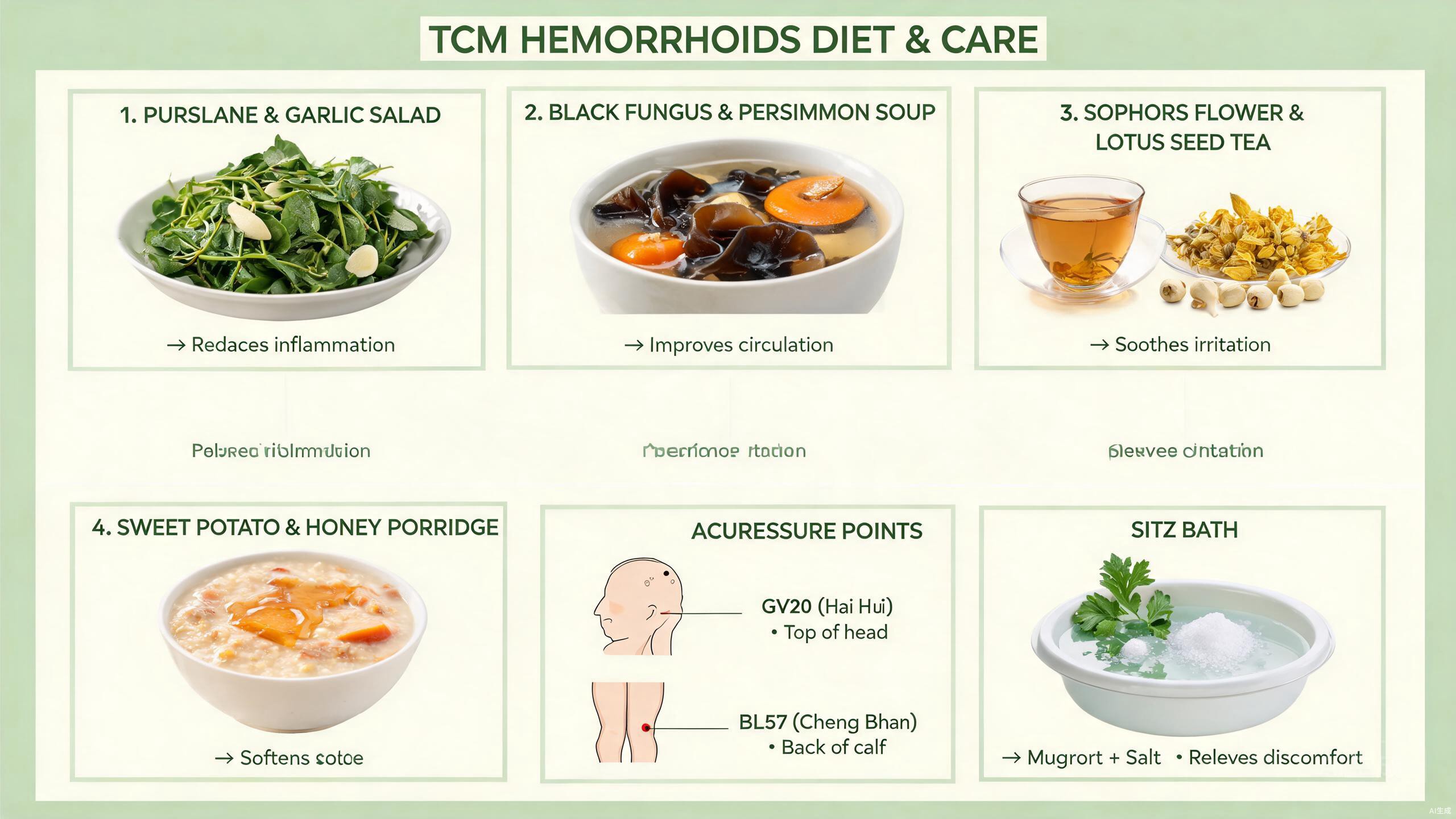
Key Takeaways
- TCM views hemorrhoids through three primary patterns: damp-heat settling downward (the most common, causing burning and bright red bleeding), spleen qi sinking (causing prolapse and heaviness), and blood heat (causing heavy, bright bleeding).
- Five traditional food therapy recipes — from spinach pork blood soup to adzuki bean coix water — use ingredients available at Western supermarkets, Asian markets, Amazon, or iHerb.
- Two acupressure points, Changqiang (GV1) at the tailbone and Chengshan (BL57) on the calf, are traditionally used to support the lower burner and promote circulation in the rectal area.
- Dietary discipline is central: TCM strongly advises avoiding spicy, greasy, fried, and alcohol-heavy foods that generate damp-heat, alongside pelvic floor exercises.
- These are traditional wellness practices, not a treatment for any medical condition. Rectal bleeding and pain require prompt evaluation by a qualified healthcare provider.
This article is for educational purposes only and is not medical advice. The foods, teas, and practices described here are traditional wellness practices rooted in Chinese culture. They are not a substitute for professional medical care, diagnosis, or treatment. Rectal bleeding, pain, or changes in bowel habits can indicate serious medical conditions including colorectal cancer, inflammatory bowel disease, or anal fissures. These require prompt evaluation by a qualified healthcare provider — never assume rectal symptoms are "just hemorrhoids" without proper diagnosis. Never stop, delay, or replace prescribed treatment based on information in this article. Some foods and herbs may interact with medications — always inform your doctor about everything you consume. These statements have not been evaluated by the FDA and are not intended to diagnose, treat, cure, or prevent any disease. Read our full disclaimer →
Hemorrhoids — swollen veins in the lower rectum and anus — are an extraordinarily common condition that affects people of all ages. Whether caused by chronic constipation, prolonged sitting, heavy lifting, pregnancy, or dietary factors, hemorrhoids can cause discomfort, itching, and bleeding that significantly affect daily life. While mild cases often respond well to dietary and lifestyle changes, it is essential to have any rectal bleeding evaluated by a healthcare provider to rule out more serious conditions. For those looking to complement their wellness routine, Traditional Chinese Medicine (TCM) offers a sophisticated framework for understanding hemorrhoids through dietary patterns and food therapy.
In TCM, hemorrhoids are understood through the concept of damp-heat settling downward into the lower body, spleen qi sinking (which weakens the body's ability to hold tissues in place), and blood heat (which causes bleeding). The large intestine is the primary organ involved, with the spleen (which governs the upward-lifting of qi) and the liver (which stores blood) playing supporting roles. The five recipes below use foods that have been enjoyed for generations to clear damp-heat, cool the blood, strengthen the spleen, and promote healthy bowel function. All ingredients are available at Western supermarkets, Asian markets, Amazon, or iHerb.
If you are new to TCM concepts, our guide to the Zang-Fu organ systems and overview of qi, blood, and body fluids are helpful starting points. For related digestive topics, see our guides to TCM for constipation and TCM for digestion.
How TCM Views Hemorrhoids
Traditional Chinese Medicine understands hemorrhoids through three interconnected mechanisms: the downward movement of damp-heat, the sinking of spleen qi, and the reckless movement of heated blood. These patterns often overlap, and a single person may have elements of more than one.
The Large Intestine is the primary organ involved. In TCM, the Large Intestine is responsible for absorbing water and forming and excreting waste. It is the partner organ of the Lung, and both are part of the Metal element. When the Large Intestine's function is disrupted — by damp-heat, dryness, or qi stagnation — the tissues in the rectal area can become inflamed, swollen, and prone to bleeding. Chronic constipation, diarrhea, straining, and prolonged sitting on the toilet all directly affect the Large Intestine's function and the circulation of qi and blood in the rectal area.
The Spleen governs the upward-lifting of qi (Pi Zhu Sheng Qing). This is a critical concept for understanding hemorrhoids, especially those involving prolapse. In TCM, the Spleen is responsible for lifting and holding the body's organs and tissues in their proper position. When spleen qi is strong, organs are supported and tissues remain where they belong. When spleen qi is deficient — from poor diet, overthinking, overwork, or chronic digestive weakness — it cannot adequately lift and hold. This "sinking" of spleen qi can contribute to the prolapse of hemorrhoidal tissue, a feeling of heaviness in the lower abdomen and rectum, and fatigue. This concept also explains why hemorrhoids are common during pregnancy and after childbirth, when the spleen's lifting function is physically challenged.
Blood heat causes reckless bleeding (Xue Re Wang Xing). In TCM, blood is supposed to remain within the vessels. When heat enters the blood — from spicy and fried foods, alcohol, emotional stress, or chronic illness — the heat "stirs" the blood, causing it to move recklessly and leak from the vessels. This is the traditional explanation for bright red, heavy bleeding from hemorrhoids. The blood-heat pattern is often seen in people who consume a diet high in spicy, fried, and barbecued foods, or who experience significant stress and frustration.
TCM identifies three primary patterns associated with hemorrhoids:
- Damp-Heat Downward (Shi Re Xia Zhu) — the most common pattern. Signs include bleeding that is bright red, a burning sensation in the anus, swelling and pain, a feeling of heaviness in the lower body, thick or sticky stools, and possibly a bitter taste in the mouth. Often triggered by a diet high in spicy, greasy, fried, and alcoholic foods, or by living in a hot, humid environment. This is the acute, inflammatory type of hemorrhoid.
- Spleen Qi Sinking (Pi Qi Xia Xian) — a deficiency pattern involving prolapse. Signs include hemorrhoids that prolapse during bowel movements and may need to be pushed back manually, a feeling of heaviness or downward pressure in the rectum, fatigue, shortness of breath, a pale complexion, and a tendency to have loose stools. Often seen in people with chronic digestive weakness, after pregnancy, or with aging. This pattern overlaps with the TCM understanding of spleen deficiency in digestion.
- Blood Heat (Xue Re Xing) — a pattern focused on bleeding. Signs include heavy, bright red bleeding during bowel movements, a dry mouth, dark urine, possible constipation with hard stools, and a feeling of internal heat. Often triggered by spicy and fried foods, alcohol, stress, or chronic constipation that creates friction and heat in the rectal area.
Understanding these patterns helps explain why TCM recommends different foods for different situations — damp-clearing foods for damp-heat, qi-lifting foods for spleen sinking, and blood-cooling foods for blood heat.
5 Food Therapy Recipes for Rectal Wellness
Each recipe below is matched to a specific TCM pattern. Choose the one that best fits your situation, and use it consistently for two to four weeks. All ingredients are available at Western supermarkets, Asian markets, Amazon, or iHerb. For best results, combine food therapy with the dietary restrictions and lifestyle practices described later in this article.
1. Spinach Pork Blood Soup (菠菜猪血汤)
Best for: Blood heat with bright red bleeding; general blood nourishment
TCM nature and flavor: Spinach (bo cai): sweet, cool. Enters the Liver, Stomach, and Large Intestine channels. Pork blood: sweet, warm. Enters the Heart and Liver channels.
Traditional use: This is a classic folk soup from southern China, traditionally served to people recovering from blood loss. Spinach is traditionally used to nourish the blood, moisten the intestines, and cool heat. Its cool nature helps counteract the heat that causes reckless bleeding. Pork blood is traditionally used in TCM's "like treats like" principle to nourish blood and replenish what has been lost through bleeding. The combination addresses both the root (blood heat causing bleeding) and the consequence (blood loss). Modern nutrition recognizes spinach as rich in iron, vitamin K (which supports blood clotting), and fiber — all relevant for hemorrhoid wellness. If pork blood is unavailable, this soup can be made with spinach alone or with lean pork.
Ingredients:
- 4 cups fresh spinach, washed and trimmed (or 2 cups frozen spinach)
- 200 grams (about 7 oz) pork blood, cut into cubes (available at Asian markets) — substitute with 4 oz lean pork if unavailable
- 4 cups chicken or vegetable broth
- 4 slices fresh ginger
- 1 teaspoon sesame oil
- A pinch of sea salt
Preparation: Blanch the spinach in boiling water for 30 seconds, then drain and cut into segments (this reduces oxalic acid). If using pork blood cubes, blanch them in boiling water for 2 minutes to remove any odor, then drain. In a pot, bring the broth and ginger to a boil. Add the pork blood and simmer for 5 minutes. Add the spinach and simmer for another 2 to 3 minutes. Drizzle with sesame oil and add salt to taste. Drink 1 bowl per day, ideally at lunch or dinner, for 1 to 2 weeks during active bleeding.
Precautions: Pork blood is a traditional ingredient that may not appeal to all readers. If unavailable or unappealing, use lean pork or simply make a spinach soup with ginger. People with a history of calcium oxalate kidney stones should blanch the spinach to reduce oxalate content. If bleeding is heavy or persistent, seek medical attention — do not rely on food therapy alone.
2. Fig Lean Pork Stew (无花果炖瘦肉)
Best for: Intestinal dryness with constipation; general rectal wellness
TCM nature and flavor: Figs (wu hua guo): sweet, neutral. Enters the Spleen, Stomach, and Large Intestine channels. Lean pork: sweet, neutral. Enters the Spleen, Stomach, and Kidney channels.
Traditional use: Figs are one of the most valued moistening and bowel-regulating foods in TCM. They are traditionally used to moisten the intestines, promote bowel movements, and resolve constipation. Their naturally sweet, moist nature is ideal for the type of hemorrhoids that are aggravated by chronic dryness and hard stools — the friction from passing hard, dry stools can irritate and damage hemorrhoidal tissue. Figs are also rich in dietary fiber, which softens stools and promotes regular elimination. Lean pork provides gentle nourishment without generating the damp-heat that fatty meats would. Together, this stew addresses one of the most common underlying causes of hemorrhoids — constipation — by moistening the intestines and promoting smooth bowel movements.
Ingredients:
- 8 to 10 dried figs (or 4 to 5 fresh figs when in season) — available at supermarkets, Amazon, or iHerb
- 300 grams (about 10 oz) lean pork, cut into chunks
- 6 cups water
- 4 slices fresh ginger
- A pinch of sea salt
Preparation: Blanch the pork in boiling water for 3 minutes, then drain and rinse. In a pot, combine the pork, dried figs, ginger, and water. Bring to a boil, then reduce heat and simmer for 60 to 90 minutes until the pork is very tender and the liquid has reduced to a rich broth. If using fresh figs, add them in the last 20 minutes of cooking. Add salt to taste. Drink 1 bowl of broth and eat the pork and figs, 2 to 3 times per week. The broth is naturally sweet and nourishing. For more on figs' bowel-regulating benefits, see our TCM for constipation guide.
Precautions: This stew is gentle and suitable for most people. If you have excessive dampness (loose, sticky stools, heavy feeling), reduce the portion or add extra ginger to balance the moistening nature of figs.
3. Sophora Honey Water (槐花蜂蜜水)
Best for: Blood heat with bleeding; cooling and protecting blood vessels
TCM nature and flavor: Sophora flower (huai hua): bitter, slightly cold. Enters the Large Intestine and Liver channels. Honey: sweet, neutral. Enters the Spleen, Stomach, Lung, and Large Intestine channels.
Traditional use: Sophora flower (also called pagoda tree flower) is one of TCM's most important blood-cooling and bleeding-stopping herbs, particularly for bleeding in the lower body. It is traditionally used to cool the blood, stop bleeding, and reduce inflammation in the intestines. For hemorrhoids with bright red bleeding, sophora flower's blood-cooling nature directly addresses the heat that causes blood to move recklessly. Honey is traditionally used to moisten the intestines, promote bowel movements, and harmonize the formula. It also provides a soothing, protective coating for irritated tissues. Together, this simple drink is a time-honored approach to hemorrhoidal bleeding — cooling the blood while supporting smooth bowel function.
Ingredients:
- 10 grams (about 1 tablespoon) dried sophora flowers (huai hua) — available on Amazon or iHerb
- 1 tablespoon raw honey (preferably raw, unprocessed)
- 2 cups hot water (80°C / 175°F)
Preparation: Rinse the dried sophora flowers. Place them in a cup or teapot. Pour hot (not boiling) water over the flowers, cover, and steep for 10 minutes. Strain into a cup. Let it cool slightly until warm but not hot (honey should not be added to boiling water, as excessive heat destroys its beneficial properties). Stir in the honey until dissolved. Drink 1 to 2 cups per day, preferably in the morning and evening, for 1 to 2 weeks during active bleeding. The drink has a mild, slightly bitter taste balanced by the sweetness of honey.
Precautions: Sophora flower is cold in nature. Avoid if you have a cold constitution with cold hands and feet, chronic diarrhea, or during menstruation with light, scanty flow. Do not use during pregnancy without consulting a qualified practitioner. Honey should not be given to infants under 1 year of age. If you have diabetes, use minimal honey or omit it.
4. Black Sesame Porridge (黑芝麻糊)
Best for: Intestinal dryness with constipation; blood and kidney nourishment
TCM nature and flavor: Black sesame (hei zhi ma): sweet, neutral. Enters the Liver and Kidney channels. Rice: sweet, neutral. Enters the Spleen and Stomach channels.
Traditional use: Black sesame is one of TCM's most beloved blood-nourishing and intestine-moistening foods. It is traditionally used to nourish the liver and kidneys, enrich the blood, and moisten the intestines. For hemorrhoids, this moistening action is particularly valuable — by lubricating the intestines and promoting soft, easy bowel movements, black sesame helps reduce the straining and friction that aggravate hemorrhoidal tissue. Its blood-nourishing properties also help replenish blood lost through bleeding. In Chinese culture, black sesame porridge (often called "black sesame paste") is a comforting, sweet dish enjoyed daily by older adults for its gentle nourishing and bowel-regulating effects. Modern nutrition recognizes black sesame as rich in fiber, healthy fats, magnesium, and calcium.
Ingredients:
- 30 grams (about 3 tablespoons) black sesame seeds — available at supermarkets, Amazon, or iHerb
- 1/2 cup white rice (short or medium grain), or rice flour
- 5 cups water
- A pinch of sea salt
- Optional: 1 teaspoon honey or maple syrup
Preparation: Lightly toast the black sesame seeds in a dry skillet over low heat for 2 to 3 minutes until fragrant. Grind the toasted sesame seeds in a blender or with a mortar and pestle until they form a smooth paste. Rinse the rice. In a pot, combine the rice, water, and ground sesame paste. Bring to a boil, then reduce heat and simmer for 30 to 40 minutes, stirring frequently, until the porridge is thick, smooth, and creamy. Add salt and optional sweetener to taste. Eat 1 bowl per day, ideally in the morning or evening. For more on black sesame's blood-nourishing properties, see our TCM for anemia guide.
Precautions: Black sesame is generally safe and gentle. If you have loose stools or diarrhea, reduce the amount, as sesame is mildly moistening to the intestines.
5. Adzuki Bean Coix Seed Water (赤小豆薏苡仁水)
Best for: Damp-heat downward (the most common pattern)
TCM nature and flavor: Adzuki bean (chi xiao dou): sweet, sour, neutral. Enters the Heart and Small Intestine channels. Coix seed / Job's tears (yi yi ren): sweet, bland, slightly cool. Enters the Spleen, Lung, and Kidney channels.
Traditional use: This is one of the most classic TCM food therapy combinations for clearing damp-heat and promoting the elimination of excess fluids. Adzuki beans are traditionally used to promote urination, reduce swelling, and clear damp-heat and toxins. They are particularly valued for conditions where damp-heat has settled in the lower body — including hemorrhoids, urinary discomfort, and lower body swelling. Coix seed is traditionally used to drain dampness, strengthen the spleen, and clear heat. Together, they form a powerful duo that addresses the damp-heat pattern at its root by draining dampness through urination while clearing heat from the lower body. This water is also widely consumed as a general detoxifying and de-swelling beverage in Chinese culture, especially in humid summer weather.
Ingredients:
- 30 grams (about 2 tablespoons) dried adzuki beans — available at supermarkets, Amazon, or iHerb
- 30 grams (about 2 tablespoons) dried coix seed (Job's tears) — available on Amazon or iHerb
- 6 cups water
- Optional: a few dried red dates (jujubes) for sweetness
Preparation: Rinse the adzuki beans and coix seed. Soak them together in water for 2 to 4 hours until softened (this reduces cooking time and improves digestibility). Drain. In a pot, combine the soaked beans, coix seed, and 6 cups of water. Bring to a boil, then reduce heat and simmer for 45 to 60 minutes until the adzuki beans are soft and splitting. The liquid will turn a deep reddish-brown. Add optional red dates in the last 15 minutes. Strain the liquid to drink as a tea, or eat the beans and coix seed along with the broth for additional fiber. Drink 1 to 2 cups per day, preferably in the morning and afternoon (not right before bed, as it is mildly diuretic). Use 3 to 4 times per week. For more on coix seed, see our TCM for water retention guide.
Precautions: Both adzuki beans and coix seed are mildly cooling and diuretic. If you have a cold constitution, add ginger or enjoy this less frequently. Coix seed is traditionally avoided in large amounts during pregnancy. If you take prescription diuretics or have kidney disease, consult your healthcare provider before using diuretic foods.
If your hemorrhoids involve burning, swelling, and bright red bleeding, choose recipes 3 (sophora honey water) and 5 (adzuki coix water) to clear damp-heat and cool the blood. If your hemorrhoids involve prolapse, heaviness, and fatigue, focus on strengthening the spleen with warm, nourishing foods and combine with the qi-lifting exercises below. If your hemorrhoids involve dryness, constipation, and hard stools, choose recipes 2 (fig stew) and 4 (black sesame porridge) to moisten the intestines. Recipe 1 (spinach pork blood soup) is a general blood-nourishing option suitable for the blood heat pattern.
Two Acupressure Points for Rectal Wellness
In addition to food therapy, TCM uses acupressure to support the lower burner and promote circulation in the rectal area. The two points below are traditionally used to support the Large Intestine, lift sinking qi, and ease discomfort. They are simple to find and can be pressed daily as part of a wellness routine.
1. Changqiang (GV1) — The "Long Strong" Point
Location: On the midline of the lower back, at the tip of the tailbone (coccyx), midway between the tip of the coccyx and the anus.
How to find it: Lie on your side or sit forward on the edge of a chair. The point is located at the very tip of the tailbone, in the depression between the coccyx and the anus. This is a sensitive area, so approach gently.
How to press: Using your index or middle finger, apply gentle pressure to the point. Hold for 1 to 2 minutes while breathing slowly and deeply. Use light to moderate pressure — this area is sensitive. Alternatively, you can use a warm compress or warm hands over the area without direct pressure.
Traditional use: Changqiang is the first point on the Governing Vessel meridian, which runs along the spine. It is traditionally used to support the lower burner, promote circulation in the rectal area, lift prolapsed tissue, and ease rectal discomfort. As the starting point of the Governing Vessel — which governs the body's yang energy and runs along the entire spine — GV1 is considered the root point for conditions involving the tailbone, rectum, and lower back. For hemorrhoids, especially those involving prolapse, Changqiang may support the body's natural lifting and holding function.
Precautions: Use gentle pressure only — the tailbone area is sensitive. If you have a tailbone injury (coccydynia), skin conditions, or infections in this area, avoid this point. If you have acute thrombosed hemorrhoids with severe pain, avoid direct pressure and consult your doctor.
2. Chengshan (BL57) — The "Mountain-Supporting" Point
Location: On the back of the calf, in the depression formed when the calf muscle is flexed, approximately midway between the back of the knee and the heel.
How to find it: Sit with your foot flexed upward (toes toward you). You will see the calf muscle bulge. The point sits in the V-shaped depression just below the center of the calf muscle belly. Press gently — this point is often tender.
How to press: Using your thumb, press into the point at a moderate angle toward the shin bone. Hold for 1 to 2 minutes on each leg while breathing slowly. Use moderate pressure; never press hard enough to cause sharp pain.
Traditional use: While Chengshan is more commonly known for leg cramp relief (see our TCM for leg cramps guide), it is also a key point in TCM for conditions of the lower body, including hemorrhoids. It is traditionally used to promote circulation in the lower body, relax muscles, and ease heaviness and pain in the lower body and legs. The Bladder meridian, on which this point sits, runs along the entire back of the body and is connected to the lower burner. For hemorrhoids, Chengshan helps move stagnant qi and blood that can contribute to swelling and discomfort in the rectal area.
Precautions: Use gentle to moderate pressure. If you have a blood clot (DVT) or varicose veins in the calf, avoid deep pressure and consult your doctor. See our acupressure safety guide for general precautions.
For a simple daily routine, gently press Changqiang (GV1) for 1 to 2 minutes while lying on your side in the morning or evening, then press Chengshan (BL57) on both calves for 1 to 2 minutes each. Combine with pelvic floor exercises (described below) and warm sitz baths for comprehensive support. Consistency matters more than duration — daily gentle practice over several weeks is more effective than occasional long sessions.
Lifestyle Tips for Rectal Wellness
TCM is a whole-person system. Foods and acupressure work best when combined with supportive daily habits. In fact, TCM texts often emphasize that lifestyle is just as important as food for preventing and managing hemorrhoids. The following areas are emphasized in classical TCM for lower burner health:
- Avoid overeating and heavy meals. In TCM, overeating overwhelms the spleen and stomach, impairing their ability to transform and transport food. This produces internal dampness and stagnation that can settle in the lower body. Eat moderate portions at regular times, and chew thoroughly. See our TCM for digestion guide for more.
- Reduce spicy, greasy, and fried foods. In TCM, spicy foods, greasy foods, and fried foods are the primary dietary causes of damp-heat. They introduce heat and dampness into the body, which can settle in the large intestine and rectal area, aggravating hemorrhoids. This is one of the most important dietary changes for the damp-heat pattern. Favor a diet of warm, cooked, easily digested foods — soups, stews, porridges, and steamed vegetables. See our congee guide for easy-to-digest options.
- Reduce alcohol. Alcohol is considered a damp-heat generating substance in TCM. It introduces both heat and dampness into the body and is one of the most common dietary triggers for hemorrhoid flare-ups. If you have active hemorrhoids, significantly reduce or avoid alcohol.
- Promote regular bowel habits. TCM emphasizes regularity in all bodily functions. Establish a consistent time for bowel movements (often the morning is best). Do not strain or sit on the toilet for prolonged periods — this increases pressure on hemorrhoidal veins. If constipation is an issue, address it through diet (figs, black sesame, adequate fiber and warm fluids) rather than straining. See our TCM for constipation guide for more.
- Practice pelvic floor exercises (Kegel-style). In TCM, the concept of "lifting qi" is central to treating prolapse-type hemorrhoids. Pelvic floor exercises — the gentle contraction and relaxation of the muscles that support the pelvic floor — directly support the spleen's "lifting" function. To perform: gently contract the muscles around the anus and pelvic floor (as if stopping the flow of urine), hold for 5 to 10 seconds, then relax. Repeat 10 to 15 times, 2 to 3 times per day. This is the TCM concept of "ti gang" (lifting the anus), a traditional practice for hemorrhoid and prolapse management.
- Avoid prolonged sitting. In TCM, prolonged sitting is said to stagnate qi and blood in the lower body. Modern science also links prolonged sitting to increased pressure on hemorrhoidal veins. If you work at a desk, stand up and walk for 2 to 3 minutes every hour. Consider a standing desk. Gentle walking and stretching help keep qi and blood flowing in the lower body.
- Keep the lower body warm. In TCM, cold is considered an enemy of proper circulation. Cold causes contraction and stagnation. Avoid sitting on cold surfaces. In cold weather, keep the lower back and abdomen warm. Warm sitz baths (sitting in warm water for 10 to 15 minutes) are a practice that aligns with both TCM's warming principles and modern hemorrhoid care recommendations.
Comparison of the Five Recipes
| Recipe | TCM Pattern | Key Action | Frequency |
|---|---|---|---|
| Spinach Pork Blood Soup | Blood Heat (bleeding) | Cool blood, nourish blood | 1 bowl daily (during bleeding) |
| Fig Lean Pork Stew | Intestinal Dryness | Moisten intestines, promote bowel | 2 to 3 times per week |
| Sophora Honey Water | Blood Heat (bleeding) | Cool blood, stop bleeding | 1 to 2 cups daily (during bleeding) |
| Black Sesame Porridge | Dryness + Constipation | Moisten intestines, nourish blood | 1 bowl daily |
| Adzuki Coix Water | Damp-Heat Downward | Clear damp-heat, drain dampness | 1 to 2 cups daily, 3 to 4x/week |
Frequently Asked Questions
What does TCM say about hemorrhoids?
In Traditional Chinese Medicine, hemorrhoids are understood through three primary patterns: damp-heat settling downward into the lower body (the most common, causing burning and bright red bleeding), spleen qi sinking (which weakens the body's ability to hold tissues in place, causing prolapse), and blood heat causing excessive bleeding. The large intestine is the primary organ involved, with the spleen (which governs the upward-lifting of qi) and the liver (which stores blood) playing supporting roles. TCM food therapy traditionally uses damp-clearing foods like adzuki beans and coix seed, blood-cooling foods like sophora flowers, and intestine-moistening foods like figs and black sesame. These are traditional wellness practices, not medical treatments. For a deeper understanding, see our zang-fu organ guide.
Which Chinese medicine foods may support hemorrhoid wellness?
Five traditional TCM food therapy recipes for hemorrhoid wellness include spinach pork blood soup, fig lean pork stew, sophora honey water, black sesame porridge, and adzuki bean coix seed water. These recipes use ingredients available at Western supermarkets, Asian markets, Amazon, or iHerb. Damp-clearing recipes (adzuki, coix seed) address the most common damp-heat pattern, blood-cooling recipes (sophora, spinach) address bleeding, and moistening recipes (figs, black sesame) support bowel regularity. They are traditional wellness foods, not treatments for any medical condition.
Can TCM acupressure help with hemorrhoid discomfort?
TCM acupressure on points like Changqiang (GV1) at the base of the tailbone and Chengshan (BL57) on the calf is traditionally used to support the lower burner, promote circulation in the rectal area, and ease discomfort. Gentle, regular pressure on these points may complement overall wellness. Changqiang (GV1) is the first point on the Governing Vessel and is traditionally used to support prolapsed tissue. However, acupressure is not a treatment for hemorrhoids or any medical condition. If you experience persistent bleeding, pain, or prolapse, consult your healthcare provider promptly for proper evaluation. See our acupressure safety guide for general precautions.
What dietary changes does TCM recommend for hemorrhoids?
TCM recommends avoiding spicy, greasy, fried, and alcohol-heavy foods that generate damp-heat in the lower body, as well as avoiding overeating and irregular meal timing that weaken the spleen. Instead, favor warm, cooked, easily digested foods rich in fiber, such as porridges, soups, and steamed vegetables. Adequate hydration with warm fluids, regular bowel habits, and avoiding straining on the toilet are also emphasized. Pelvic floor exercises (Kegel-style exercises, called "ti gang" or lifting the anus in TCM) may support the body's ability to hold tissues in place. These dietary concepts are traditional and should complement professional medical guidance.
Precautions and When to Seek Help
While TCM food therapy and acupressure may support general wellness, rectal symptoms can indicate serious medical conditions that require professional evaluation:
- Seek prompt medical attention if you experience significant rectal bleeding, especially if the blood is dark or mixed with stool, or if bleeding is accompanied by changes in bowel habits, unexplained weight loss, or abdominal pain. These may indicate colorectal cancer, inflammatory bowel disease, or other serious conditions — never assume rectal bleeding is "just hemorrhoids" without proper diagnosis.
- See your doctor if you experience persistent or worsening pain, swelling, or prolapse, or if hemorrhoids do not improve with dietary and lifestyle changes within a few weeks. Thrombosed hemorrhoids (with a blood clot) can cause severe pain and require medical treatment.
- Age-appropriate screening. Adults over 45 (or earlier with risk factors or family history) should discuss colorectal cancer screening with their healthcare provider, including colonoscopy.
- Medication interactions. If you take blood thinners (anticoagulants), blood pressure medication, or have bleeding disorders, consult your healthcare provider before using blood-cooling foods or herbs like sophora flower, which may affect bleeding.
- Not a substitute. TCM food therapy is complementary. It sits alongside — never in place of — professional medical care, including proper diagnosis and treatment.
For related topics, see our guides on TCM for constipation, TCM for digestion, and TCM for water retention.
The Bottom Line
Traditional Chinese Medicine offers a sophisticated, food-based tradition for supporting rectal wellness. By understanding whether your hemorrhoids are rooted in damp-heat downward, spleen qi sinking, or blood heat, you can choose foods that work with your body's specific pattern. Adzuki bean coix seed water clears damp-heat from the lower body. Sophora honey water and spinach pork blood soup cool the blood and address bleeding. Fig lean pork stew and black sesame porridge moisten the intestines and promote the regular, soft bowel movements that are essential for reducing hemorrhoidal irritation. Two acupressure points — Changqiang (GV1) at the tailbone and Chengshan (BL57) on the calf — support the lower burner and promote circulation. Paired with dietary discipline (avoiding spicy, greasy, fried, and alcoholic foods), pelvic floor exercises, regular bowel habits, and avoiding prolonged sitting, these traditional practices form a whole-person approach to rectal wellness.
But they are traditions — not treatments, and not a replacement for medical care. Rectal bleeding and pain require prompt evaluation by a qualified healthcare provider to rule out serious conditions. Use these traditional practices only as complementary wellness habits, alongside your doctor's guidance.
This article shares traditional wellness practices for educational purposes only. It is not a substitute for medical advice, diagnosis, or treatment. The foods, teas, and acupressure practices described here are not intended to treat, cure, or prevent any disease, including hemorrhoids, colorectal cancer, inflammatory bowel disease, or anal fissures. If you experience rectal bleeding, persistent pain, changes in bowel habits, or unexplained weight loss, consult your healthcare provider promptly for proper evaluation. These statements have not been evaluated by the FDA. Never stop or adjust prescribed treatment without your doctor's explicit guidance. Read our full disclaimer →