Key Takeaways
- Tongue diagnosis (She Zhen) is one of the most important and reliable diagnostic methods in TCM because the tongue changes visibly with internal health shifts.
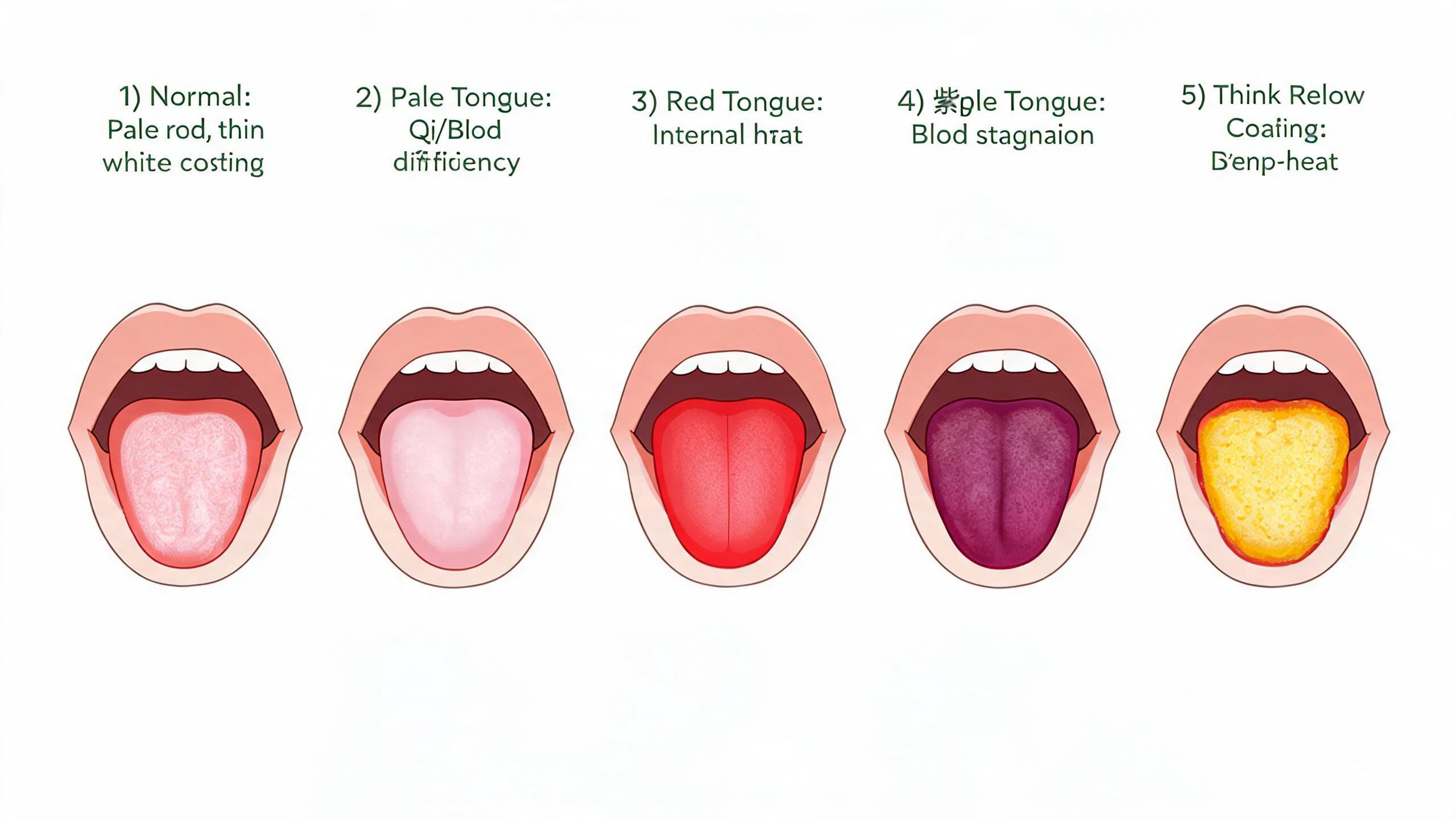
- Tongue body color reflects the state of qi and blood — pale suggests deficiency, red suggests heat, purple suggests stagnation.
- Tongue coating reflects the state of the stomach and the presence of pathogens — thin white is normal, thick indicates accumulation.
- Tongue shape reveals organ strength — swollen with teeth marks suggests spleen deficiency with dampness, thin suggests blood deficiency.
- Always examine the tongue in natural daylight, first thing in the morning, before eating or brushing.
- This guide is an educational introduction — clinical tongue diagnosis requires professional training.
Quick Answer: Learn TCM tongue diagnosis at home. Discover what tongue body color, coating color, coating thickness, tongue shape, and sublingual veins reveal about your...
This article is for educational purposes only and provides an introduction to TCM tongue diagnosis concepts. Tongue diagnosis requires extensive professional training to perform accurately. The information here cannot be used to self-diagnose or treat any medical condition. If you have health concerns, consult a qualified healthcare provider or a licensed TCM practitioner. Do not make health decisions based solely on tongue appearance.
Of all the diagnostic methods in Traditional Chinese Medicine, tongue diagnosis holds a special place. The tongue is the only internal organ that you can see directly without any instruments, and in TCM theory, it is intimately connected to the internal organs through the meridian system. The heart opens to the tongue, the spleen governs its taste, the kidneys connect to its root, and the stomach and spleen produce its coating. Because of these connections, changes in the tongue's appearance often precede or accompany internal changes, making it an extraordinarily useful early warning system.
This guide introduces the five dimensions of tongue observation: body color, coating color, coating thickness, tongue shape, and sublingual veins. By learning to observe these five aspects, you can begin developing an understanding of what your tongue is telling you — and, just as importantly, what it is not.
How TCM Tongue Observation Works
In TCM, the tongue is divided into areas that correspond to different organ systems. The tip of the tongue reflects the heart and lungs. The middle reflects the spleen and stomach. The root (back) reflects the kidneys. The sides reflect the liver and gallbladder. When a particular area shows changes — such as redness, coating changes, or ulcers — it suggests an imbalance in the corresponding organ system.
Tongue diagnosis examines two main components: the tongue body (the flesh of the tongue itself, including its color, shape, and moisture) and the tongue coating (the fur-like layer on its surface). The body reflects the deeper, more constitutional state of qi, blood, and yin, while the coating reflects the more superficial state of the stomach and the presence of external pathogens or internal dampness. A skilled practitioner reads both together, along with the sublingual veins beneath the tongue, to form a complete picture.
For foundational TCM concepts that support understanding tongue diagnosis, see our guide to yin and yang and our overview of zang-fu organs.
Tongue Body Color: The Foundation
The color of the tongue body is the single most important aspect of tongue diagnosis. It reflects the state of qi and blood and the presence of heat or cold in the body. The tongue body should be observed in natural light, as artificial lighting can significantly distort color perception.
Normal Tongue Body Color
A normal tongue body is described in TCM as "light red" or "fresh pink" (淡红). It should be vibrant and moist, indicating that qi and blood are sufficient and circulating well. This color is sometimes described as "the color of fresh meat."
Abnormal Colors and Their Meanings
| Tongue Body Color | TCM Pattern | What It Suggests |
|---|---|---|
| Pale (淡白) | Qi and/or Blood Deficiency / Cold | Insufficient qi and blood to fill the tongue, or internal cold constricting vessels. May accompany fatigue, dizziness, pale lips, cold limbs, or scanty menstruation. Often seen in anemia, chronic illness, or poor nutrition. |
| Red (红) | Heat Pattern (Excess or Deficiency Heat) | Heat is present in the body. If the tongue is bright red all over, it suggests excess heat. If only specific zones are red (e.g., the tip), it points to heat in the corresponding organ. May accompany fever, thirst, irritability, or a rapid pulse. |
| Crimson / Deep Red (绊&#) | Heat Entering the Nutritive and Blood Levels | A deeper, more serious heat pattern. In febrile disease, this indicates heat has penetrated to a deep level. In chronic conditions, it often indicates severe yin deficiency with empty heat. May accompany high fever, night sweats, or delirium in acute cases. |
| Purple (紫) | Blood Stasis | Blood is not circulating freely. A pale-purple tongue suggests cold-induced stasis (often with cold limbs and pain). A dark purple or red-purple tongue suggests heat-induced stasis. May accompany fixed, sharp pain, dark spots, or menstrual clots. |
| Blue (青) | Severe Cold / Blood Stasis | Rare but significant. Indicates extreme cold constricting blood vessels or severe blood stasis. A blue tongue is a serious sign that requires immediate medical attention. |
A red tip suggests heart fire (anxiety, insomnia, palpitations). Red sides suggest liver fire (irritability, headache). A red center suggests stomach heat (bad breath, hunger, mouth ulcers). Always note which area of the tongue shows the most change.
Tongue Coating Color: Reading the Surface
The tongue coating (also called "fur") is produced by the stomach's qi rising to the tongue. A normal coating indicates healthy stomach function. Changes in coating color reflect the nature of pathogens or internal conditions affecting the digestive system and the body as a whole.
Normal Coating
A thin, white, evenly distributed coating that allows the tongue body color to show through. It should be neither too dry nor too wet. This indicates that stomach qi is functioning normally and there are no significant pathogenic factors.
Abnormal Coating Colors and Their Meanings
| Coating Color | TCM Pattern | What It Suggests |
|---|---|---|
| Thick White (白苧) | Cold Pattern / Dampness | A thick white coating that obscures the tongue body suggests cold or damp-cold. May accompany aversion to cold, no thirst, abdominal fullness, or loose stools. Often seen in the early stage of a cold or in chronic digestive weakness. |
| Yellow (黄苧) | Heat Pattern / Damp-Heat | Yellow indicates heat. A thin yellow coating suggests mild heat (often as a cold transforms from wind-cold to wind-heat). A thick, yellow, greasy coating suggests damp-heat, common in digestive disorders. May accompany fever, thirst, bad breath, or constipation. |
| Gray-Black (灰黑苧) | Extreme Cold or Extreme Heat | A rare but significant sign. A gray-black coating that is dry suggests extreme heat scorching fluids. A gray-black coating that is moist suggests extreme cold. Either pattern is serious and requires professional evaluation. Note: certain foods and medications (like bismuth) can temporarily darken the coating. |
| Peeled / No Coating (光苧 / 无苧) | Stomach Yin Deficiency / Stomach Qi Deficiency | When the coating is partially or completely absent, the tongue body shines through. This indicates that stomach yin or qi is insufficient to produce the coating. A completely peeled, mirror-like tongue ("mirror tongue") suggests severe yin deficiency. May accompany dry mouth, poor appetite, or post-illness weakness. |
Important Notes on Coating
- Coffee, tea, colored foods, and smoking can stain the coating. Always check before consuming food or drink.
- Tongue scrapers remove the coating and make diagnosis impossible. If you are tracking your tongue, avoid scraping for at least 24 hours before observation.
- Antibiotics can dramatically alter or eliminate the tongue coating by disrupting oral microbiota.
Coating Thickness: Depth of the Pattern
Coating thickness tells you about the depth and severity of a condition. A thin coating suggests a mild or superficial pattern, while a thick coating suggests a deeper or more severe accumulation. The progression from thin to thick (or vice versa) is as informative as the thickness itself.
Thin Coating (薄苧)
A thin coating through which the tongue body is visible is normal in healthy individuals. In illness, a thin coating suggests that the pathogen is still at a superficial level — the condition is relatively new or mild. A thin white coating is the most normal variant.
Thick Coating (厚苧)
A thick coating that obscures the tongue body indicates that pathogens or internal accumulations (food stagnation, phlegm, dampness) are significant. The thicker the coating, the more substantial the accumulation. A thick, greasy coating suggests dampness or phlegm, while a thick, dry coating suggests heat drying out fluids.
| Coating Thickness | TCM Interpretation | Common Context |
|---|---|---|
| Thin and white | Normal or early-stage external pattern | Healthy state, or early stage of a cold |
| Thick and white | Cold or dampness accumulation | Digestive sluggishness, damp-cold |
| Thick and yellow | Damp-heat or food stagnation with heat | Overeating, digestive infection, damp-heat |
| Thick, greasy, and sticky | Phlegm-dampness or food retention | Heavy limbs, chest oppression, bloating |
| No coating (peeled) | Stomach yin or qi deficiency | Chronic illness, post-surgery, aging |
| Geographic (patchy) | Stomach yin deficiency with dampness | Transitional state, often in children or digestive disorders |
Tracking Changes
In clinical practice, watching how the coating changes over time is one of the most valuable aspects of tongue diagnosis. If a thick yellow coating gradually becomes thin and white, it suggests the heat pattern is resolving. If a thin coating becomes thick, it suggests a condition is deepening. If a coating that was present begins to peel, it suggests that stomach yin is being damaged — sometimes by the illness itself or by prolonged medication use.
Tongue Shape: Form and Function
The shape, size, and texture of the tongue body provide information about the strength of qi and blood, the presence of dampness, and the state of yin. A healthy tongue should fit comfortably in the mouth, be neither too fat nor too thin, and have a smooth surface without cracks or prominent marks.
Normal Tongue Shape
The tongue is of moderate size, flexible, and smooth. It is moist but not overly wet. The edges are smooth without indentations from the teeth.
Abnormal Shapes and Their Meanings
| Shape | TCM Pattern | What It Suggests |
|---|---|---|
| Swollen/puffy with teeth marks (胖大有龶迹) | Spleen Qi Deficiency with Dampness | The tongue is enlarged by retained dampness and presses against the teeth, creating scalloped edges. Very common. May accompany fatigue, bloating, loose stools, and heavy limbs. The single most common abnormal tongue shape. |
| Thin and small (瘦薄) | Qi and Blood Deficiency / Yin Deficiency | The tongue lacks substance because qi, blood, or yin is insufficient to fill it. May accompany weight loss, dry mouth, or chronic illness. |
| Cracked (裂纹舌) | Yin Deficiency (especially Stomach/Heart) | Cracks of varying depth and pattern indicate yin is insufficient to moisten the tongue. A central crack often relates to the stomach. A crack running to the tip may relate to the heart. May accompany dry mouth, night sweats, or hunger without appetite. |
| With thorns/prickles (苓刺) | Excess Heat | The papillae are enlarged and red, giving the tongue a rough, prickly appearance. Indicates heat accumulation, often in the corresponding organ zone (e.g., prickles at the tip = heart fire). |
| Stiff (强硬) | Internal Wind / Phlegm Obstructing Channels | The tongue cannot move freely. In TCM, this is a serious sign suggesting wind-phlegm obstructing the channels, often seen in stroke. Requires immediate medical attention. |
| Deviated to one side (歉斜) | Wind / Stroke | When extended, the tongue leans to one side. This can be an early sign of wind stroke or nerve damage. Requires immediate medical evaluation. |
| Trembling (顿动) | Spleen Qi Deficiency / Internal Wind | A slight trembling when the tongue is extended. May accompany fatigue and nervousness (qi deficiency) or, in severe cases, internal wind. |
A stiff, deviated, or severely trembling tongue can indicate serious neurological conditions, including stroke. If you or someone else notices these signs — especially if accompanied by facial drooping, slurred speech, weakness, or confusion — seek emergency medical care immediately. Do not wait.
Sublingual Veins: The Hidden Clues
The veins beneath the tongue are examined by curling the tongue upward toward the roof of the mouth. In TCM, these sublingual veins provide a direct window into the state of blood circulation, particularly the presence of blood stasis. This examination is often overlooked in casual self-observation but is highly valued in clinical practice.
How to Observe
Open your mouth and curl the tip of your tongue upward and backward, so the underside faces up. Look at the two veins running along the underside of the tongue, on either side of the frenulum (the central tissue connecting the tongue to the floor of the mouth).
Normal Sublingual Veins
Light purple in color, thin (approximately 2 mm or less in diameter), and not excessively long — they should not extend beyond 3/5 of the distance from the frenulum to the tongue tip. They should not be noticeably swollen or twisted.
Abnormal Findings
| Observation | TCM Pattern | What It Suggests |
|---|---|---|
| Dark purple or blackish | Blood Stasis | Blood is not circulating freely. May accompany chest pain, menstrual pain with clots, or chronic pain that is fixed and stabbing in nature. |
| Thickened and distended | Blood Stasis (more severe) | The veins are noticeably swollen (>2.5 mm). The thicker and darker, the more significant the stasis pattern. |
| Long and tortuous (twisted) | Chronic Blood Stasis | Veins that are long, twisted, and dark suggest long-standing blood stasis. Often seen in chronic cardiovascular conditions, chronic pain, or tumors (which require medical evaluation). |
| Red or bright purple | Heat in the Blood | Heat is affecting the blood vessels. May accompany skin rashes, nosebleeds, or a red tongue body. |
| Pale and thin | Blood Deficiency | Insufficient blood to fill the veins. May accompany a pale tongue body, dizziness, and dry skin. |
Important Notes
- Darker sublingual veins are common in older adults and may reflect age-related circulatory changes rather than acute disease.
- Any sudden change in the sublingual veins, especially accompanied by chest pain or breathing difficulty, requires prompt medical evaluation.
- The sublingual veins should be observed alongside the tongue body and coating — never interpreted in isolation.
Common Tongue Combinations: Putting It Together
In practice, tongue diagnosis involves reading multiple signs together. The tongue body and coating often tell complementary stories. Here are some of the most common combinations and what they typically suggest:
| Combination | TCM Pattern | Typical Symptoms |
|---|---|---|
| Pale body + thin white coating | Qi/Blood Deficiency | Fatigue, dizziness, pale complexion, scanty periods |
| Pale body + thick white coating | Cold-Dampness / Spleen Yang Deficiency | Cold abdomen, loose stools, heavy limbs, clear urine |
| Red body + thin yellow coating | Heat Pattern (mild) | Thirst, irritability, slight fever, yellow urine |
| Red body + thick yellow greasy coating | Damp-Heat | Sticky mouth, bitter taste, heavy limbs, bad breath |
| Red body + no coating | Yin Deficiency with Empty Heat | Night sweats, dry mouth at night, 5-center heat (hot palms, soles, chest) |
| Pale body + teeth marks + white coating | Spleen Qi Deficiency with Dampness | The most common combination. Fatigue, bloating, loose stools, heavy feeling |
| Purple body + thin white coating | Blood Stasis (cold type) | Fixed sharp pain, cold limbs, dark menstrual blood with clots |
| Dark red body + yellow coating | Blood Stasis with Heat | Sharp pain that worsens with heat, irritability, dark urine |
| Normal body + thick greasy coating | Food Stagnation / Dampness | Bloating, belching, bad breath, feeling of fullness after eating little |
The most useful approach for beginners is to photograph your tongue every morning for two weeks under consistent lighting. This creates a baseline and helps you notice gradual changes that would otherwise be invisible from day to day. Use your phone's camera in the same window at the same time each morning.
How to Observe Your Tongue Correctly
Practical Tips
Accurate tongue observation requires proper technique. The following guidelines ensure that what you see reflects your actual health state rather than artifacts of observation:
- Timing: The best time is first thing in the morning, before eating, drinking, brushing teeth, or using mouthwash. The morning tongue reflects the body's resting state without external influences.
- Lighting: Use natural daylight whenever possible. Stand facing a window. Avoid fluorescent lighting, which can make the tongue look bluish or greenish. If natural light is unavailable, use a warm-white LED light.
- Posture: Open your mouth naturally and extend the tongue gently. Do not strain or extend forcefully, as this can change the tongue's color (prolonged extension makes it redder). Keep the tongue flat and relaxed.
- Duration: Observe for no more than 15-20 seconds. After that, the tongue begins to change color from the effort of extension. If you need more time, retract the tongue, rest for a few seconds, and extend again.
- Sequence: First observe the overall body color and coating. Then examine specific zones (tip, sides, center, root). Next, note the shape and any teeth marks or cracks. Finally, curl the tongue up to examine the sublingual veins.
- Photography: If photographing for tracking, use the same lighting, angle, and distance each time. Avoid using flash, which distorts colors.
- Food and drink effects: Coffee, tea, curry, colored candies, and some medications can temporarily stain the coating. Wait at least 2 hours after consuming colored foods before observing, or simply observe before eating.
For a complementary diagnostic method, see our TCM self-assessment guide, which covers urine, mucus, facial color, nails, and sleep observation.
Frequently Asked Questions
What does a normal tongue look like in TCM?
In TCM, a normal tongue has a light red or fresh pink body color with a thin, white, evenly distributed coating. The tongue should be of normal size — not swollen or thin — with a moist surface and no cracks or prominent marks. When you lift the tongue, the sublingual veins should be light purple, thin, and not excessively long. This indicates healthy qi, blood, and organ function.
When is the best time to examine my tongue?
The best time is in the morning, after waking but before brushing your teeth, eating, or drinking. This is because food, beverages, brushing, and even scraping the tongue can alter the coating and color, giving a false reading. Natural daylight is the ideal light source, as artificial lighting can distort color perception. Examine the tongue for no more than 15-20 seconds, as prolonged extension can change the tongue's color.
Can tongue diagnosis detect specific diseases?
No. TCM tongue diagnosis identifies patterns of imbalance — such as heat, cold, deficiency, or stagnation — rather than specific medical diseases. A red tongue does not mean you have a named disease; it suggests a heat pattern that a TCM practitioner would interpret alongside other signs. Tongue diagnosis cannot replace medical tests for conditions like anemia, infections, or vitamin deficiencies. If you have health concerns, consult a healthcare provider for proper medical evaluation.
Why does my tongue coating change throughout the day?
Tongue coating naturally fluctuates based on hydration, meals, oral hygiene, and time of day. Morning coating is typically thicker because saliva production decreases overnight and bacteria accumulate. After eating, the mechanical action of food can reduce coating. Drinking coffee, tea, or colored beverages can temporarily stain the coating. These daily fluctuations are normal. For consistent observations, always check your tongue first thing in the morning before any food or drink.
This article is for educational and informational purposes only and is not a substitute for professional medical advice, diagnosis, or treatment. TCM tongue diagnosis requires extensive professional training and cannot be used to self-diagnose or treat any medical condition. If you notice concerning changes in your tongue — such as persistent ulcers, lumps, color changes, or pain — or if you have any health concerns, consult a qualified healthcare provider. Read our full disclaimer →