Key Takeaways
- TCM holds that "the Kidney manifests in the hair" (肾其华在发) — hair vitality is a direct reflection of Kidney essence (Jing). Healthy, abundant hair signals strong essence; thinning or graying reflects depletion.
- The scalp is traversed by multiple meridians, including the Gallbladder, Bladder, and Stomach channels. Scalp massage stimulates these pathways, promoting Qi and Blood circulation to the hair follicles.
- The practice combines three elements: a massage tool (wooden brush or fingertips), a nourishing oil (rosemary or castor oil), and consistent pressure on key acupressure points.
- Practice 3 to 5 times per week, 5 to 10 minutes per session, ideally in the evening. Results require patience — 8 to 12 weeks of consistency.
- Scalp massage is a traditional wellness practice — it does not treat medical hair loss conditions like alopecia areata or androgenetic alopecia. Consult a dermatologist for clinical concerns.
This article is for educational purposes only and is not medical advice. Scalp massage is a traditional wellness practice, not a medical treatment. It is not intended to diagnose, treat, cure, or prevent any disease or hair loss condition. Hair loss can result from genetics, hormonal imbalance, nutritional deficiency, thyroid disease, autoimmune conditions, stress, and other medical factors that require professional evaluation. Always consult a qualified healthcare provider or dermatologist for hair loss concerns. Read our full disclaimer →
Healthy hair has always been a symbol of vitality in Chinese culture — and in the Chinamaxxing beauty world, the secret to luxurious hair is no longer hidden. The TCM approach to hair is unique because it does not focus on the hair itself. Instead, it looks at the root system beneath the scalp and the internal organs that nourish it. The principle is ancient and clear: "the Kidney manifests in the hair" (肾其华在发), and "Blood and Qi are abundant, then the hair is lush".
This guide covers the TCM theory of hair health, the tools and oils used in scalp massage, a complete step-by-step routine, and the acupressure points that support hair vitality. For related reading, see our TCM hair growth guide and our yin and yang guide for Kidney theory.
The TCM Theory of Hair Health
TCM connects hair to two internal systems:
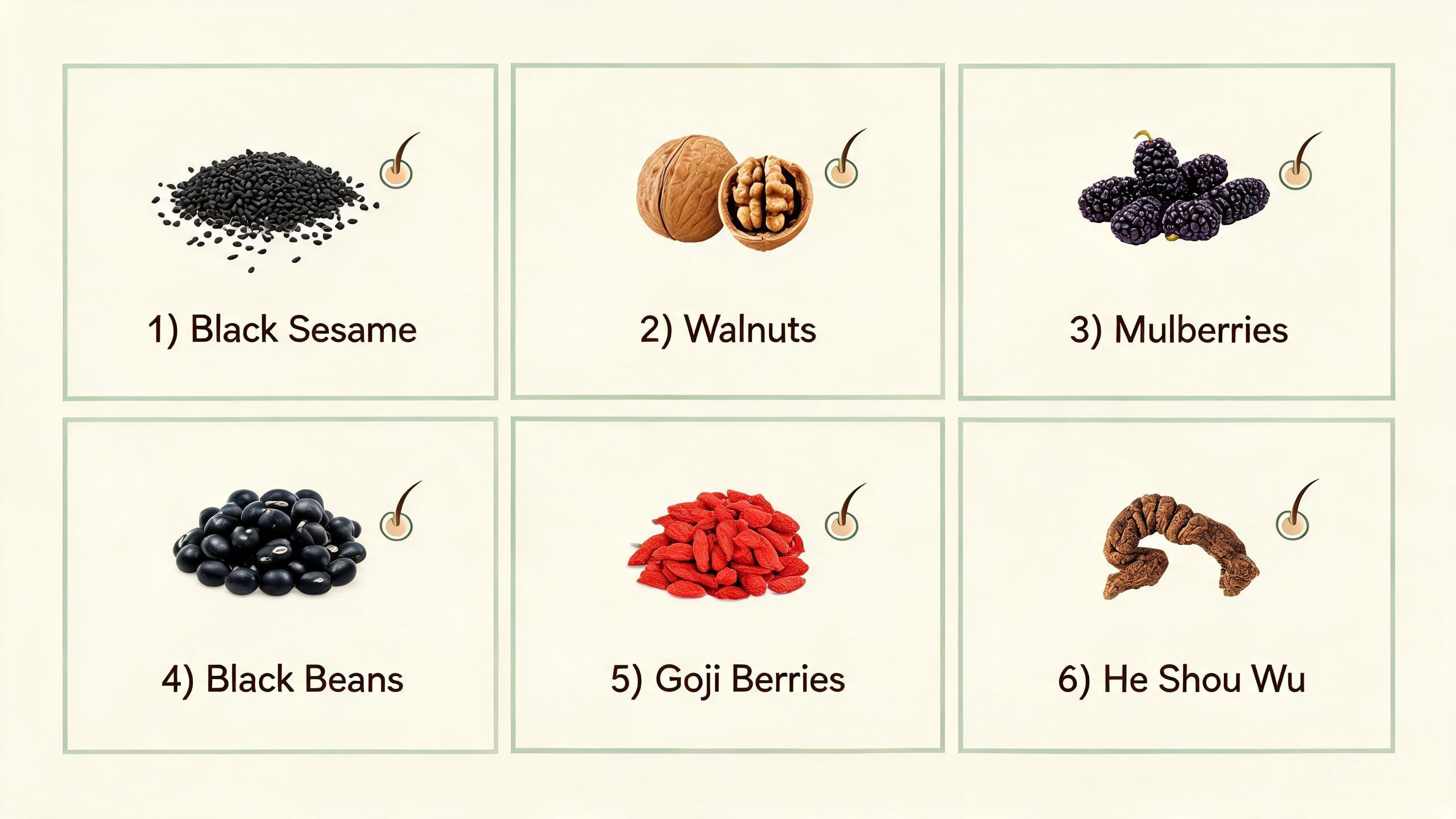
- The Kidney stores essence (Jing) and manifests in the hair. Essence is the body's foundational substance, governing growth, development, and aging. When Kidney essence is abundant, hair is thick, dark, and lustrous. When essence is depleted — through aging, overwork, chronic stress, or constitutional weakness — hair may thin, gray prematurely, or lose its shine. This is why TCM anti-hair-loss practices always include Kidney-nourishing foods like black sesame, walnuts, and mulberries. See our TCM anti-aging foods guide.
- The Liver stores Blood, and Blood nourishes the hair. The Liver ensures that Blood is distributed to every tissue, including the scalp. When liver blood is sufficient, the hair follicles receive the nourishment they need. When liver blood is deficient — from poor sleep, stress, poor nutrition, or blood loss — the hair may become dry, brittle, or thin. The TCM body clock assigns 1 AM to 3 AM to the Liver, making sleep a critical factor in hair health.
Additionally, the scalp itself is a meridian crossroads. The Gallbladder channel runs along the sides of the head, the Bladder channel runs over the crown, and the Stomach channel traverses the face and jaw. The "Hundred Meetings" point (Baihui, GV20) — at the crown of the head — is where multiple yang meridians converge. Stimulating the scalp activates these channels, promoting the circulation of Qi and Blood to the hair follicles.
Tools and Oils for Scalp Massage
Massage Tools
- Wooden scalp massage brush: The most popular tool. Look for one with rounded wooden bristles that do not scratch the scalp. Search "wooden scalp massager brush" on Amazon. The wide handle and springy bristles make it easy to apply even pressure across the entire scalp.
- Silicone scalp massager: A handheld tool with soft silicone tips. Gentle and easy to clean. Good for sensitive scalps.
- Your fingertips: The most accessible tool. Use the pads of your fingers (not the nails) in small circular motions. This is the traditional method and offers the most control.
- Avoid: Metal combs with sharp teeth, brushes with stiff plastic bristles, and any tool that scratches or irritates the scalp.
Nourishing Oils
Applying a small amount of oil before or during massage provides slip and delivers nourishing compounds to the scalp:
- Rosemary essential oil (diluted in a carrier oil) — the most studied essential oil for scalp health. Dilute 3 to 5 drops in 1 tablespoon of carrier oil. Search "rosemary essential oil for hair" on Amazon.
- Castor oil — rich in ricinoleic acid; traditionally used to support hair thickness. Thick and sticky — blend with a lighter oil.
- Jojoba oil — closely matches the scalp's natural sebum; an excellent carrier oil.
- Argan oil — rich in fatty acids and vitamin E; nourishing for the scalp and hair shaft.
The Complete Scalp Massage Routine
Practice this routine 3 to 5 times per week, ideally in the evening. Each session takes 5 to 10 minutes.
Step 1: Prepare (1 minute)
If using oil, warm 1 to 2 teaspoons between your palms. Part the hair and apply the oil directly to the scalp in sections. If using a dry massage (no oil), simply begin. Take three slow breaths to settle.
Step 2: Activate the Crown (1 minute)
Using your fingertips or the massage brush, press gently on Baihui (GV20) — at the very top of the head, in line with the tops of the ears. Hold for 10 seconds, then release. Repeat 3 times. This point is where the yang meridians converge; stimulating it supports overall Qi flow to the head.
3: Circular Massage (3 to 5 minutes)
Using your fingertips or the brush, make small circular motions across the entire scalp. Work systematically:
- Start at the hairline and work back to the nape of the neck
- Then work from the temples up to the crown
- Then work along the sides, from the ears up
- Finally, massage the back of the head (occipital area) where the neck meets the skull
Use moderate pressure — firm enough to move the scalp, not just the hair. The scalp should feel warm and alive after a few minutes.
Step 4: Acupressure Points for Hair (2 minutes)
- Baihui (GV20) — crown of the head. Press for 30 seconds. Supports overall yang Qi.
- Fengchi (GB20) — at the base of the skull, in the hollows on either side of the neck. Press with thumbs for 30 seconds per side. This point supports blood flow to the head and relieves neck tension that can restrict circulation. See our acupressure for headache guide for more on this point.
- Jiaosun (TE20) — above the ear, at the temple hairline. Press for 20 seconds per side. Supports the Triple Burner channel that traverses the side of the head.
Step 5: Finish (1 minute)
Run your fingers (or the brush) through the entire scalp one final time with long, sweeping strokes from the hairline to the nape. If you applied oil, you can leave it on for 30 minutes to 2 hours before washing, or overnight if your scalp tolerates it well.
TCM emphasizes that external practices work best when paired with internal nourishment. For hair health, include Kidney-nourishing foods in your diet: black sesame, walnuts, goji berries, mulberries, and black beans. See our TCM hair growth guide for food therapy recipes. Also prioritize sleep before 11 PM, as the Liver restores Blood between 1 AM and 3 AM — Blood that nourishes the hair follicles.
Frequency, Expectations, and Safety
How often? Three to five sessions per week is ideal. Daily is acceptable if your scalp tolerates it. Each session: 5 to 10 minutes.
When will you see results? Hair grows slowly — about half an inch per month. Noticeable changes in scalp health (less itchiness, improved comfort) may appear within 2 to 4 weeks. Changes in hair quality or growth require patience: 8 to 12 weeks of consistent practice is the minimum to evaluate results. Individual results vary significantly.
Important safety notes:
- Scalp massage does not treat medical hair loss conditions such as androgenetic alopecia, alopecia areata, telogen effluvium, or hair loss from thyroid disease, PCOS, or nutritional deficiency. If you are experiencing significant hair loss, consult a dermatologist.
- Avoid scalp massage over sunburn, open wounds, scalp infections, or active psoriasis/eczema flare-ups.
- Always patch-test essential oils on the inner forearm 24 hours before applying to the scalp.
- Never use essential oils undiluted on the scalp — always dilute in a carrier oil.
- If you experience increased shedding, redness, itching, or irritation, discontinue use and consult a dermatologist.
Frequently Asked Questions
Does TCM scalp massage really help hair growth?
TCM scalp massage is a traditional practice that promotes Qi and Blood circulation to the scalp and stimulates meridian points like Baihui (GV20) and Fengchi (GB20). Improved circulation may support the environment around hair follicles. Some modern studies on scalp massage and rosemary oil show promising results for certain types of hair concerns. However, scalp massage is a wellness practice, not a medical treatment. It does not treat androgenetic alopecia, alopecia areata, or hair loss from medical conditions. If you are experiencing significant hair loss, consult a dermatologist for proper diagnosis.
What does TCM say about hair loss?
TCM attributes hair health primarily to the Kidney and Liver systems. The Kidney stores essence (Jing) and manifests in the hair, so thinning, graying, or dry hair is seen as a sign of Kidney essence depletion. The Liver stores Blood, which nourishes the scalp and follicles, so liver blood deficiency from poor sleep, stress, or poor nutrition also contributes. TCM traditionally recommends Kidney-nourishing foods (black sesame, walnuts, goji berries), adequate sleep, stress management, and scalp massage. These are traditional wellness practices, not medical treatments.
What oil is best for TCM scalp massage?
The most popular choices are rosemary essential oil (diluted 3 to 5 drops in 1 tablespoon of carrier oil), castor oil (blended with a lighter oil), and jojoba oil as a carrier. Rosemary oil is the most studied essential oil for scalp health. Always dilute essential oils in a carrier oil and patch-test before use. Apply a small amount to the scalp in sections before massage. These are available on Amazon.
How often should I massage my scalp for hair growth?
Three to five times per week, 5 to 10 minutes per session, is ideal. Daily practice is acceptable if your scalp tolerates it. Because hair grows slowly, consistency over 8 to 12 weeks is needed before evaluating results. Always use gentle to moderate pressure — the goal is to move the scalp, not scratch it. If you notice irritation or increased shedding, reduce frequency or discontinue and consult a dermatologist.
The Bottom Line
TCM scalp massage is a beautiful example of the Chinamaxxing philosophy: it works with the body's natural systems rather than against them. By combining physical stimulation of the scalp's meridian network with the TCM understanding that hair vitality reflects Kidney essence and Liver Blood, the practice addresses both the local environment of the follicles and the internal foundation that nourishes them. Choose a quality tool, use a nourishing oil, practice consistently, and pair it with Kidney-nourishing foods and adequate sleep.
But it is a tradition — not a treatment. Hair loss has many medical causes that require professional evaluation. If you are experiencing significant or sudden hair loss, consult a dermatologist. Used wisely and patiently, TCM scalp massage is a grounding daily ritual that connects the modern hair care routine to centuries of Chinese wellness wisdom.
This article is for educational and informational purposes only and is not a substitute for professional medical advice, diagnosis, or treatment. Always consult a qualified healthcare provider before beginning any new wellness practice, especially if you are pregnant, nursing, taking medication, or have a medical condition. Read our full disclaimer →