Key Takeaways
- Zhan Zhuang (站桩, "standing like a stake") is a standing meditation practice that builds Qi through stillness rather than movement.
- The basic posture — feet shoulder-width, knees soft, arms holding an imaginary ball — engages every muscle group without strain and opens the body's meridian network.
- Beginners start at 5 minutes and progress to 30 minutes over several months; the body reorganizes itself through the challenge of holding still.
- Common sensations include warmth, tingling, trembling, and fullness in the lower abdomen (Dan Tian) — all signs that Qi is accumulating.
- Advanced postures vary the arm position to target specific meridians and organs while maintaining the same foundational alignment.
Why Standing Still Builds Qi
Of all the practices in the vast landscape of qigong, none is more deceptively simple — or more profoundly powerful — than Zhan Zhuang. The name translates to "standing like a stake" or "standing like a tree," and the practice appears, to the uninitiated, to be doing nothing at all. You stand. You hold your arms in a rounded shape. You breathe. That is the entire practice.
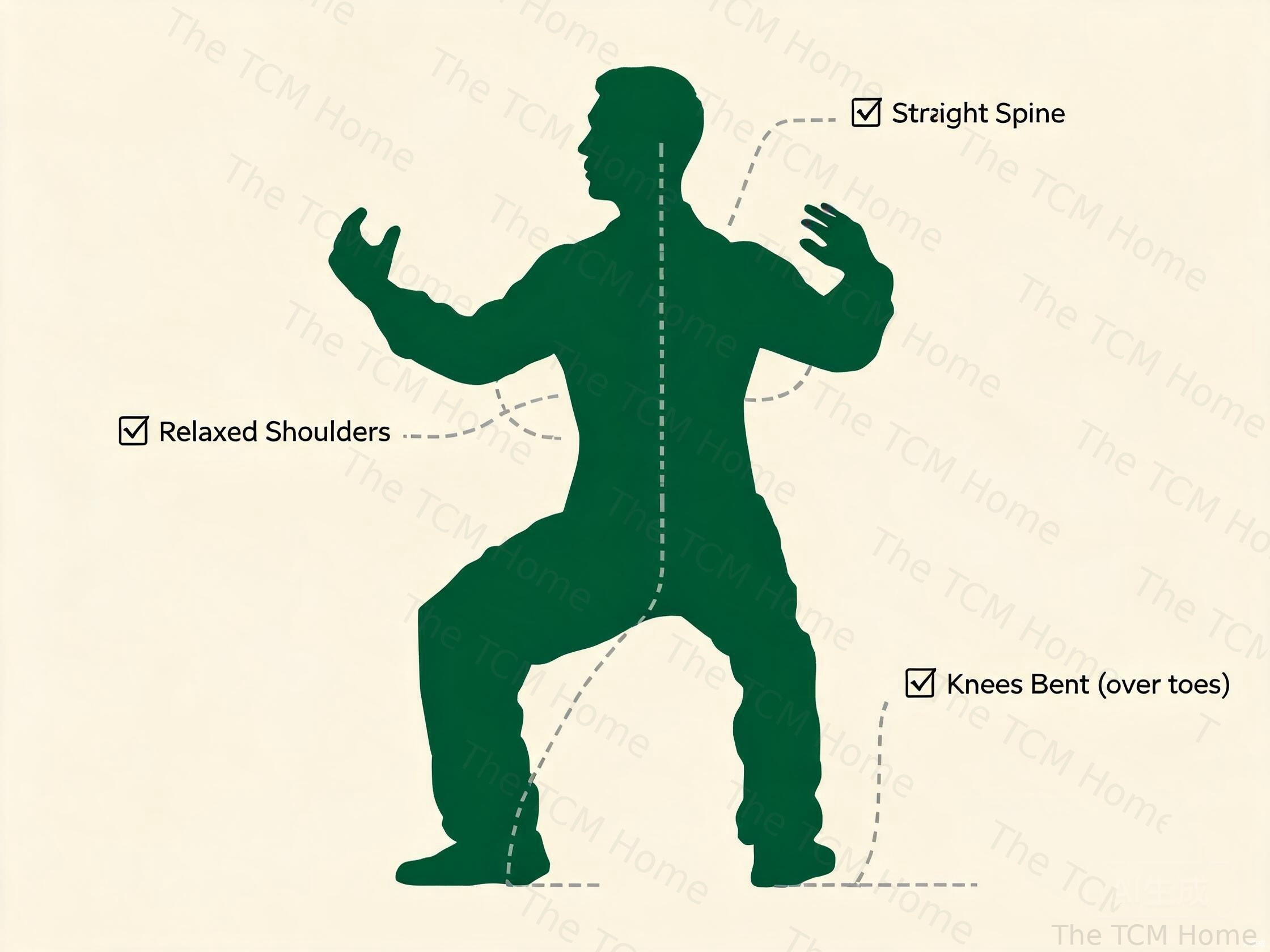
Yet this apparent simplicity conceals a sophisticated internal technology. In TCM theory, there are two fundamental modes of qigong: moving practice (Dong Gong), which circulates Qi, and still practice (Jing Gong), which accumulates Qi. Movement is like opening the windows to let stale air out and fresh air in. Stillness is like banking a fire — gathering and concentrating energy rather than spending it. Zhan Zhuang is the supreme form of still practice.
When you hold the body in a specific aligned posture and relax deeply, several things happen simultaneously. The nervous system shifts from sympathetic (fight-or-flight) to parasympathetic (rest-and-digest) mode. The deep postural muscles that modern life neglects — the psoas, the pelvic floor, the transverse abdominis — engage to maintain the posture. Chronic tension patterns in the shoulders, jaw, and lower back begin to release. And as the body settles, Qi that was previously scattered by constant movement and mental activity begins to sink and collect in the Lower Dan Tian, the energy center three finger-widths below the navel.
The result is a practice that simultaneously builds structural strength, calms the mind, opens the meridian system, and accumulates internal energy. Martial artists have used Zhan Zhuang for centuries to develop the rooted, unshakeable stability that makes internal martial arts like Tai Chi and Bagua effective. But you do not need to be a martial artist to benefit — the same stillness that builds fighting power builds health.
Think of yourself as a tree. Your feet are the roots, sinking into the earth. Your legs and torso are the trunk, stable and upright. Your arms are the branches, held up without effort by the internal pressure of sap — or in your case, Qi. Like a tree, you are not inert. You are alive, growing, and gathering energy, even in stillness.
The Basic Posture: Step-by-Step
The foundational Zhan Zhuang posture is called Hun Yuan Zhuang (浑元桩), meaning "Round and Complete Posture" or "Universal Post." Follow these steps to set it up correctly. Every detail matters — alignment is the foundation of the entire practice.
Step 1: The Feet
Stand with your feet shoulder-width apart, parallel to each other. Distribute your weight evenly across the entire sole of each foot — not just the heels, not just the balls. Feel the three points of contact: the center of the heel, the ball of the big toe, and the ball of the little toe. Imagine these points gripping the ground like the roots of a tree.
Step 2: The Knees
Soften your knees. Do not bend them deeply — just unlock them. The knees should feel springy and alive, never locked straight. A subtle sinking occurs as the weight drops into the legs. Imagine sitting back slightly onto the heels, as if about to sit on a high stool. This knee position opens the Kidney meridian and allows Qi to sink into the legs.
Step 3: The Hips and Pelvis
Tuck the tailbone slightly under, as if sitting on the edge of a chair. This releases the lower back and allows the pelvis to tilt forward gently. Do not exaggerate the tuck — just enough to flatten the lumbar curve slightly. This position, called song kua (relaxing the groin), opens the hip joints and allows Qi to flow freely between the upper and lower body.
Step 4: The Spine and Head
Imagine a golden thread pulling the crown of your head upward. Let your spine lengthen and decompress, vertebra by vertebra. Tuck the chin slightly to lengthen the back of the neck. The head should feel as if it is floating above the shoulders, perfectly balanced. This alignment opens the Governing Vessel (Du Mai) that runs along the spine.
Step 5: The Shoulders and Arms
Let your shoulders drop and relax downward — do not hunch them up toward your ears. Now slowly raise your arms in front of you to about chest height, as if holding a large imaginary ball. The hands face your body, fingers pointing toward each other but not touching, about one fist-width apart. The elbows are slightly lower than the wrists. The armpits should feel as if you are holding a small lemon under each one — not squeezed, not open.
Step 6: The Hands and Fingers
Round your hands as if cradling that ball. The fingers are spread gently apart, not rigid. The palms are concave. The thumbs point upward slightly. This hand shape, called laogong opening (after the PC8 point in the center of the palm), allows Qi to flow in and out of the hands freely. You may eventually feel warmth or a magnetic sensation between your palms.
Step 7: The Breath and Mind
Breathe naturally through the nose. Do not control or force the breath — simply observe it. Let the abdomen expand on the inhale and retract on the exhale. Place your attention in the Lower Dan Tian, three finger-widths below the navel. If your mind wanders, gently return it to the breath and the Dan Tian. That is the entire practice.
Progression: From 5 to 30 Minutes
Zhan Zhuang is a cumulative practice. The body adapts and strengthens over weeks and months, not days. Follow this progression to build your practice safely and effectively.
| Stage | Duration | Focus | Timeline |
|---|---|---|---|
| Beginner | 5 minutes | Learning alignment, relaxing the shoulders, finding the Dan Tian | Weeks 1–3 |
| Foundational | 10 minutes | Stabilizing posture, beginning to feel warmth and tingling | Weeks 4–8 |
| Intermediate | 15–20 minutes | Deeper relaxation, trembling subsides, Qi clearly felt | Months 2–4 |
| Advanced | 30 minutes | Stillness becomes effortless, body feels light and full | Months 4–6+ |
The key principle is never force duration. If you are tense, trembling violently, or holding your breath, you have gone too long. Stop, rest, and return tomorrow. Quality of stillness always trumps quantity of minutes. A relaxed 5-minute stand builds more Qi than a tense 20-minute stand.
Common Sensations and What They Mean
As you practice Zhan Zhuang, you will experience a range of sensations. Most are signs that the practice is working. Understanding them prevents unnecessary concern.
- Warmth in the hands and Dan Tian: The most common first sign. Qi is accumulating and the microcirculation is improving. Welcome it.
- Tingling or pulsing in the palms: Qi is beginning to move through the Pericardium and Lung meridians in the arms. The Laogong (PC8) points are opening.
- Trembling or shaking: Deep postural muscles are engaging for the first time, and chronic tension is releasing. Do not resist it — relax into the shaking and let it pass. It will decrease as your body strengthens.
- Heaviness in the legs: Qi is sinking downward, exactly as it should. The legs are grounding your energy. This heaviness eventually transforms into a feeling of deep rootedness.
- Lightness or floating sensation: As Qi fills the upper body, the structure feels supported from within. This is the "body full of Qi" feeling that advanced practitioners describe.
- Spontaneous deep breaths or sighs: The nervous system is releasing stored stress. Allow these to happen without forcing them.
- Emotional release: Sometimes sadness, anger, or joy surfaces during standing. This is Qi moving through areas where emotion was stored. Simply observe and let it pass.
In Zhan Zhuang, never push to 100% of your capacity. Stay at about 70% — challenged but not strained. This applies to knee bend depth, arm height, and duration. The 70% rule allows the nervous system to relax rather than brace, which is essential for Qi accumulation.
Advanced Postures
Once you can comfortably hold the basic posture for 15 minutes, you can explore variations that target specific meridians and aspects of Qi development. All advanced postures maintain the same lower-body alignment — only the arm position changes.
1. Holding the Belly Posture (Fu Fu Zhuang)
Place both hands on the lower abdomen, one over the other, with the center of the back hand over the Dan Tian. This posture is deeply nourishing and is used to build Kidney Qi and consolidate energy. It is excellent for fatigue, recovery from illness, and older practitioners.
2. Raising the Water Posture (Tuo Shui Zhuang)
Raise the arms to forehead height, palms facing upward, as if supporting a basin of water. This opens the Lung and Heart meridians more intensely and builds Qi in the upper body. It is more demanding on the shoulders and should be approached gradually.
3. Splitting the Mountain Posture (Pi Shan Zhuang)
Extend the arms to the sides at shoulder height, palms facing outward. This powerfully opens the chest and the Gallbladder meridian along the sides of the body. It is one of the most physically demanding postures and builds both structural strength and Qi capacity.
4. Embracing the Tree Posture (Bao Shu Zhuang)
Similar to the basic posture but with the arms slightly lower and wider, as if embracing the trunk of a large tree. This is the classic internal martial arts posture and develops the most balanced, whole-body Qi. It is often the main practice for intermediate and advanced practitioners.
Troubleshooting Common Problems
Shoulders Tensing Up
This is the most common problem. Every few minutes, consciously drop your shoulders down and let the elbows grow heavy. Imagine water pouring down your arms. If tension persists, lower your arms to waist height until the shoulders relax, then slowly raise them back.
Knees Hurting
Knee pain means your weight is too far forward. Shift your weight back toward the heels and reduce the knee bend. The knees should track directly over the toes, never collapsing inward. If pain persists, stop and consult a qualified instructor to check your alignment.
Mind Racing
A wandering mind is normal. Do not fight it — that creates more tension. Instead, bring your attention to the physical sensations of the body: the weight on the feet, the temperature of the hands, the movement of the breath. The body is always in the present moment; the mind is not. Sensation anchors you in the now.
Holding the Breath
When concentrating on posture, many people unconsciously hold their breath. Check your breathing every minute or so. If you find you have stopped breathing, take three deep breaths and let the rhythm return to natural. The breath should always be slow, soft, and abdominal.
Feeling Dizzy or Lightheaded
This can happen if you are holding tension in the chest or breathing too forcefully. Stop, sit down, and breathe normally. Next time, reduce the duration and focus on relaxing the chest. If dizziness persists, practice a moving qigong form like the Eight Brocades instead, and return to Zhan Zhuang when your body is ready.
Daily Practice Routine
The ideal schedule for Zhan Zhuang is simple and consistent:
- Morning (upon waking): 5 to 20 minutes. This sets the tone for the day, accumulates fresh morning Qi, and energizes the body.
- Evening (before bed): 5 to 15 minutes of the Holding the Belly posture. This calms the nervous system, consolidates the day's energy, and prepares for deep sleep.
- Frequency: Daily. Zhan Zhuang rewards consistency above all. Five minutes every day is far more powerful than an hour twice a week.
- Best location: Outdoors in nature if possible — among trees, near water, or in a garden. If indoors, face a window or wall and ensure the room is well-ventilated.
Frequently Asked Questions
Why does standing still build more Qi than moving exercises?
In TCM, movement circulates Qi while stillness accumulates it. When the body is held in a relaxed but structurally aligned posture, the nervous system switches from fight-or-flight to rest-and-digest mode. The body redirects energy from constant muscle tension and mental activity into the deeper internal structures — the organs, bones, and marrow. This is why Zhan Zhuang practitioners often feel warmth, tingling, and fullness in the Dan Tian after just a few minutes of stillness. It is the difference between spending money (moving) and saving it (standing).
How long should a beginner stand in Zhan Zhuang?
Beginners should start with 5 minutes and add 1 to 2 minutes each week. The goal is not duration but quality of stillness. It is far better to stand correctly for 5 minutes than to struggle and tense up for 20. Most practitioners reach 30 minutes within 3 to 6 months of consistent daily practice. Never push through pain or extreme discomfort — the body strengthens through gentle, repeated challenge, not through strain.
Is it normal to feel shaking or trembling during Zhan Zhuang?
Yes, trembling is completely normal and is actually a sign that the practice is working. As deep postural muscles that are rarely used begin to engage, and as chronic tension patterns release, the body naturally shakes and vibrates. This is called spontaneous movement and should not be suppressed or feared. Simply relax into it and allow the body to reorganize itself. Over time, as your structure strengthens, the trembling will decrease and eventually stop.
Can Zhan Zhuang be harmful if practiced incorrectly?
The most common problems come from holding tension in the shoulders, locking the knees, or forcing the breath. These can cause stiffness, knee discomfort, or lightheadedness. If you feel pain rather than fatigue, stop and adjust your posture. Zhan Zhuang should always feel challenging but never painful. Those with severe knee, hip, or spinal conditions should consult a qualified instructor before beginning. Educational content only. Not medical advice.
This article is for educational purposes only and does not constitute medical advice. Educational content only. Not medical advice. While Zhan Zhuang is generally safe for healthy adults, individuals with cardiovascular conditions, severe joint problems, or who are pregnant should consult a qualified healthcare provider before beginning. If you experience dizziness, chest pain, or sharp joint pain during practice, stop immediately and seek medical evaluation.
Related Guides
Qigong for Stress Relief: 10-Min Reset
A 10-minute qigong routine with five movements to relieve stress, soothe the liver, open the chest, and calm the nervous system.
Eight Brocades Qigong: Complete Guide
The complete guide to all eight Ba Duan Jin movements for comprehensive health and vitality.
Six Healing Sounds Qigong
Use six vocalized sounds to cleanse and balance the five Yin organs and the Triple Burner.
Microcosmic Orbit Meditation
Learn to circulate Qi through the Ren and Du meridians in this guided energy meditation.