Key Takeaways
- The Microcosmic Orbit (小周天, Xiao Zhou Tian, "Small Heavenly Circle") circulates Qi through the two central meridians: the Governing Vessel (Du Mai) up the spine and the Conception Vessel (Ren Mai) down the front of the body.
- The tongue touching the upper palate (Magpie Bridge) connects the two vessels and completes the energetic circuit.
- The pathway runs from the perineum (Huiyin CV1) up the spine to the crown (Baihui GV20), then down the front to return to the perineum.
- Progression moves through four stages: awareness, sensation, voluntary circulation, and spontaneous circulation.
- Safety requires always closing the practice by returning Qi to the Lower Dan Tian to prevent Qi deviation.
The Ren and Du Meridians: The Body's Central Circuit
Of the eight extraordinary meridians in the TCM system, two are considered the most fundamental: the Governing Vessel (Du Mai, 督脉) and the Conception Vessel (Ren Mai, 任脉). Together, they form the central energetic axis of the human body — the microcosmic orbit through which all Qi eventually flows.
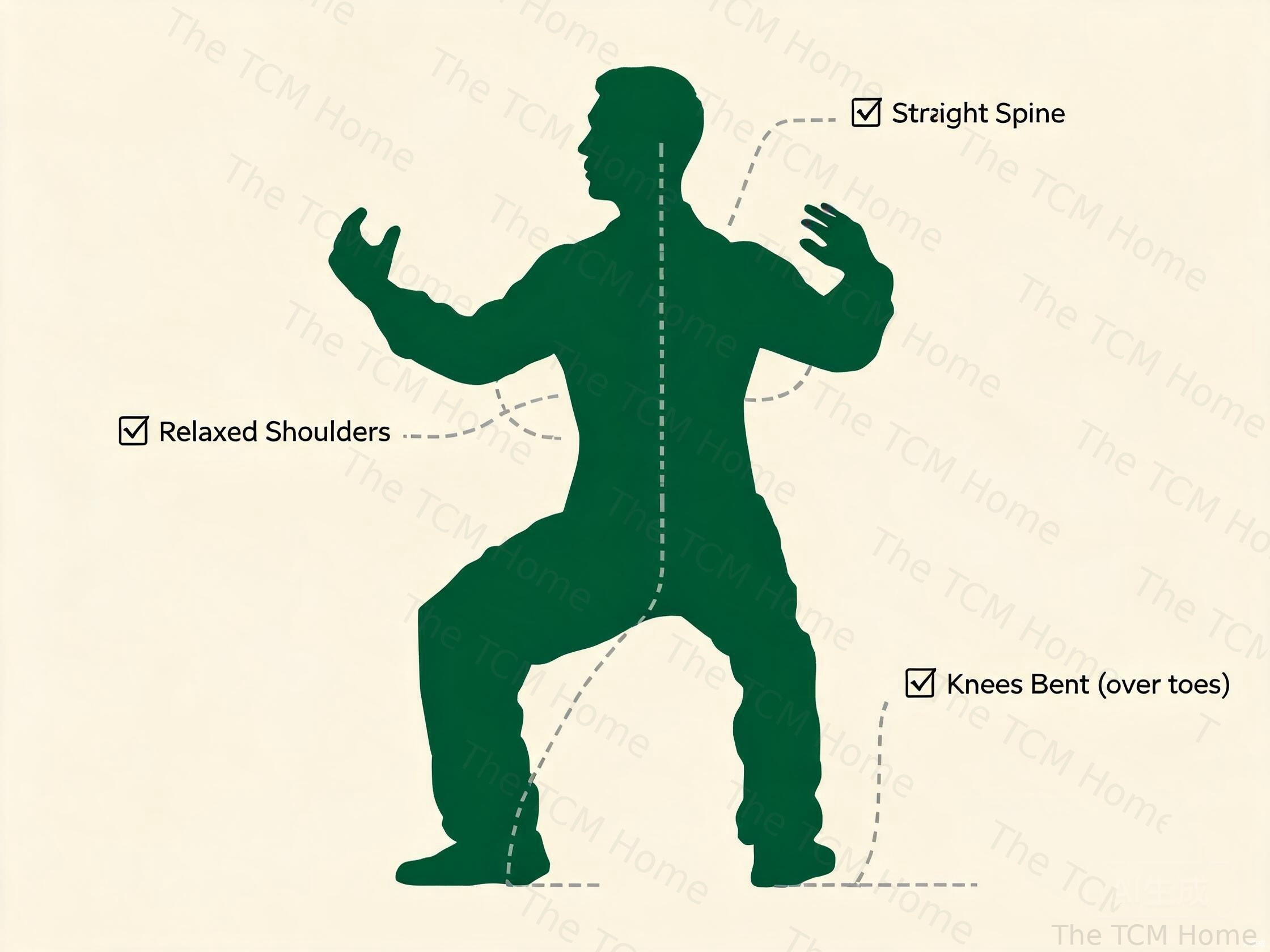
The Governing Vessel (Du Mai) runs along the posterior midline of the body. It begins at the perineum (the Huiyin point, CV1), travels up the spine, passes over the crown of the head, and ends just below the nose at the upper lip. The Du Mai governs all Yang energy in the body — it is the "sea of Yang meridians." It controls the nervous system, the spine, and the brain.
The Conception Vessel (Ren Mai) runs along the anterior midline. It begins at the perineum, travels up the front of the body along the centerline of the abdomen and chest, passes through the throat and chin, and ends just below the lower lip. The Ren Mai governs all Yin energy — it is the "sea of Yin meridians." It controls the reproductive organs, the digestive system, and the body's fluids.
Together, the Du Mai and Ren Mai form a complete loop — one continuous circuit that runs up the back and down the front. This loop is the Microcosmic Orbit, also called the Small Heavenly Circle. When Qi circulates freely through this orbit, the body's Yang and Yin are balanced, the nervous and endocrine systems are regulated, and the organs receive a steady supply of vital energy.
The Microcosmic Orbit circulates Qi through just the two central vessels. Once mastered, advanced practitioners extend the circulation through all 12 regular meridians — a practice called the Macrocosmic Orbit (Da Zhou Tian, 大周天), or "Great Heavenly Circle." The Microcosmic Orbit must always be learned and stabilized first, as it is the foundation upon which the larger circuit is built.
How to Circulate Qi Through the Orbit
The Microcosmic Orbit is a sitting meditation. There is no physical movement — the practice is entirely internal. The method uses the mind's intention (Yi) to guide Qi along a specific pathway. In TCM theory, "Yi leads the Qi" (意到气到) — where the attention goes, Qi follows. By systematically moving your awareness along the orbit, you teach the Qi to flow through this circuit.
The Tongue-to-Palate Connection (Magpie Bridge)
The most important technical detail of the Microcosmic Orbit is the position of the tongue. The Governing Vessel ends at the upper lip, and the Conception Vessel ends at the lower lip. Normally, these two vessels are not connected — they are like two halves of an open electrical circuit. When you place the tip of your tongue against the roof of your mouth, just behind the upper front teeth, you create a bridge between them.
This connection is called the Magpie Bridge (Que Qiao, 鹊桥), named after the bridge of magpies in Chinese mythology that connects two separated lovers across the Milky Way. With the tongue in place, the circuit is complete and Qi can flow continuously from the Du Mai into the Ren Mai and back again, without interruption.
The tongue should rest gently — not pressed hard. It should touch the soft palate just behind the teeth, in the natural resting position. If your tongue becomes tired, you are pressing too hard. Relax and let it float to the roof of the mouth naturally.
The Perineum-to-Crown-to-Perineum Pathway
The complete orbit follows this precise pathway. Memorize the route before beginning practice:
- Start at the Dan Tian: Three finger-widths below the navel, in the center of the lower abdomen. This is where Qi is stored.
- Down to the perineum (Huiyin, CV1): The Qi sinks from the Dan Tian down through the pelvis to the perineum — the midpoint between the anus and the genitals.
- Up the spine (Du Mai): From the perineum, Qi rises up through the tailbone, along the center of the spine, vertebra by vertebra.
- Through the neck and head: Qi continues up through the neck, over the back of the skull, and up to the crown of the head (Baihui, GV20).
- Down the face (Ren Mai): From the crown, Qi flows down the forehead, between the eyebrows (Yintang), down the bridge of the nose, through the tongue (the Magpie Bridge), and into the throat.
- Down the front of the body: Qi continues down the center of the chest, through the solar plexus, and back to the Dan Tian.
- Return to start: The Qi has now completed one full orbit — perineum to crown to Dan Tian to perineum. The circuit is continuous.
Step-by-Step Guided Meditation
Follow these steps for a complete Microcosmic Orbit session. Beginners should practice for 20 minutes daily. Have a timer nearby so you do not need to check the clock.
Step 1: Settle the Body
Sit comfortably on a chair or cushion with your spine erect but not rigid. Your feet should be flat on the floor (if in a chair) or crossed (if on a cushion). Rest your hands in your lap, palms facing upward, with the right hand resting in the left. Close your eyes gently. Take five slow, deep abdominal breaths to settle the nervous system.
Step 2: Place the Tongue
Place the tip of your tongue gently against the roof of your mouth, just behind the upper front teeth. This is the Magpie Bridge. Keep it there throughout the entire meditation. If saliva accumulates in your mouth, you may swallow — this is natural and beneficial in Daoist practice.
Step 3: Gather Qi in the Dan Tian
Bring your attention to the Lower Dan Tian, three finger-widths below the navel. Do not concentrate intensely — just rest your awareness there gently, as if watching a small, warm light. Breathe naturally and allow the breath to expand the lower abdomen. Spend 3 to 5 minutes simply accumulating and feeling the Qi in this center. You may feel warmth, fullness, or a gentle pulsing.
Step 4: Sink Qi to the Perineum
When you feel the Dan Tian is warm and full, guide the Qi downward. Imagine the warm energy sinking from the Dan Tian through the pelvis to the perineum (Huiyin point). This is the lowest point of the orbit — the base from which Qi will rise. Rest your attention there for 10 to 15 seconds.
Step 5: Rise Up the Spine (Du Mai)
Now slowly guide the Qi up the spine. Move your awareness up from the perineum to the tailbone, then vertebra by vertebra up through the lower back, mid-back, upper back, and neck. Imagine the Qi as a warm, glowing light ascending the spine like a slow elevator. When you reach the crown of the head (Baihui), pause for a few seconds and feel the energy pool there. Do not rush — the ascent from perineum to crown should take about 30 to 45 seconds.
Step 6: Descend the Front (Ren Mai)
From the crown, guide the Qi down the front of the body. It flows down the forehead, between the eyebrows (Yintang), down the bridge of the nose, through the tongue (the Magpie Bridge), into the throat, down the center of the chest (through the sternum), through the solar plexus, and back to the Dan Tian. This descent should feel like cool water flowing down — a gentle, soothing release. The front path is Yin — cooling, nourishing, soft.
Step 7: Complete the Circuit
From the Dan Tian, the Qi sinks back down to the perineum, and the circuit begins again. Continue guiding the Qi through the orbit — up the back (warm, Yang), down the front (cool, Yin) — for the remaining time. Each complete circuit takes about 1 to 2 minutes. Do not force the speed — let the Qi move at its own natural pace, guided by your gentle attention.
Step 8: Close the Practice (Essential)
This step is absolutely critical for safety. When your session time is complete, do not simply stop and open your eyes. You must return all the Qi to the Dan Tian. Guide your attention to the Lower Dan Tian and imagine all the circulating Qi gathering there, like water collecting in a basin. Place both hands over the lower abdomen. Take five deep breaths, imagining the Qi condensing and storing in the Dan Tian with each exhale. Then gently rub your palms together until they are warm, wash your face with your warm hands, and slowly open your eyes. This closing prevents Qi from remaining trapped in the head or other areas.
Safety Precautions
The Microcosmic Orbit is powerful because it directly manipulates the body's energetic core. This power carries responsibility. The following precautions are essential:
- Always close the practice. Returning Qi to the Dan Tian is non-negotiable. Skipping this step can leave Qi stuck in the head, causing headaches, pressure, insomnia, or agitation — a condition called Qi deviation (走火入魔).
- Do not force the circulation. Use gentle intention, not willpower. If you cannot feel the Qi moving, simply rest your attention at the Dan Tian and try again next session. Forcing creates tension, which blocks the very flow you are trying to create.
- Do not concentrate on the crown excessively. Spending too long at Baihui (GV20) can cause pressure, headaches, or a feeling of energy being stuck in the head. Move through the crown smoothly — pause briefly, then descend.
- Avoid practicing on a full stomach. Wait at least 90 minutes after eating. Digestion draws Qi to the stomach and can interfere with the orbit.
- Limit session length as a beginner. Start with 15 to 20 minutes. Do not exceed 30 minutes until you have practiced daily for at least a month and feel comfortable with the technique.
- Do not practice if emotionally distressed. Strong anger, grief, or fear disrupts the flow of Qi and can cause it to move erratically. Wait until you are calm before meditating.
- Pregnancy precaution: The Microcosmic Orbit strongly affects the Ren Mai, which governs the uterus. Pregnant women should consult a qualified instructor before practicing and should never focus energy on the lower Dan Tian during pregnancy.
If you experience persistent headaches, pressure in the head, insomnia, agitation, or a feeling of heat rising uncontrollably after practice, stop meditating immediately. These are signs of Qi deviation. To correct it: rub the soles of your feet (Yongquan, KD1) firmly for 2 minutes to draw energy downward; massage the lower abdomen in clockwise circles; and practice gentle physical exercise like walking to disperse the concentrated Qi. Do not resume the orbit meditation until symptoms fully resolve. If symptoms persist, consult a qualified qigong instructor or TCM practitioner.
Progression Stages
The Microcosmic Orbit unfolds in four distinct stages. Each stage builds on the previous one, and practitioners should not rush ahead.
| Stage | Name | Experience | Timeline |
|---|---|---|---|
| 1 | Awareness | You move your attention along the pathway but feel little sensation. You are learning the route. | Weeks 1–3 |
| 2 | Sensation | You begin to feel warmth, tingling, or flow along the path as you move your attention. | Weeks 3–8 |
| 3 | Voluntary Circulation | With each breath or intention, Qi clearly flows through the full orbit. You can direct it at will. | Months 2–6 |
| 4 | Spontaneous Circulation | Qi flows through the orbit continuously and automatically, even during daily activities, without conscious effort. | Months 6–24+ |
Benefits of the Microcosmic Orbit
When practiced correctly and consistently, the Microcosmic Orbit offers benefits that go beyond ordinary meditation:
- Balances Yin and Yang: By circulating Qi through the sea of Yang (Du Mai) and the sea of Yin (Ren Mai), the practice restores the fundamental balance of the body's energy systems.
- Strengthens the nervous system: The Du Mai governs the spine and nervous system. Circulating Qi through it nourishes and regulates the entire neural network.
- Deepens meditation: The orbit gives the mind a continuous, structured object of attention that naturally induces deep meditative absorption.
- Improves sleep: Practicing the orbit before bed calms the mind and brings energy down from the head, promoting deep, restful sleep.
- Replenishes Kidney Qi: The orbit passes through the lower back, the home of the Kidneys, nourishing the body's deepest energy reserves.
- Prepares for advanced practice: The Microcosmic Orbit is the gateway to all higher Daoist energy practices, including the Macrocosmic Orbit and spiritual alchemy.
Frequently Asked Questions
What is the difference between the Microcosmic Orbit and the Macrocosmic Orbit?
The Microcosmic Orbit (Xiao Zhou Tian) circulates Qi through the two central meridians — the Governing Vessel (Du Mai) up the spine and the Conception Vessel (Ren Mai) down the front of the body. This is the foundational circuit. The Macrocosmic Orbit (Da Zhou Tian) extends this circulation through all 12 regular meridians of the body, creating a complete circuit through every organ system and limb. The Microcosmic Orbit is always learned and stabilized first, as it is the central highway upon which all other meridians depend. Attempting the Macrocosmic Orbit before the Microcosmic is stable can lead to energy imbalances.
Why must the tongue touch the roof of the mouth during the Microcosmic Orbit?
The tongue acts as a switch that connects the Governing Vessel (which ends below the upper lip) to the Conception Vessel (which begins at the lower lip). Without the tongue touching the upper palate, the circuit is broken — like an open electrical switch. The tongue-to-palette contact, called the Magpie Bridge (Que Qiao), completes the energetic loop and allows Qi to flow continuously through the entire orbit, from the spine down through the tongue and into the front channel. This is why the tongue position is the single most important technical detail of the practice.
Is the Microcosmic Orbit meditation dangerous?
When practiced correctly and gradually, the Microcosmic Orbit is safe. However, forcing Qi circulation, concentrating too intensely on any single point, or progressing too quickly can cause Qi deviation — symptoms like headaches, pressure in the head, insomnia, or emotional agitation. This is why the meditation should always end by returning Qi to the Dan Tian, and why beginners should start with short sessions of 15 to 20 minutes. If you follow the safety precautions outlined above and never force the practice, the risk is minimal. Those with severe mental health conditions or psychosis should consult a qualified instructor before practicing.
How long does it take to feel Qi circulating in the Microcosmic Orbit?
Some practitioners feel sensations of warmth, tingling, or flow within their first few sessions, especially if they already have qigong or meditation experience. For most people, it takes 2 to 4 weeks of daily 20-minute practice to clearly feel the circulation along the spine and front of the body. Complete mastery — where Qi flows effortlessly through the entire orbit without conscious effort, even during daily activities — can take months or even years. Progress depends on baseline sensitivity, consistency of practice, and the degree of relaxation achieved. Rushing the process is counterproductive.
This article is for educational purposes only and does not constitute medical advice. Educational content only. Not medical advice. The Microcosmic Orbit is an advanced energetic meditation that should be approached with respect and caution. Individuals with mental health conditions, cardiovascular disease, epilepsy, or who are pregnant should consult a qualified healthcare provider and experienced qigong instructor before beginning. Never force Qi circulation or skip the closing procedure. If you experience persistent discomfort, pressure, or emotional disturbance, stop practice and consult a qualified instructor.
Related Guides
Standing Meditation (Zhan Zhuang)
The hidden power of stillness — how standing meditation builds internal Qi and structural strength.
Six Healing Sounds Qigong
Use six vocalized sounds to cleanse and balance the five Yin organs and the Triple Burner.
Qigong for Stress Relief: 10-Min Reset
Five simple qigong movements to relieve stress, soothe the liver, and reset your nervous system.
Wild Goose Qigong: Flowing Movement Guide
The 64-movement flowing form from the Kunlun Mountains that builds circulation, flexibility, and lightness.