Key Takeaways
- Ginseng is called the "King of Herbs" in TCM for its unmatched ability to strongly tonify Qi — but the two main types are opposite in temperature and must be chosen correctly.
- Asian ginseng (红参/人参) is warm and powerfully tonifies Qi and Yang — for severe fatigue, cold extremities, and post-illness collapse; best in winter.
- American ginseng (西洋参/花旗参) is cool and tonifies Qi while nourishing Yin and clearing heat — for fatigue with dry mouth, thirst, and irritability; best in summer.
- Brew with 3 to 5 g of ginseng slices and 250 ml of water, steeping 10 to 15 minutes; the same slices can be re-steeped 3 to 4 times and even eaten at the end.
- Avoid ginseng during colds and fevers, in high blood pressure with heat, and in children and pregnancy, and never take it with radish or strong tea.
1. What Is Ginseng Tea?
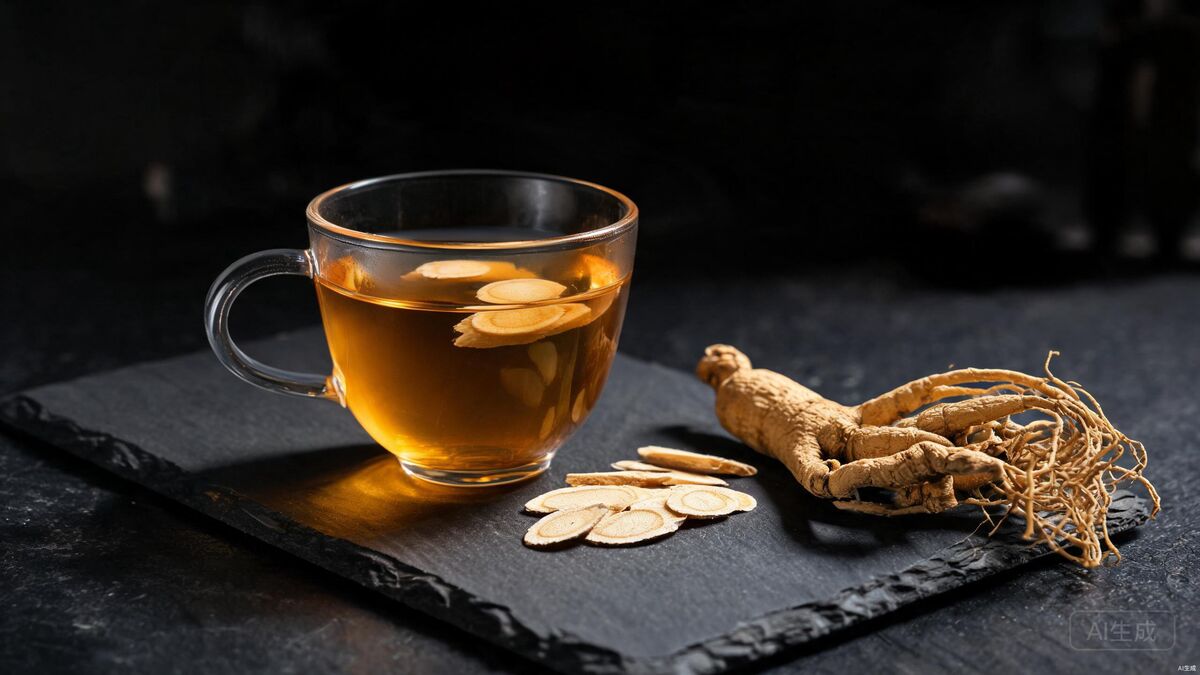
Ginseng tea (人参茶, rénshēn chá or 西洋参茶, xīyángshēn chá) is the most esteemed tonic tea in all of Chinese medicine. Made by steeping thin slices of ginseng root in hot water, it produces a clear, pale-golden drink with a distinctive aroma that is earthy, slightly sweet, and faintly bitter — a flavor the Chinese describe as hui gan, or "returning sweetness," because a pleasant sweet aftertaste lingers after the initial bitterness fades.
Ginseng's reputation is not folk legend but pharmacological reality. The root contains ginsenosides, a group of compounds that modern research has linked to improved energy metabolism, stress adaptation, immune support, and cognitive function. In TCM, however, ginseng is valued for something more specific: it is the most powerful herb for tonifying Qi — the vital energy that powers every function of the body. When Qi is profoundly depleted, whether by severe illness, chronic overwork, aging, or prolonged stress, ginseng is the herb that is turned to first.
What makes ginseng confusing for newcomers is that there are two main types with opposite effects. Asian ginseng (Panax ginseng) is warming and strongly stimulating; American ginseng (Panax quinquefolius) is cooling and gently nourishing. Using the wrong type for your constitution can not only fail to help but can actively make you feel worse. The first and most important step in using ginseng well is understanding this distinction, which the next section explains in detail.
2. Asian Ginseng vs American Ginseng
The two ginsengs are cousins — same plant genus, different species — but in TCM they are classified as opposites in temperature and used for nearly opposite situations. Getting this right is the single most important thing to learn about ginseng.
| Property | Asian Ginseng (亚洲人参/红参) | American Ginseng (西洋参/花旗参) |
|---|---|---|
| Botanical name | Panax ginseng | Panax quinquefolius |
| TCM temperature | Warm (温) | Cool (凉) |
| Core action | Greatly tonifies original Qi and Yang (大补元气); restores pulse and secures collapse (复脉固脱) | Tonifies Qi and nourishes Yin (补气养阴); clears fire and generates fluids (清火生津) |
| Best for | Severe fatigue, cold limbs, pale complexion, shortness of breath, post-illness collapse, Qi and Yang deficiency | Fatigue with dry mouth, thirst, irritability, low-grade heat, Qi and Yin deficiency |
| Best season | Winter, cold weather | Summer, hot weather |
| Strength | Strong, stimulating — use with care | Milder, gentler — safer for regular use |
| Who should avoid | Heat conditions, high blood pressure with heat, excess-type constitutions | Cold-type deficiency with loose stools, damp conditions |
A simple rule of thumb: if you are cold, pale, and deeply exhausted, Asian ginseng is the one to reach for. If you are tired but also dry, thirsty, warm, or irritable, American ginseng is the better and far safer choice. Most modern, overstressed people who run slightly warm or "dry" actually do better with American ginseng, which is why it is the more widely recommended type for everyday use in the West.
3. TCM Properties in Detail
Asian Ginseng (Ren Shen)
Asian ginseng is warm, sweet, and slightly bitter, and enters the Lung, Spleen, and Heart meridians. Its defining action is to greatly tonify the original Qi (大补元气) — the deepest, most fundamental energy of the body, inherited from one's parents and stored in the Kidneys. When original Qi is severely depleted, the body begins to fail: extreme weakness, cold sweats, shortness of breath, a faint pulse, and in extreme cases, a tendency to collapse. Asian ginseng is the emergency herb for this state, and the everyday herb for profound chronic deficiency. It also tonifies Spleen and Lung Qi, generates fluids, and calms the Spirit when exhaustion reaches the Heart.
American Ginseng (Xi Yang Shen)
American ginseng is cool, sweet and slightly bitter, and enters the Heart, Lung, and Kidney meridians. It shares Asian ginseng's Qi-tonifying action but is gentler, and crucially it also nourishes Yin and clears heat while generating fluids. This makes it the right choice when deficiency is accompanied by dryness and heat — the classic pattern of Qi and Yin dual deficiency, which presents as chronic fatigue together with a dry mouth, thirst, low-grade afternoon heat, irritability, and a red tongue with little coating. Because it is cool, it does not cause the internal heat, agitation, or insomnia that Asian ginseng can trigger in warm constitutions.
4. Ingredients List
Ginseng tea is intentionally simple — the root should be the star. Here is the complete ingredient list with amounts and sourcing notes. All ingredients are available on Amazon or iHerb.
| Ingredient | Amount | Notes |
|---|---|---|
| American ginseng slices (西洋参片) | 3 to 5 g (1 to 2 teaspoons of slices) | Available on Amazon and iHerb. Look for Wisconsin-grown or Canadian Ontario-grown roots. Slices are easiest to brew and re-steep. For Asian ginseng, use 1 to 3 g — it is stronger. |
| Water | 250 ml (1 cup) | Filtered or spring water. Ginseng is delicate — never use water at a rolling boil, which destroys some of its active compounds. |
| Honey (蜂蜜) — optional | 1 teaspoon | Any supermarket. Sweetens and harmonizes the bitter notes. Always add AFTER the tea has cooled below 60°C (140°F). |
| Goji berries (枸杞) — optional | 8 to 10 berries | Amazon or iHerb. Nourish Liver and Kidney Yin and support the eyes; a balanced addition to American ginseng. |
| Red dates (红枣) — optional | 2 to 3 pieces, pitted | Amazon or Asian grocery stores. Nourish Blood and Spleen, sweeten the tea, and moderate ginseng's strength — the classic pairing in TCM tonifying formulas. |
5. How to Make Ginseng Tea
There are three traditional ways to prepare ginseng tea. The steeping method is for everyday use, the simmering method is for a stronger medicinal dose, and the sublingual method is the most efficient way to absorb ginseng's active compounds.
Ingredients: 3 to 5 g American ginseng slices (or 1 to 3 g Asian ginseng), 250 ml water just off the boil.
Instructions:
- Rinse the ginseng slices briefly under cool water to remove any dust.
- Place the slices in a thermos, teapot, or mug with a lid.
- Pour 250 ml of water just off the boil (about 90°C / 195°F) over the slices. Do not use a rolling boil.
- Cover tightly and steep for 10 to 15 minutes. The longer steep extracts more of the ginsenosides.
- Drink warm. You can re-steep the same slices 3 to 4 times, adding a little more time to each steep, until the flavor fades. Eat the softened slices at the end for the full benefit — they contain valuable compounds that do not fully dissolve.
Best for: Daily Qi support, gentle recovery from fatigue, and office or travel use — the thermos keeps it warm all morning.
Ingredients: 3 to 5 g American ginseng slices (or 1 to 3 g Asian ginseng), 300 ml water.
Instructions:
- Place the ginseng slices in a small ceramic or glass saucepan (avoid iron or aluminum, which can react with ginseng).
- Add 300 ml of cold water.
- Bring to a gentle simmer over low heat — do not let it reach a hard boil. Simmer for 15 minutes with the lid on.
- Remove from the heat and let it rest for 5 minutes. Strain into a cup.
- Drink warm. The slices can be eaten afterward or re-simmered once more for a second, lighter cup.
Best for: A stronger, more medicinal dose for deeper fatigue or post-illness recovery, when you want maximum extraction of the active compounds.
Ingredients: 1 to 2 thin slices of ginseng (about 1 to 2 g).
Instructions:
- Take 1 to 2 thin slices of good-quality ginseng.
- Place them in your mouth, between the cheek and gum or under the tongue.
- Let them soften slowly, gently chewing now and then to release the juices. Keep the slices in the mouth for 10 to 15 minutes.
- When fully softened, chew thoroughly and swallow. Do not spit them out.
Best for: The most efficient absorption of ginsenosides, which are absorbed directly through the mucous membranes and bypass digestive breakdown. This is the method traditionally favored by the elderly and by those who want maximum effect from a small amount of precious root.
6. Health Benefits and Who It Helps
Ginseng is a powerful tonic, and its benefits are clearest in people who are genuinely depleted. It is not a stimulant like caffeine — it does not create artificial energy — but rather restores the body's own energy reserves. Here are the people it helps most.
- American ginseng (cooling): Tonifies Qi, nourishes Yin, clears fire, and generates fluids. Best for fatigue with dry mouth and thirst, chronic low-grade heat, irritability, dry cough, and the wiped-out feeling after a fever or a hot summer. Ideal for daily use in warm weather and for people who run warm or dry.
- Asian ginseng (warming): Greatly tonifies original Qi, restores the pulse, and secures collapse. Best for severe, deep fatigue, cold limbs, shortness of breath on exertion, pale complexion, weak voice, and recovery from serious illness or surgery. Ideal in winter and for people who run cold and profoundly depleted.
- Chronic fatigue and burnout — the modern pattern of long-term overwork, poor sleep, and stress that leaves you running on empty. A short course of American ginseng is often the right starting point.
- Low immunity and frequent colds — ginseng strengthens the defensive (Wei) Qi, and is traditionally used preventively during cold and flu season.
- Post-illness and post-surgery recovery — to rebuild strength and appetite once the acute phase has passed but energy has not returned.
- High-pressure work and exam periods — to support stamina, concentration, and stress tolerance during intense stretches, without the crash of stimulants.
A note on caffeine: ginseng contains no caffeine, and its energy is not the jittery, short-lived boost of coffee. Instead, it builds the body's underlying capacity to generate and sustain energy. Many people find that replacing a second or third coffee with ginseng tea during a demanding week gives steadier, cleaner stamina.
7. Contraindications and Precautions
Ginseng is a strong herb, and "strong" in TCM means it must be used with discernment. Taking ginseng when it is not appropriate can cause agitation, insomnia, headache, elevated blood pressure, or nosebleeds. Pay close attention to the following cautions.
- Colds, flu, and fever. Do not take ginseng during an active infection with fever. In TCM, tonifying herbs "trap the thief inside" — they strengthen the pathogen along with the body. Wait until the illness has fully cleared before resuming.
- High blood pressure with heat. Asian ginseng, in particular, can raise blood pressure and should be avoided in hypertension with red face, headache, and agitation. American ginseng is gentler but still warrants caution — consult your doctor.
- Excess-heat and excess-fire patterns. A red face, a loud voice, irritability, constipation, and a thick yellow tongue coating are signs of excess, not deficiency. Ginseng tonifies and will feed the excess. It is for deficiency, not for strength.
- Children. Ginseng is generally not given to children unless specifically prescribed, as their Qi is naturally abundant and tonifying it can cause precocious development or agitation.
- Pregnancy and breastfeeding. Not recommended without the explicit guidance of a qualified practitioner. Asian ginseng in particular is contraindicated in pregnancy.
- Insomnia and anxiety. Especially with Asian ginseng, taking it late in the day or in too high a dose can cause or worsen insomnia and agitation. Take ginseng in the morning or early afternoon, and start with a small amount.
- Do not combine with radish, turnip, or strong tea. See the FAQ section for the reason. Coffee and stimulants should also be limited while taking ginseng.
- Do not overuse. More is not better. Long-term high-dose use of Asian ginseng can cause "ginseng abuse syndrome" with insomnia, hypertension, and nervousness. Use in courses of a few weeks with breaks, not indefinitely.
8. Where to Buy Ginseng
Ginseng is widely available online, but quality varies enormously. Here is what to look for and where to find it.
American Ginseng
The best American ginseng is grown in Wisconsin, USA and in Ontario, Canada — these are the two premier growing regions, and their roots are considered the gold standard. On iHerb and Amazon, look for brands such as Prince of Peace, Imperial Elixir, and labels that specifically state "Wisconsin-grown." You can buy it as whole roots, pre-cut slices, or powder; slices are the best choice for tea because they are easy to dose and re-steep. Expect to pay more for genuine Wisconsin ginseng — it is worth it.
Asian Ginseng (Red Ginseng)
The most reputable Asian ginseng comes from Korea, where it is traditionally steamed and dried to produce red ginseng (hong shen). Look for brands like Cheong Kwan Jang (Korea Ginseng Corporation) on Amazon, or visit a Korean or Asian grocery store. Red ginseng is sold as whole roots, sliced "tea" portions, or in extract form. Slices or extract tea bags are the most convenient for everyday brewing.
What to Look For
- Whole roots or pre-cut slices, not powder — powder is easy to adulterate and hard to assess for quality.
- Clear origin labeling — Wisconsin, Ontario, or Korea. Avoid products with vague or no origin.
- Plump, firm slices with visible ring markings — the age and quality of the root show in the dense, concentric rings on each slice.
- A clean, earthy, slightly sweet aroma — no musty, sour, or chemical smell.
- Sealed, light-proof packaging — ginseng loses potency when exposed to air and light. Store at home in a sealed glass jar in a cool, dry place.
Frequently Asked Questions
What is the difference between Asian ginseng and American ginseng?
They are two closely related species with opposite temperatures in TCM. Asian ginseng (Panax ginseng, also sold as red ginseng) is warm in nature and strongly tonifies Qi and Yang — it is used for severe fatigue, cold limbs, pale complexion, and post-illness collapse, and is best taken in winter. American ginseng (Panax quinquefolius, also called Xi Yang Shen or Hua Qi Shen) is cool in nature and tonifies Qi while nourishing Yin and clearing heat — it is used for fatigue with dry mouth, thirst, and irritability, and is better suited to summer and to people who run warm. In short: Asian ginseng warms and strongly boosts; American ginseng cools and gently nourishes. Most modern, warm-running people do better starting with American ginseng.
Can I drink ginseng tea every day?
For most healthy adults, a small daily cup of American ginseng tea (3 to 5 g of slices) for a limited course of 2 to 4 weeks is safe and effective for recovery from fatigue or illness. Asian ginseng is stronger and is best used in shorter courses or only when you are genuinely, deeply deficient. Long-term daily use of either type is not recommended without guidance from a qualified practitioner, as the body can become over-stimulated. A common and sensible approach is to take ginseng for a few weeks, then pause for a week or two before resuming. This cycling lets the body rest and prevents the "ginseng abuse" effects of overuse.
Why should ginseng not be taken with radish or strong tea?
In TCM, radish (both white radish and daikon) strongly moves Qi downward and disperses, which directly counteracts ginseng's Qi-tonifying, upward-lifting action — together they are said to reduce or cancel ginseng's benefit. Strong black or green tea contains tannins that can bind to ginseng's active compounds and reduce their absorption. To get the full effect, avoid radish, turnips, and strong tea on the days you take ginseng. If you do consume them, leave a gap of several hours. Coffee and other stimulants should also be limited while taking ginseng, to avoid overloading the system.
Where can I buy good quality ginseng?
American ginseng is widely available on iHerb and Amazon — look for slices or whole roots from Wisconsin (the premier U.S. growing region) or from Ontario, Canada. Reputable brands include Prince of Peace, Imperial Elixir, and Wisconsin-grown labels. Asian ginseng (red ginseng) is available from Korean brands such as Cheong Kwan Jang, on Amazon, and at Asian grocery stores. Buy whole roots or pre-cut slices rather than powder, which is easy to adulterate and hard to assess. Store your ginseng in a sealed, dry container away from light to preserve its potency.
This article is for educational and informational purposes only and is not a substitute for professional medical advice, diagnosis, or treatment. The herbal teas and practices described here are traditional self-care methods and are not intended to treat, cure, or prevent any disease. Ginseng is a potent herb that can interact with medications including blood thinners, diabetes drugs, antidepressants, and blood pressure medications. Always consult a qualified healthcare provider before beginning any new herbal practice, especially if you are pregnant, nursing, taking medication, or have a medical condition. Never disregard professional medical advice or delay seeking it because of something you have read on this site. Read our full disclaimer →