Key Takeaways
- In TCM, tinnitus is understood through several patterns — the most common being Kidney deficiency (gradual onset, low sound, worse with fatigue), Liver fire (sudden, loud, with irritability), and Phlegm-fire (with ear fullness and dizziness).
- TCM theory states that “the Kidneys open into the ears” — linking auditory wellness to Kidney essence and highlighting why chronic tinnitus is most often associated with Kidney deficiency, especially in older adults.
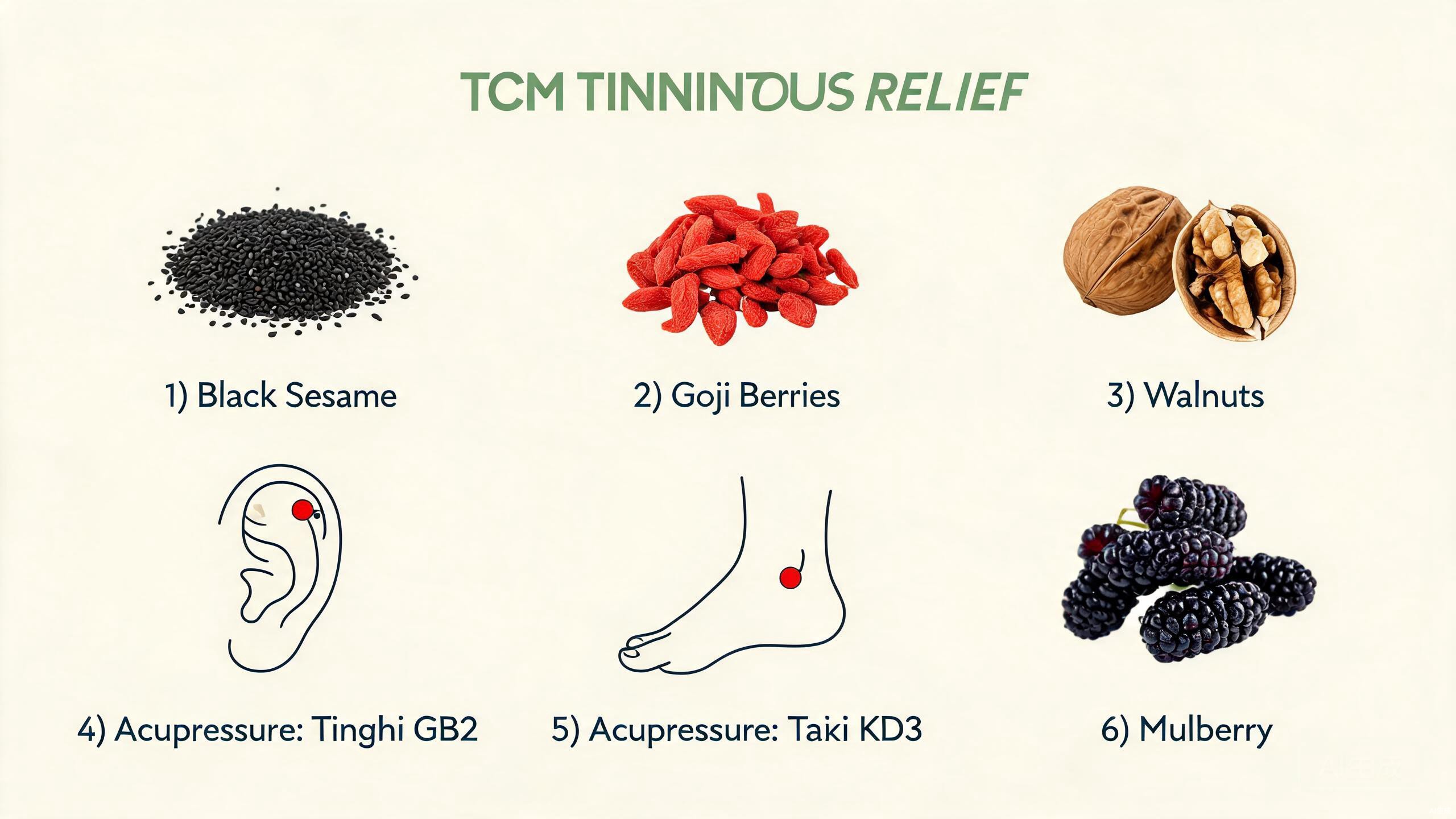
- Eight key acupressure points — TE17 (Yifeng), TE21 (Ermen), GB2 (Tinghui), SI19 (Tinggong), KI3 (Taixi), LR3 (Taichong), GB20 (Fengchi), and DU20 (Baihui) — are traditionally used to support auditory wellness.
- Herbal teas such as chrysanthemum (for Liver fire) and goji berry (for Kidney deficiency) may offer complementary support, depending on the underlying TCM pattern.
- TCM emphasizes managing stress, protecting sleep, avoiding loud noise, and supporting Kidney health through diet and lifestyle as prevention strategies.
- These are complementary wellness practices, not medical treatments. Tinnitus can sometimes indicate serious underlying conditions. Always consult your healthcare provider for diagnosis and treatment. These statements have not been evaluated by the FDA.
This article is for educational purposes only and is not medical advice. The acupressure points, herbal teas, and practices described here are traditional wellness practices rooted in Chinese culture. They are not a substitute for professional medical care, diagnosis, or treatment of tinnitus or any other condition. Tinnitus can be a symptom of serious underlying conditions, including acoustic neuroma, Meniere’s disease, vascular disorders, TMJ disorders, or sudden sensorineural hearing loss. Sudden tinnitus, especially in one ear, requires prompt medical evaluation. Never stop, adjust, or replace prescribed treatment based on information in this article. These statements have not been evaluated by the FDA. This article is not intended to diagnose, treat, cure, or prevent any disease.
Introduction: Tinnitus and the TCM Perspective
Tinnitus — the perception of sound when no external sound is present — affects an estimated 15 to 20 percent of people worldwide. It is commonly described as ringing, buzzing, humming, hissing, or whistling in one or both ears. For some, tinnitus is a mild annoyance that comes and goes. For others, it is a persistent and distressing condition that interferes with concentration, sleep, and emotional well-being. Tinnitus is not a disease itself but a symptom that can arise from many different causes, including noise exposure, age-related hearing loss, earwax buildup, certain medications, cardiovascular conditions, and disorders of the inner ear.
Conventional medicine approaches tinnitus by first identifying and treating any underlying cause. When no treatable cause is found — which is common — management focuses on sound therapy, hearing aids (if hearing loss is present), cognitive behavioral therapy for tinnitus distress, and in some cases, tinnitus retraining therapy. There is currently no universally effective medication or cure for tinnitus.
Traditional Chinese Medicine offers a complementary perspective on tinnitus that dates back over two thousand years. In TCM theory, the ears are closely connected to the Kidneys — the classical texts state that “the Kidneys open into the ears” (肾开窍于耳). This means that the health of the Kidney system, particularly Kidney essence (Jing) and Kidney yin, is considered fundamental to auditory wellness. However, TCM also recognizes that tinnitus can arise from other organ systems and patterns, including Liver fire, Phlegm-fire, and Wind-heat. Understanding which pattern is involved is key to the TCM approach. For an overview of our other tinnitus content, see our article on TCM for tinnitus.
How TCM Understands Tinnitus
To understand how TCM approaches tinnitus, it helps to understand four key concepts: the Kidney-ear connection, Liver fire rising upward, Phlegm-fire obstructing the ears, and Wind-heat invading the exterior. These form the theoretical foundation for the acupressure points, herbal teas, and dietary recommendations described later in this guide.
The Kidney-ear connection: In TCM, the Kidneys are considered the “root of life” and store congenital essence (Jing). The classical texts establish a direct relationship between the Kidneys and the ears: the Kidneys “open into” the ears, meaning that Kidney health is reflected in auditory function. When Kidney essence or Kidney yin is deficient — whether through aging, overwork, chronic illness, or constitutional weakness — the ears may not receive adequate nourishment, and tinnitus may result. This is why chronic, gradual-onset tinnitus in older adults is most commonly attributed to Kidney deficiency in TCM. The Kidney meridian also has a connection to the ear through its relationship with the Triple Energizer meridian, which circles the ear. For more on Kidney health, see our guide on TCM for kidney stones.
Liver fire rising upward: In TCM, the Liver ensures the smooth flow of Qi and stores Blood. When Liver Qi stagnates — often due to emotional stress, frustration, or anger — it can transform into Liver fire, which rises upward toward the head. The ears, being in the upper body, can be affected by this ascending fire. Liver fire tinnitus is typically sudden in onset, loud, and high-pitched, and is often accompanied by irritability, headache, red face, dry mouth, and a bitter taste. This pattern is more common in younger adults and those experiencing significant emotional stress. For more on this mechanism, see our guide on TCM liver qi stagnation and stress.
Phlegm-fire obstructing the ears: When the Spleen’s function of transforming fluids is impaired, dampness accumulates and can transform into phlegm. If phlegm combines with heat, it becomes phlegm-fire, which can obstruct the ears and produce tinnitus. This type is often accompanied by a feeling of fullness or blockage in the ear, dizziness, nausea, and a sticky or greasy feeling in the mouth. The tongue coating is typically thick and greasy. For related conditions, see our guide on TCM for dizziness.
Wind-heat invading: This pattern is associated with acute onset of tinnitus following an upper respiratory infection, cold, or flu. In TCM, external Wind-heat can invade the body through the nose and mouth, affecting the Lung meridian and its associated structures, including the ears. Symptoms include sudden tinnitus, ear fullness, mild hearing reduction, and accompanying cold symptoms such as sore throat, fever, and headache. This pattern is typically short-lived and resolves as the external pathogen is cleared.
Differentiating Tinnitus Types by TCM Pattern
One of the most distinctive aspects of TCM is its emphasis on pattern differentiation — identifying the specific underlying pattern rather than treating all cases of tinnitus the same way. The characteristics of the tinnitus sound itself, the manner of onset, and the accompanying symptoms all provide clues to the pattern. Accurate pattern identification requires a qualified practitioner who examines the tongue, feels the pulse, and takes a detailed history, but the following general guidelines outline the traditional framework.
| Characteristic | Kidney Deficiency | Liver Fire | Phlegm-Fire | Wind-Heat |
|---|---|---|---|---|
| Onset | Gradual, chronic | Sudden | Gradual or intermittent | Sudden, after cold |
| Sound quality | Low-pitched, like cicada chirping | Loud, high-pitched, like ocean waves | Ringing with fullness | Ringing, with ear fullness |
| Volume | Soft to moderate | Loud | Moderate, with pressure | Mild to moderate |
| Worse with | Fatigue, overwork, night, standing | Stress, anger, tension | After heavy meals, damp weather | Cold/flu symptoms |
| Accompanying symptoms | Fatigue, lower back/knee soreness, frequent urination, dizziness | Irritability, headache, red face, bitter taste, dry mouth | Ear fullness, dizziness, nausea, chest tightness | Sore throat, fever, headache, nasal congestion |
| Tongue | Pale, thin coating | Red body, yellow coating | Red body, thick greasy yellow coating | Red tip, thin white or yellow coating |
| Pulse | Deep, thin, weak | Wiry, rapid | Wiry, slippery, rapid | Floating, rapid |
Kidney Deficiency Type: The Most Common Pattern
Kidney deficiency is the most frequently identified pattern for chronic tinnitus in TCM, particularly in adults over 50. This reflects the TCM understanding that Kidney essence naturally declines with age, and that the ears — as the sensory opening of the Kidneys — are among the first structures to show signs of this decline. This pattern aligns with the modern understanding that age-related hearing loss (presbycusis) is the most common cause of tinnitus in older adults.
Characteristics: Kidney deficiency tinnitus is typically gradual in onset, chronic, and low-pitched — often described as a soft chirping like cicadas. The sound may be intermittent or constant and tends to worsen with fatigue, overwork, and at night. Accompanying symptoms may include lower back soreness, knee weakness, dizziness, occasional blurred vision, frequent urination (especially at night), cold extremities (in Kidney yang deficiency) or night sweats and dry mouth (in Kidney yin deficiency). The tongue is typically pale with a thin coating, and the pulse is deep and weak.
TCM approach: Treatment focuses on nourishing Kidney essence and yin (or yang, depending on the presentation). Dietary recommendations include foods that nourish the Kidneys: black sesame seeds, walnuts, goji berries, black beans, and bone broth. Acupressure focuses on Kidney points such as KI3 (Taixi) and points around the ear. Herbal teas with goji berry and cordyceps may support Kidney essence. Stress management and adequate rest are essential, as overwork and exhaustion further deplete Kidney essence. For related wellness guidance, see our TCM stress and anxiety guide.
Liver Fire Type: Sudden and Loud
Liver fire tinnitus is more commonly seen in younger and middle-aged adults, particularly those experiencing significant emotional stress, frustration, or anger. In TCM theory, when Liver Qi stagnates over time, it can transform into fire, which rises upward to disturb the head and ears. This pattern is often acute and intense.
Characteristics: Liver fire tinnitus is typically sudden in onset, loud, and high-pitched — often described as resembling ocean waves or a loud ringing. The sound is usually continuous and may be worse during episodes of stress, anger, or tension. Accompanying symptoms include irritability, easily flared temper, headache (often temporal or pulsing), red face and eyes, bitter taste in the mouth, dry throat, and sometimes constipation or dark urine. The tongue is red with a yellow coating, and the pulse is wiry and rapid.
TCM approach: Treatment focuses on clearing Liver fire, calming the Liver, and promoting the smooth flow of Liver Qi. Dietary recommendations emphasize cooling foods: chrysanthemum tea, celery, mung beans, green leafy vegetables, and avoiding spicy, greasy, and alcohol-containing foods. Acupressure focuses on Liver points such as LR3 (Taichong) and points around the ear. Emotional regulation is essential — stress management, adequate sleep, and practices that promote relaxation are central. For headaches that may accompany this pattern, see our guide on acupressure for headaches and migraines.
Phlegm-Fire Type: Fullness and Dizziness
Phlegm-fire tinnitus occurs when Spleen dysfunction leads to dampness accumulation, which transforms into phlegm and combines with heat. The resulting phlegm-fire obstructs the ears, producing a distinctive pattern of symptoms. This type is often seen in individuals with poor dietary habits (excessive intake of greasy, sweet, or dairy foods) and a sedentary lifestyle.
Characteristics: Phlegm-fire tinnitus is typically accompanied by a feeling of fullness or blockage in the ear, as if something is obstructing it. The sound may be ringing or buzzing, moderate in volume, and may be accompanied by dizziness, vertigo, nausea, chest tightness, and a heavy feeling in the body. The tongue is red with a thick, greasy yellow coating, and the pulse is wiry, slippery, and rapid.
TCM approach: Treatment focuses on clearing heat, transforming phlegm, and opening the orifices. Dietary recommendations emphasize light, easily digestible foods that support the Spleen and resolve dampness: barley, coix seed (in appropriate amounts), winter melon, and warm, cooked vegetables. Avoid greasy, sweet, and dairy-heavy foods that generate dampness. Acupressure focuses on points around the ear and Spleen-supporting points. For related guidance, see our TCM insomnia patterns guide, as phlegm-fire can also disrupt sleep.
Key Acupressure Points for Tinnitus
The following eight points are traditionally used in TCM to support auditory wellness. They include local points around the ear and distal points on the limbs that address the underlying organ patterns. When performing acupressure, use your thumb or fingers to apply firm but comfortable pressure — you should feel a pleasant ache or mild tenderness, never sharp pain. For general safety guidelines, see our acupressure safety guide.
1. Yifeng — TE17 (翳风)
Location: In the depression behind the earlobe, between the mastoid bone (the bony prominence behind the ear) and the angle of the jaw. Technique: Use your index finger or thumb to press firmly into the depression behind the earlobe for 1 to 2 minutes on each side. You can also use gentle circular motions. Traditional benefits: TE17 is one of the most important points for ear-related conditions. It is traditionally used to benefit the ears, disperse wind, and clear heat from the local area. Its location directly behind the ear makes it a primary local point for tinnitus, ear fullness, and ear pain.
2. Ermen — TE21 (耳门)
Location: In the depression just above the front of the ear, at the upper border of the ear opening, in a slight depression when the mouth is slightly open. Technique: Open your mouth slightly to locate the point. Use your index finger to press gently into the depression above the front of the ear for 1 to 2 minutes on each side. Traditional benefits: TE21 is on the Triple Energizer meridian, which circles the ear. It is traditionally used to benefit the ears, clear heat, and reduce fullness and ringing. It is a key local point for tinnitus and ear congestion.
3. Tinghui — GB2 (听会)
Location: In the depression just below the front of the ear, directly below TE21, at the lower border of the ear opening (also best found with the mouth slightly open). Technique: Open your mouth slightly. Use your index finger to press gently into the depression below the front of the ear for 1 to 2 minutes on each side. Traditional benefits: GB2 is on the Gallbladder meridian, which also circles the ear. It is traditionally used to benefit hearing, disperse wind-heat, and address tinnitus, ear fullness, and hearing difficulties. The name “Tinghui” literally means “meeting of hearing.”
4. Tinggong — SI19 (听宫)
Location: In the depression directly in front of the ear opening, between the tragus (the small cartilaginous flap in front of the ear) and the jaw joint. The point is best located with the mouth slightly open. Technique: Open your mouth slightly. Use your index finger to press gently into the depression in front of the ear opening for 1 to 2 minutes on each side. Traditional benefits: SI19 is on the Small Intestine meridian. It is traditionally used to benefit the ears, clear heat, and address tinnitus, hearing impairment, and ear fullness. Together, TE21, GB2, and SI19 form a trio of points that surround the front of the ear opening.
5. Taixi — KI3 (太溪)
Location: In the depression between the inner ankle bone (medial malleolus) and the Achilles tendon, on the inner side of the ankle. Technique: Use your thumb to press gently into the depression behind the inner ankle bone for 1 to 2 minutes on each ankle. Traditional benefits: KI3 is the source point of the Kidney meridian — the point where the Kidney’s deepest energy is said to be accessible. Because the Kidneys “open into the ears,” KI3 is a key distal point for Kidney deficiency tinnitus. It is traditionally used to tonify Kidney yin and yang, nourish essence, and strengthen the lower back and knees.
6. Taichong — LR3 (太冲)
Location: On the top of the foot, in the webbing between the big toe and the second toe, about 1.5 to 2 inches up from the webbing, in the depression between the first and second metatarsal bones. Technique: Use your thumb to press firmly into the point, sliding upward between the bones, for 1 to 2 minutes on each foot. The point is often tender, especially in people with Liver Qi stagnation. Traditional benefits: LR3 is the source point of the Liver meridian and one of the most important points for calming the Liver, clearing Liver fire, and promoting the smooth flow of Liver Qi. It is the primary distal point for Liver fire type tinnitus and is also widely used for stress, headache, and irritability.
7. Fengchi — GB20 (风池)
Location: At the base of the skull, in the depression on either side of the neck, where the neck muscles attach to the skull. To find it, tilt your head slightly forward and feel for the two hollows at the base of the skull, just below the occipital bone. Technique: Use your thumbs to press gently but firmly into the hollows at the base of the skull for 1 to 2 minutes. You can also use a gentle circular motion. Traditional benefits: GB20 is one of the most important points for conditions of the head. It is traditionally used to disperse wind, clear heat, calm the Liver, and benefit the head and senses. It is commonly used for tinnitus, headache, dizziness, neck tension, and cold symptoms.
8. Baihui — DU20 (百会)
Location: At the very top of the head, on the midline, approximately at the intersection of the line connecting the tops of the ears and the midline of the skull. Technique: Use your index or middle finger to press gently on the point at the top of the head for 1 to 2 minutes. You may also use a gentle circular motion. Traditional benefits: DU20 is the highest point on the body’s meridian system and is traditionally used to lift yang energy, calm the mind, and unify the meridians of the head. It is used as a supporting point for tinnitus, headache, dizziness, and conditions involving the head and sensory organs.
| Point | Location | Meridian | Technique | Duration | Primary Traditional Benefit for Tinnitus |
|---|---|---|---|---|---|
| TE17 (Yifeng) | Behind earlobe, in depression between mastoid and jaw | Triple Energizer | Firm finger pressure, circular motion | 1–2 min each side | Primary local point; benefits ears, disperses wind |
| TE21 (Ermen) | Above front of ear, upper border of ear opening | Triple Energizer | Gentle finger pressure (mouth slightly open) | 1–2 min each side | Clears heat, reduces ringing and fullness |
| GB2 (Tinghui) | Below front of ear, lower border of ear opening | Gallbladder | Gentle finger pressure (mouth slightly open) | 1–2 min each side | Benefits hearing, disperses wind-heat |
| SI19 (Tinggong) | In front of ear opening, between tragus and jaw | Small Intestine | Gentle finger pressure (mouth slightly open) | 1–2 min each side | Benefits ears, clears heat, addresses fullness |
| KI3 (Taixi) | Depression behind inner ankle bone | Kidney | Gentle thumb pressure | 1–2 min each ankle | Tonifies Kidney essence; key for Kidney deficiency type |
| LR3 (Taichong) | Top of foot, between big toe and second toe | Liver | Firm thumb pressure, slide upward | 1–2 min each foot | Clears Liver fire; key for Liver fire type |
| GB20 (Fengchi) | Base of skull, hollows on either side of neck | Gallbladder | Gentle thumb pressure, circular motion | 1–2 min | Disperses wind, calms Liver, benefits head and senses |
| DU20 (Baihui) | Top of head, midline | Governing Vessel | Gentle finger pressure, circular motion | 1–2 min | Lifts yang, calms mind, unifies head meridians |
Step-by-Step Acupressure Routine Around the Ear
The following routine combines the eight points into a structured session. It takes approximately 10 to 15 minutes and may be performed once or twice daily. Always wash your hands before beginning, and sit in a comfortable, relaxed position.
Step 1 — Prepare (1 minute). Sit comfortably with your spine straight. Take several slow, deep breaths. Rub your palms together until they feel warm. Place your warm palms gently over both ears for 30 seconds, allowing the warmth to penetrate. This is a traditional practice called “palm warming of the ears” and serves to relax the area and begin encouraging circulation.
Step 2 — TE17 Yifeng (2 minutes). Use your index fingers or thumbs to press firmly into the depression behind each earlobe (TE17). Apply steady pressure with small circular motions for 1 minute on each side, or both sides simultaneously. This is the most important local point for ear wellness.
Step 3 — TE21, GB2, and SI19 trio (3 minutes). Open your mouth slightly. Use your index fingers to press gently on the three points surrounding the front of the ear: TE21 (above the ear opening), GB2 (below the ear opening), and SI19 (in front of the ear opening). Press each point for about 1 minute, or press all three simultaneously by placing your finger along the front of the ear. This trio of points surrounds the ear opening and is traditionally used together for auditory conditions.
Step 4 — GB20 Fengchi (2 minutes). Tilt your head slightly forward. Use your thumbs to press into the hollows at the base of the skull (GB20) on either side of the neck. Apply gentle but firm pressure with small circular motions for 1 to 2 minutes. This point benefits the entire head and is particularly useful when tinnitus is accompanied by neck tension or headache.
Step 5 — DU20 Baihui (1 minute). Use your middle finger to press gently on the point at the very top of the head (DU20). Apply light pressure with slow circular motions for 1 minute. This calms the mind and unifies the energy of the head.
Step 6 — Distal points: KI3 and/or LR3 (2 minutes). If your tinnitus is gradual and worse with fatigue (suggesting Kidney deficiency), press KI3 (behind the inner ankle) for 1 minute on each side. If your tinnitus is sudden and loud with irritability (suggesting Liver fire), press LR3 (between the big toe and second toe on the foot) for 1 minute on each side. You may also press both if you are unsure of the pattern.
Step 7 — Ear massage (1 minute). Gently massage the outer ear with your thumb and index finger, working from the earlobe upward along the outer rim. Then gently press the tragus (the small flap in front of the ear) inward to briefly close the ear opening, and release. Repeat several times. This promotes local circulation and completes the routine.
In TCM, acupressure is most effective when practiced consistently over time, rather than in intense, infrequent sessions. A daily 10-to-15-minute routine is more beneficial than an occasional 60-minute session. Be patient — tinnitus is a complex condition, and acupressure may offer supportive care but is unlikely to provide immediate or complete resolution. If your tinnitus worsens, changes character, or is accompanied by new symptoms, consult your healthcare provider.
Herbal Teas for Tinnitus
In TCM, herbal teas are a gentle way to support the body’s underlying patterns. The choice of herb depends on the pattern identified. The following are traditional teas that may complement the acupressure routine. Always consult your healthcare provider before using herbs, especially if you take medications.
Chrysanthemum tea (Ju Hua Cha, 菊花茶) — for Liver fire type: Chrysanthemum is classified as cool, sweet, and bitter, entering the Lung and Liver channels. It is traditionally used to clear Liver heat, soothe the eyes, and calm the head. For tinnitus associated with Liver fire (sudden, loud, with irritability), chrysanthemum tea may offer complementary support. Steep 5 to 8 dried chrysanthemum flowers in a cup of boiling water for 5 to 8 minutes. Drink 1 to 2 cups daily. For a detailed guide, see our chrysanthemum guide.
Goji berry tea (Gou Qi Zi Cha, 枸杞子茶) — for Kidney deficiency type: Goji berries are sweet and neutral, entering the Liver and Kidney channels. They are traditionally used to nourish Liver Blood and Kidney essence. For tinnitus associated with Kidney deficiency (gradual, low sound, with fatigue), goji berry tea may support the underlying pattern. Steep 10 to 15 goji berries in a cup of hot water for 10 minutes. You may eat the softened berries after drinking the tea. Drink 1 to 2 cups daily. For a detailed guide, see our goji berry guide.
Cordyceps (Dong Chong Xia Cao, 冬虫夏草) — for Kidney deficiency type: Cordyceps is a valued tonic in TCM, classified as sweet and warm, entering the Kidney and Lung channels. It is traditionally used to tonify Kidney yang, nourish Kidney yin, and support essence. For chronic tinnitus associated with Kidney deficiency, cordyceps may be used as a complementary tonic. It is typically brewed in decoction or taken as a supplement. Caution: Cordyceps is expensive and subject to quality and adulteration issues. Consult a qualified practitioner before use.
Magnetite (Ci Shi, 磁石) — traditional use: In classical TCM, magnetite (magnetic iron ore) is sometimes included in formulas for tinnitus and hearing issues, as it is said to “anchor” ascending energy and benefit the ears. However, magnetite is a mineral substance that carries potential toxicity concerns and should only be used under the strict guidance of a qualified practitioner. It is not recommended for self-care.
TCM Dietary Recommendations
Diet plays an important role in TCM’s approach to tinnitus, as the foods you eat directly affect the organ systems involved. The dietary recommendations vary by pattern:
For Kidney deficiency: Emphasize foods that nourish Kidney essence: black sesame seeds, walnuts, goji berries, black beans, dark-colored foods (black rice, black fungus), bone broth, and moderate amounts of seafood. Avoid excessive cold and raw foods, which burden the Spleen and indirectly weaken the Kidneys. Eat warm, cooked meals and avoid eating late at night.
For Liver fire: Emphasize cooling foods that clear heat and soothe the Liver: chrysanthemum tea, celery, mung beans and mung bean soup, cucumber, green leafy vegetables, pear, and watermelon (in season). Avoid spicy foods, alcohol, greasy fried foods, and excessive coffee, all of which generate heat and can exacerbate Liver fire.
For Phlegm-fire: Emphasize foods that support the Spleen and resolve dampness: barley, coix seed (yi yi ren, in appropriate amounts), winter melon, white radish (daikon), and warm, light, easily digestible meals. Avoid dairy, greasy foods, sweets, and cold foods, which generate dampness and phlegm. Eat regular meals and avoid overeating.
Lifestyle Modifications
Beyond acupressure and diet, TCM emphasizes that daily habits are the foundation of wellness. For tinnitus, three lifestyle areas are particularly important: sleep, stress management, and noise protection.
Sleep: In TCM, adequate sleep is essential for Kidney essence conservation and Liver blood replenishment. The Liver is said to be most active in restoring Blood during the hours of 11 PM to 3 AM, making sleep before midnight particularly important. Chronic sleep deprivation is also one of the most common triggers for tinnitus exacerbation in modern medicine. Aim for 7 to 9 hours of quality sleep per night. For comprehensive guidance, see our TCM insomnia patterns guide.
Stress management: Stress and emotional turbulence are primary triggers for Liver Qi stagnation and Liver fire, which can exacerbate tinnitus. TCM recommends practices that promote the smooth flow of Qi: gentle exercise (walking, tai chi, qigong), spending time in nature, open emotional expression, and meditation or breathing exercises. The relationship between stress and tinnitus is well-recognized in modern medicine as well — stress does not cause tinnitus, but it significantly amplifies the perception and distress of tinnitus. See our TCM stress and anxiety guide for more.
Noise management: While TCM does not use the language of decibels and hair cell damage, its principle of protecting the body from external harm translates directly to modern advice about noise exposure. Avoid prolonged exposure to loud noise, use hearing protection in noisy environments, and keep personal audio device volume at safe levels. Noise-induced damage is one of the most preventable causes of tinnitus and hearing loss.
Prevention Strategies
TCM offers several principles for preventing tinnitus or reducing its severity, grounded in the understanding that auditory wellness depends on the health of the whole body:
Support Kidney health throughout life: Since the Kidneys “open into the ears,” conserving Kidney essence is the most important long-term strategy for auditory wellness. This includes avoiding chronic overwork and exhaustion, getting adequate rest, managing stress, and eating foods that nourish the Kidneys (black sesame, walnuts, goji berries) regularly.
Protect from loud noise: The most preventable cause of tinnitus is noise exposure. Use hearing protection at concerts, around loud machinery, and when using power tools. Keep headphone volume moderate.
Manage stress and emotions: Since Liver fire is a common pattern for acute tinnitus, maintaining emotional balance and managing stress helps prevent the Liver Qi stagnation that can lead to fire.
Avoid ototoxic medications when possible: Certain medications, including high-dose aspirin, some antibiotics, and certain chemotherapy drugs, can cause or worsen tinnitus. Always discuss medication side effects with your healthcare provider and never stop prescribed medication without medical guidance.
Maintain cardiovascular health: Cardiovascular health is closely linked to auditory health, as the inner ear depends on a robust blood supply. Regular exercise, a healthy diet, and blood pressure management support both cardiovascular and auditory wellness.
When to See a Doctor: Red Flags
The acupressure points, herbal teas, and practices in this article are complementary wellness traditions, not medical treatments. Tinnitus can sometimes be a symptom of serious underlying conditions that require medical diagnosis and treatment. You should consult a healthcare provider — such as an audiologist, ENT specialist (otolaryngologist), or primary care physician — if you experience any of the following:
- Tinnitus in only one ear (unilateral tinnitus), which requires medical evaluation to rule out serious causes
- Sudden onset of tinnitus, especially if accompanied by sudden hearing loss — this may require urgent treatment
- Pulsatile tinnitus (a rhythmic pulsing or whooshing sound that beats in time with your pulse), which may indicate a vascular issue
- Tinnitus accompanied by dizziness, vertigo, or balance problems, which may indicate Meniere’s disease or other inner ear conditions
- Tinnitus following head trauma or injury
- Tinnitus that is severe, persistent, or worsening over time
- Tinnitus that interferes with sleep, concentration, or emotional well-being
- Tinnitus accompanied by ear pain, drainage, or visible changes in the ear
- Any hearing changes, whether gradual or sudden
A healthcare provider can perform a thorough evaluation, including hearing tests, ear examination, and if necessary, imaging studies, to identify any underlying cause. Some causes of tinnitus — such as earwax impaction, ear infections, or certain medications — can be treated directly. For tinnitus without a treatable cause, modern management options include sound therapy, hearing aids, cognitive behavioral therapy, and tinnitus retraining therapy. If you take medication or have a medical condition, consult your healthcare provider before using herbal teas or beginning any new wellness practice. These statements have not been evaluated by the FDA.
The Bottom Line
Tinnitus is a complex and often frustrating condition that affects millions of people worldwide. Traditional Chinese Medicine offers a complementary perspective that views auditory wellness as deeply connected to the health of the whole body — particularly the Kidneys, Liver, and Spleen. The TCM principle that “the Kidneys open into the ears” provides a framework for understanding why chronic tinnitus is most often associated with Kidney essence decline, while patterns such as Liver fire and Phlegm-fire explain acute and symptomatic presentations.
The eight acupressure points described in this guide — TE17, TE21, GB2, SI19, KI3, LR3, GB20, and DU20 — represent a holistic approach that addresses both local symptoms around the ear and underlying organ patterns through distal points on the limbs. The step-by-step acupressure routine, herbal teas, dietary recommendations, and lifestyle modifications offer a comprehensive framework for complementary self-care.
However, these practices are most effective when used as part of a comprehensive approach that includes professional medical evaluation and treatment. Tinnitus can sometimes signal serious underlying conditions, and any new, changing, or unilateral tinnitus warrants medical attention. The traditions described here are meant to support — never to replace — the care of qualified medical professionals. For continued reading, explore our articles on TCM for tinnitus, TCM for dizziness, and acupressure for headaches and migraines.
Frequently Asked Questions
Can acupressure cure tinnitus?
No, acupressure cannot cure tinnitus. There is currently no universally effective cure for tinnitus in any system of medicine. Acupressure may offer complementary support by promoting relaxation, encouraging local circulation around the ear, and helping manage stress, which is known to exacerbate tinnitus. These are self-care wellness practices rooted in Traditional Chinese Medicine, not medical treatments. Tinnitus should be evaluated by a healthcare professional, as it can sometimes indicate underlying conditions that require medical attention. Acupressure should be used alongside, not as a replacement for, professional care.
What is the TCM view of tinnitus?
In TCM, tinnitus is understood through several patterns. The most common is Kidney deficiency, which TCM associates with gradual onset, low-pitched sounds, and worsening with fatigue. Liver fire pattern presents as sudden, loud, high-pitched ringing with irritability and headache. Phlegm-fire pattern involves fullness in the ear and dizziness. Wind-heat pattern is associated with acute onset following a cold. TCM theory connects the ears to the Kidneys (the Kidneys open into the ears) and to the Triple Energizer, Gallbladder, and Small Intestine meridians that circle the ear.
Which acupressure points are best for tinnitus?
TCM traditionally uses several points around the ear and on distal meridians for tinnitus support. Key points include TE17 (Yifeng) behind the earlobe, TE21 (Ermen) above the front of the ear, GB2 (Tinghui) below the front of the ear, SI19 (Tinggong) in front of the ear opening, KI3 (Taixi) at the inner ankle for Kidney support, LR3 (Taichong) on the foot for Liver fire, GB20 (Fengchi) at the base of the skull, and DU20 (Baihui) at the top of the head. TCM typically uses a combination of local points around the ear and distal points on the limbs.
What herbs or teas may help with tinnitus in TCM?
TCM tradition uses several herbs in tea form for tinnitus support, depending on the underlying pattern. For Kidney deficiency patterns, goji berry tea and cordyceps may be used to nourish Kidney essence. For Liver fire patterns, chrysanthemum tea may help clear heat and soothe the Liver. These should be used as complementary wellness practices, not as medical treatments. Always consult your healthcare provider before using herbs, especially if you take medications, as some herbs may interact with drugs. These statements have not been evaluated by the FDA.
Is tinnitus always a sign of Kidney deficiency in TCM?
No. While Kidney deficiency is the most commonly identified pattern for chronic tinnitus in TCM (because the Kidneys are said to open into the ears), tinnitus can also arise from Liver fire, Phlegm-fire, or Wind-heat patterns. The pattern depends on the characteristics of the tinnitus (sudden vs gradual, loud vs soft, high-pitched vs low-pitched) and accompanying symptoms. A qualified TCM practitioner performs pattern differentiation through examination of the tongue, pulse, and symptoms. Self-diagnosis is not recommended.
When should I see a doctor for tinnitus?
You should see a healthcare provider if your tinnitus occurs in only one ear (unilateral), begins suddenly, is accompanied by dizziness, vertigo, or balance problems, follows head trauma, is pulsatile (beating in rhythm with your pulse), or is accompanied by hearing loss. Seek immediate medical attention if tinnitus begins suddenly with sudden hearing loss, as this may require urgent treatment. Tinnitus can sometimes indicate conditions such as acoustic neuroma, Meniere’s disease, temporomandibular joint (TMJ) disorders, or vascular issues that require medical diagnosis and treatment.
How long does it take for acupressure to help with tinnitus?
Acupressure is not a quick fix for tinnitus. In TCM tradition, consistent daily practice over weeks or months is recommended before assessing results. Some people may notice reduced perception of tinnitus or improved relaxation and sleep relatively quickly, while others may not notice significant changes. Results vary by individual and depend on the underlying pattern, the chronicity of the tinnitus, and overall health. If your tinnitus does not improve or worsens despite consistent practice, consult your healthcare provider for a thorough evaluation.
This article shares traditional wellness practices for educational purposes only. It is not a substitute for medical advice, diagnosis, or treatment. The acupressure points, herbal teas, and practices described here are not intended to diagnose, treat, cure, or prevent any disease, including tinnitus. Tinnitus can be a symptom of serious underlying conditions, including acoustic neuroma, Meniere’s disease, vascular disorders, or sudden sensorineural hearing loss. Sudden tinnitus, especially in one ear, requires prompt medical evaluation. If you take medication or have a medical condition, consult your healthcare provider before using herbal teas or beginning any new wellness practice. Never stop or adjust prescribed treatment without your doctor’s explicit guidance. These statements have not been evaluated by the FDA. This information is provided by The TCM Home for educational purposes and is not intended as medical advice.