Key Takeaways
- In TCM, the spine is the pathway of the Governing Vessel (Du Mai), and back pain often reflects blocked Qi in this vessel and the Bladder meridian that runs parallel to it.
- This routine uses six movements — each taking 2 to 3 minutes — to gently mobilize, stretch, and decompress the entire spine.
- The movements include the spinal wave, cat-cow, torso spirals, side stretches, kidney rub, and hanging forward bend.
- Acupressure points Shenshu (BL23) on the lower back and Weizhong (BL40) behind the knee are integrated to directly relieve spinal pain.
- Practice the full 15-minute routine once or twice daily — morning to loosen, evening to decompress.
The Spine in TCM: The Governor Vessel Pathway
In Traditional Chinese Medicine, the spine is far more than a structural column of bone. It is the central energetic highway of the body — the pathway of the Governing Vessel (Du Mai, 督脉). The Du Mai runs from the tailbone, up the center of the spine, over the crown of the head, and down to the upper lip. It governs all the Yang meridians of the body and is responsible for the strength, alignment, and energetic integrity of the entire back.
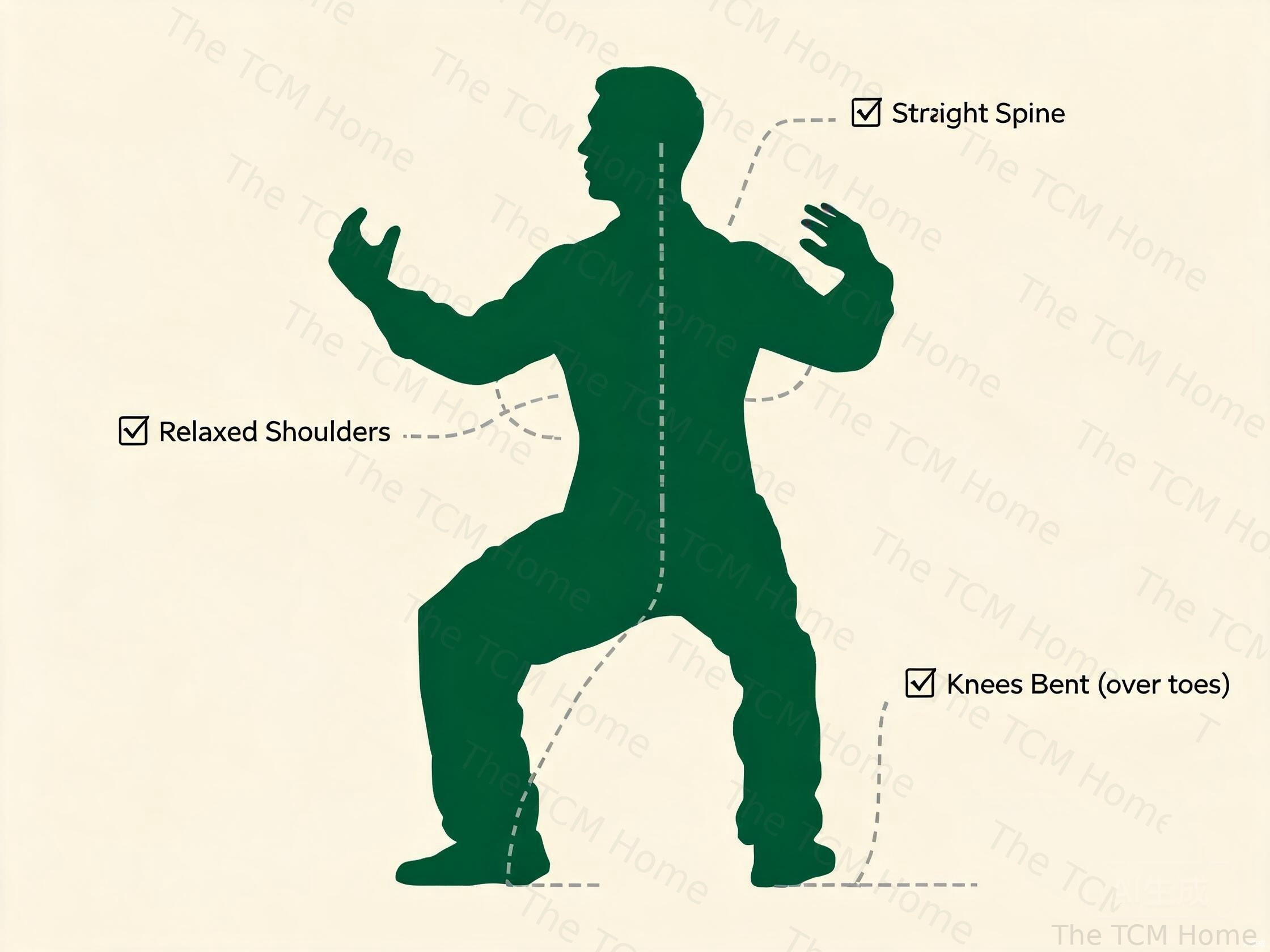
Running parallel to the Governing Vessel, on both sides of the spine, is the Bladder meridian (Zu Tai Yang). This is the longest meridian in the body, containing 67 points on each side. The Bladder meridian's inner branch runs just 1.5 cun (about two finger-widths) from the spine and contains the Back Shu points — powerful points that connect directly to every internal organ. When the Bladder meridian is blocked, pain radiates along the back, and the organs it serves cannot receive adequate Qi.
Back pain in TCM is understood as Qi and Blood stagnation in the local area, often complicated by Kidney deficiency. The Kidney, in TCM theory, governs the bones and marrow — and the lower back is the "house" of the Kidney. Chronic lower back pain is almost always connected to Kidney Qi or Kidney Yin deficiency. This is why the qigong movements that mobilize the spine must be combined with movements and acupressure points that nourish the Kidney.
"Where there is no flow, there is pain. Where there is flow, there is no pain" (不通则痛). The primary goal of this qigong routine is not to strengthen or stretch in the Western sense, but to restore the flow of Qi and Blood through the spine, Governing Vessel, and Bladder meridian. When flow returns, pain diminishes.
Preparation
- Time: 15 minutes. Six movements, 2 to 3 minutes each.
- Posture: Stand with feet shoulder-width apart for most movements. Two movements are performed on the floor on hands and knees.
- Location: A clear space where you can move your arms freely. A yoga mat or carpeted floor for the kneeling movements.
- Mindset: Before beginning, place both hands on your lower back and take three slow breaths. Set the intention: "I am releasing tension from my spine and restoring flow."
- Safety: Move slowly and gently. Never force a stretch. If any movement causes sharp or radiating pain, stop immediately and skip that movement.
The Six Movements: Step-by-Step Guide
1. Spinal Wave (脊柱波浪) — 3 Minutes
Chinese Name: Ji Zhu Bo Lang
Posture: Stand with feet shoulder-width apart. Arms relaxed at your sides.
Movement: This movement creates a wave that travels up the spine from tailbone to crown. Begin by tucking your tailbone under, as if tucking it between your legs. Let the tuck propagate upward — your lower back flattens, then your mid-back rounds, then your upper back softens, and finally your chin tucks toward your chest. The entire spine flexes forward in a smooth wave. Then reverse the wave: release the tailbone backward, let your lower back curve gently, your chest opens, your chin lifts slightly, and the crown of your head rises. The wave flows up and down the spine continuously.
Visual Description: Imagine your spine is a chain of beads, and a wave is passing through each bead one at a time — first forward, then backward. No single vertebra moves alone; each follows the one below it in sequence. The movement is serpentine, smooth, and continuous.
Breathing: Exhale as the spine flexes forward (rounding). Inhale as it extends backward (opening).
Intention (Yi): As the wave moves up your spine, visualize warm, golden light — the Qi of the Governing Vessel — flowing from your tailbone up to your crown. As the wave moves down, visualize the light returning, carrying away tension and stagnation.
Duration: 3 minutes (approximately 12 to 15 wave cycles).
The spinal wave mobilizes every vertebra individually, decompressing the discs and restoring mobility to segments that have become rigid. It directly stimulates the Governing Vessel and the Bladder meridian points along the spine, restoring Qi flow through the body's central energetic highway.
2. Cat and Cow Spinal Mobilization (猫牛式) — 2 Minutes
Chinese Name: Mao Niu Shi
Posture: Come to the floor on hands and knees. Hands directly under shoulders, knees directly under hips, spine neutral.
Movement: Inhale and drop your belly toward the floor, lift your chest forward and up, and tilt your tailbone toward the ceiling. This is the "cow" position — the spine extends and opens. Then exhale and reverse: arch your back toward the ceiling like an angry cat, tuck your chin to your chest, and draw your navel strongly inward. Alternate between cow (extended) and cat (flexed) with each breath.
Visual Description: The spine alternates between a deep U-curve (belly down, chest up) and a deep arch (belly up, back rounded). The movement is driven by the tailbone — it leads each transition, and the rest of the spine follows.
Breathing: Inhale into the cow position. Exhale into the cat position.
Duration: 2 minutes (approximately 10 to 12 cycles).
3. Torso Spirals (拧腰转脊) — 3 Minutes
Chinese Name: Ning Yao Zhuan Ji
Posture: Stand with feet shoulder-width apart, slightly wider than usual. Arms relaxed at your sides.
Movement: Slowly twist your entire torso to the right, letting your arms swing loosely. Your right arm swings behind you and your left arm swings across the front of your body. The twist originates from the waist — the hips stay relatively still while the torso rotates. Allow the momentum to carry you back through center and then twist to the left, arms swinging to the opposite sides. The arms are completely passive — they are whipped around by the torso's rotation like rags on a spinning wheel.
Visual Description: Your torso is a washing machine agitator, rotating left and right. Your arms are towels caught in the spin, flopping loosely. The twisting wrings out the spine like wringing a wet towel — squeezing out stagnation from the deep muscles along the vertebrae.
Breathing: Exhale as you twist to each side. Inhale as you pass through center.
Intention (Yi): With each twist, imagine you are wringing stagnant Qi out of the muscles alongside your spine — the erector spinae and the deep rotatores. The Bladder meridian points along the spine are being massured by the rotation of the vertebrae.
Duration: 3 minutes (approximately 20 to 25 twists per side).
4. Side Spine Stretch (侧展脊柱) — 2 Minutes
Chinese Name: Ce Zhan Ji Zhu
Posture: Stand with feet shoulder-width apart. Raise your right arm overhead.
Movement: Reach your right hand up toward the ceiling and then slowly bend your entire upper body to the left, reaching the right arm over and to the left. You should feel a deep stretch along the entire right side of your torso — from the hip, through the ribs, to the armpit. This stretches the quadratus lumborum and the intercostal muscles along the side of the spine. Hold the stretch for 5 seconds, then slowly return to center. Switch to the left arm and bend to the right.
Visual Description: Your body forms a C-curve, with the top arm reaching over your head like a bow being drawn. The opposite hip stays grounded, anchoring the stretch. The side of your body that is being stretched opens like an accordion expanding.
Breathing: Inhale as you reach up. Exhale as you bend to the side. Breathe normally during the hold.
Duration: 2 minutes (5 stretches per side, held for 5 seconds each).
5. Kidney Rub and Tap (擦肾叩腰) — 2 Minutes
Chinese Name: Ca Shen Kou Yao
Posture: Stand with feet shoulder-width apart. Bring both hands to your lower back, placing the backs of your hands over the kidney area (on either side of the spine, at waist level).
Movement: Briskly rub the backs of your hands up and down over your lower back, creating friction and warmth. Rub until the skin feels warm — about 30 seconds. Then make loose fists with both hands and lightly tap the lower back with the backs of your fists, alternating left and right. The tapping should be firm but not painful — like a gentle percussion massage. Continue tapping for about 90 seconds.
Visual Description: Your fists are like two small hammers, drumming a steady rhythm on your lower back. The area being tapped corresponds to the Shenshu (BL23) acupressure points on both sides of the spine.
Breathing: Natural breathing throughout. No need to coordinate with the tapping.
Intention (Yi): The warmth and percussion stimulate the Kidney organ system, which in TCM governs the bones, marrow, and lower back. Direct your attention to the lower back and imagine warm, dark blue energy (the color of the Kidney/Water element) being absorbed into the kidneys with each tap, strengthening them.
Duration: 2 minutes (30 seconds rubbing, 90 seconds tapping).
6. Hanging Forward Bend (前屈松脊) — 3 Minutes
Chinese Name: Qian Qu Song Ji
Posture: Stand with feet shoulder-width apart.
Movement: Slowly bend forward from the waist, letting your arms, head, and torso hang loosely toward the floor. Do not try to touch the floor — just let everything hang. Your knees should be soft and slightly bent. Allow the weight of your upper body to gently traction the spine, creating space between the vertebrae. Let your head and arms dangle completely. Breathe deeply into your lower back, feeling it expand and release with each breath. After 2 minutes of hanging, slowly roll up vertebra by vertebra — stacking each one on top of the one below, head coming up last.
Visual Description: Your body is like a ragdoll, completely relaxed and folded forward. The spine lengthens downward, and gravity gently pulls the vertebrae apart, creating decompression. Rolling back up is like stacking coins — each vertebra is placed carefully on the last.
Breathing: Deep, slow breathing throughout. Inhale into the lower back. Exhale and feel the back release further.
Intention (Yi): This movement stretches the entire Bladder meridian, which runs from the inner eye, over the top of the head, down the back, through the hamstrings, to the little toe. As you hang, visualize a line of light traveling down this entire pathway, releasing every point of congestion. The forward bend also opens the Weizhong (BL40) point at the back of the knee.
Duration: 3 minutes (2 minutes hanging, 1 minute rolling up slowly).
Combining With Acupressure: BL23 and BL40
The qigong movements above open the spine and restore Qi flow, but you can amplify their effect by pressing two key acupressure points immediately after the routine. In TCM, these two points are considered the master points for back pain.
Shenshu (BL23) — Kidney Shu Point
Location: On the lower back, 1.5 cun (about two finger-widths) lateral to the lower border of the spinous process of the second lumbar vertebra (L2). To find it practically: place your hands on your waist with thumbs pointing backward. Your thumbs will naturally rest near BL23 on both sides.
How to Press: Reach behind you with both hands and press your thumbs firmly into the points on both sides simultaneously. Alternatively, have a partner press for you, or lie on your back and place two tennis balls under these points.
Effect: BL23 is the Back Shu point of the Kidney. It tonifies Kidney Qi and Yang, strengthens the lower back, and benefits the bones. Since the Kidney governs the lower back in TCM, this point is the primary treatment for chronic lower back pain, weakness, and stiffness. Press for 1 to 2 minutes with firm, circular pressure.
Weizhong (BL40) — Command Point of the Back
Location: At the midpoint of the transverse crease on the back of the knee, in the popliteal fossa. The point lies in the soft depression at the center of the back of the knee when the leg is slightly bent.
How to Press: Sit on a chair and cross one ankle over the opposite knee. Use your thumb to press firmly into BL40 on the bent leg. You should feel a strong, slightly achy sensation. Hold for 1 minute per leg.
Effect: The famous TCM saying "For all pain in the lower back, use Weizhong" (腰背委中求) captures its power. BL40 is the "command point of the back" — it relieves pain throughout the entire spine, especially acute lower back strain, sciatica, and stiffness. It also clears heat and promotes the movement of Blood in the lower back.
For maximum benefit, practice the 15-minute qigong routine first, then spend 5 minutes pressing BL23 (2 minutes) and BL40 (3 minutes — 1.5 minutes per leg). The total routine takes 20 minutes and addresses back pain from both the movement and pressure angles.
TCM Benefits of This Routine
- Restores Qi Flow in the Governing Vessel (通督脉): The spinal wave and torso spirals directly mobilize the Du Mai, clearing stagnation from the body's central Yang pathway.
- Opens the Bladder Meridian (舒膀胱经): The hanging forward bend stretches the entire Bladder meridian from head to toe, releasing the 67 points along its course.
- Tonifies the Kidney (补肾气): The kidney rub and BL23 acupressure strengthen the organ system that governs the bones and lower back in TCM.
- Decompresses the Spine: The cat-cow, spinal wave, and hanging bend create intervertebral space, relieving pressure on discs and nerves.
- Releases the Deep Spinal Muscles: The torso spirals wring out the deep rotator muscles that conventional stretching cannot reach.
Frequently Asked Questions
Can qigong cure chronic back pain?
Qigong cannot cure all types of back pain, but regular practice can significantly reduce chronic lower back pain for many people. Clinical studies have shown that qigong is as effective as conventional physical therapy for chronic lower back pain in some populations. The gentle, flowing movements restore mobility and circulation without the impact forces that can aggravate spinal conditions. However, results depend on the cause of the pain, consistency of practice, and individual factors. Always consult a healthcare provider for proper diagnosis before starting any exercise program for back pain.
Which acupressure points work best with qigong for back pain?
The two most effective points are Shenshu (BL23), located on the lower back beside the second lumbar vertebra, and Weizhong (BL40), located at the center of the back of the knee crease. BL23 tonifies the Kidney, which governs the bones and lower back in TCM, making it the primary point for chronic lower back weakness. BL40 is called the "command point of the back" and is famous for relieving acute and chronic pain throughout the entire spine. Pressing both points after the qigong routine creates a powerful synergy between movement and acupressure.
Is the spinal wave movement safe for herniated discs?
The spinal wave should be performed very gently if you have a herniated disc. Never force the wave into a painful range — keep the amplitude small and the movement slow. If any movement causes sharp, radiating, or electric pain that travels down the leg (a sign of nerve compression), stop immediately and skip that movement. The cat-cow and side stretches are generally safer for disc issues. Always consult a physical therapist or doctor to determine which movements are safe for your specific condition before continuing.
How often should I practice this back pain routine?
Practice this 15-minute routine once or twice daily. Morning practice loosens the spine after a night of stillness and prepares the back for the day's activities. Evening practice releases the day's accumulated tension and decompresses the spine before sleep. For acute flare-ups, practice gently twice daily. For maintenance once the pain has subsided, once daily is sufficient. Consistency is more important than duration — 15 minutes every day will produce better results than an hour once a week.
This article is for educational purposes only and does not constitute medical advice. Educational content only. Not medical advice. Back pain can have many causes, including herniated discs, spinal stenosis, kidney infections, and other serious conditions that require medical diagnosis and treatment. Always consult a qualified healthcare provider before beginning any exercise program for back pain. If you experience severe pain, numbness, weakness in the legs, or loss of bladder or bowel control, seek emergency medical care immediately.
Related Guides
Qigong for Stress Relief: 10-Min Reset
Five simple qigong movements to relieve stress, soothe the liver, open the chest, and calm the nervous system.
Standing Meditation (Zhan Zhuang)
The hidden power of stillness — how standing meditation builds internal Qi and structural strength.
Acupressure for Neck & Shoulder Pain
Learn the most effective acupressure points to release tension and relieve pain in the neck and shoulders.
TCM Approaches to Back Pain
A comprehensive guide to treating back pain with Traditional Chinese Medicine — acupressure, qigong, food therapy, and herbal tea.