Key Takeaways
- In TCM, cold-type menstrual pain (cold uterus) is caused by cold invading the uterus or kidney yang deficiency, resulting in blood stagnation that produces sharp, cramping pain relieved by warmth.
- Moxibustion on Sanyinjiao (SP6), Guanyuan (CV4), and Qihai (CV6) warms the uterus, promotes blood circulation, and resolves cold-type menstrual cramps.
- Begin moxibustion 3 to 5 days before the expected period and continue during menstruation if cramps persist, for cold-type pain only.
- Combining moxibustion with ginger and brown sugar tea enhances the warming effect and helps dispel cold from the uterus.
- Moxibustion is contraindicated for heat-type menstrual pain (bright red blood, relieved by cold) and during pregnancy. Always confirm your pattern before treating.
Understanding Cold Uterus in TCM
In Traditional Chinese Medicine, the concept of cold uterus (han gong) is one of the most important diagnostic patterns for menstrual disorders. The uterus in TCM is not just a physical organ but an energetic space where blood must flow freely and warmly for healthy menstruation. When cold invades the uterus, whether from external cold exposure, consumption of cold foods and drinks, or underlying yang deficiency, the blood congeals and stagnates. In TCM theory, cold causes contraction and stagnation, and when blood stagnates in the uterus, pain results.
Cold-type menstrual pain is characterized by cramps that are relieved by the application of warmth, such as a heating pad or hot water bottle on the lower abdomen. The menstrual blood is often dark in color with visible clots. The pain may worsen with cold drinks, cold weather, or immersion in cold water. This is in contrast to heat-type menstrual pain, which is characterized by bright red blood, a feeling of heat, and pain that is worsened by warmth.
Recognizing Cold-Type Menstrual Pain
Before using moxibustion for menstrual pain, it is essential to determine whether your cramps are the cold type. Moxibustion is a warming therapy and is only effective, and safe, for cold-type menstrual pain. Using moxa on heat-type pain will make it worse.
Signs of Cold-Type Menstrual Pain
- Cramping pain that is relieved by a heating pad or warm water bottle on the abdomen
- Menstrual blood that is dark, purplish, or contains dark clots
- Pain that worsens with cold drinks, cold weather, or cold-water swimming
- A feeling of coldness in the lower abdomen, especially before and during the period
- Lower back that feels cold and achy during the period
- A pale or purplish tongue, possibly with a white coating
- Menstrual flow that improves after the clots are passed
Signs of Heat-Type Menstrual Pain (Do Not Use Moxa)
- Pain that is burning in nature and worsened by heat
- Bright red menstrual blood that flows freely
- Feeling of heat in the body, possibly with thirst
- A red tongue with a yellow coating
- Relief from cold drinks or cool applications
Do not use moxibustion for menstrual pain if your symptoms indicate heat-type pain (bright red blood, burning pain worsened by heat). If you are unsure whether your menstrual pain is cold or heat type, consult a qualified TCM practitioner for proper diagnosis before beginning self-treatment. Using moxa on the wrong pattern can worsen your symptoms.
Key Acupoints for Menstrual Pain
Three acupoints are particularly effective for cold-type menstrual pain. Together, they warm the uterus, promote blood circulation, and regulate the menstrual cycle.
Sanyinjiao (SP6) - The Gynecological Point
Location: On the inner side of the lower leg, four finger-widths above the highest point of the inner ankle bone, just behind the shinbone. There is often a slight tenderness at this point.
Benefits: Sanyinjiao is the most important acupoint in TCM for women's health. The name means three yin intersection, because it is the meeting point of three yin meridians: the spleen, kidney, and liver. This point regulates menstruation, tonifies blood, resolves blood stasis, and warms the lower abdomen. It is effective for menstrual cramps, irregular periods, and PMS symptoms. Moxibustion here has a direct warming and regulating effect on the uterus.
Duration: 10 minutes per leg.
Guanyuan (CV4) - The Uterus Warmer
Location: On the midline of the lower abdomen, three finger-widths below the navel.
Benefits: Guanyuan is the primary point for warming the uterus and tonifying kidney yang. It is considered the front gate to the uterus in TCM. Moxibustion here warms the uterus directly, dispels cold, promotes blood circulation in the lower abdomen, and relieves menstrual cramps. It is also used to support fertility and reproductive health. For cold-type menstrual pain, this is the most important abdominal point to treat.
Duration: 10 to 15 minutes.
Qihai (CV6) - The Qi Tonic
Location: On the midline of the lower abdomen, one and a half finger-widths below the navel. It is very close to Guanyuan, just slightly above it.
Benefits: Qihai means sea of qi, reflecting its role as a major point for tonifying the body's qi. For menstrual pain, it works synergistically with Guanyuan to warm the lower abdomen and promote the smooth flow of qi and blood. In TCM theory, where qi goes, blood follows, so tonifying qi at Qihai helps move stagnant blood in the uterus.
Duration: 10 minutes.
Technique and Treatment Protocol
The technique for menstrual pain focuses on deep, sustained warmth to the lower abdomen and the legs. The moxa stick method is the most practical for home use.
Step-by-Step Session Guide
1. Treat Sanyinjiao (SP6): Sit comfortably. Apply moxa to SP6 on each leg for 10 minutes per side. Use sparrow-pecking or circular motions. This point is easily accessible and is a good starting point. The warming effect here begins to regulate the uterus even before you treat the abdomen.
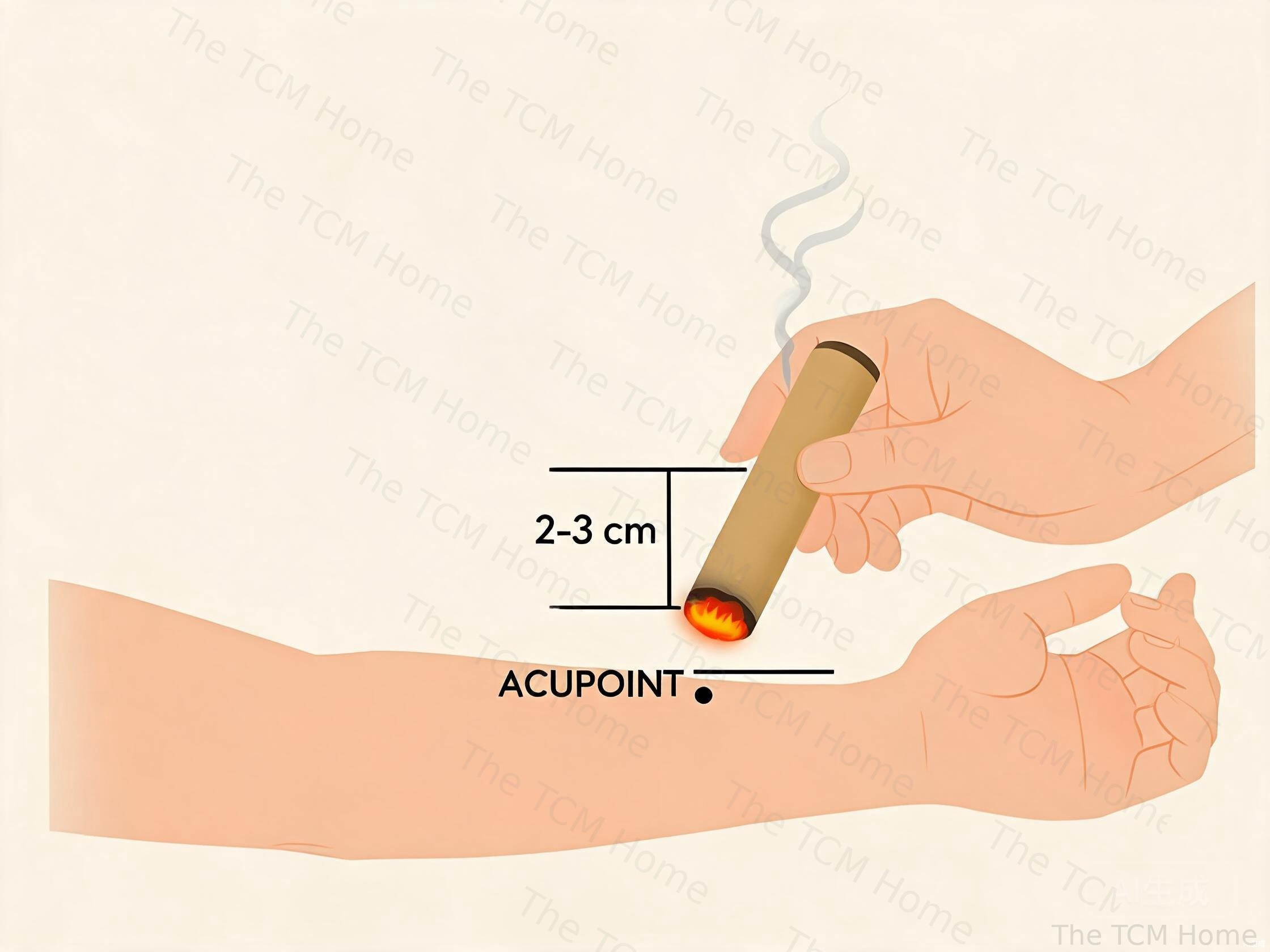
2. Treat Guanyuan (CV4): Lie on your back. Hold the moxa stick 2 to 3 cm above the point, three finger-widths below your navel. Use gentle circular motions for 10 to 15 minutes. You should feel a deep, penetrating warmth spreading through your lower abdomen.
3. Treat Qihai (CV6): Move the moxa stick slightly upward to Qihai, one and a half finger-widths below the navel. Continue for 10 minutes. The combined warmth from CV4 and CV6 creates a broad warming zone over the uterus and lower abdomen.
4. For lower back coldness: If you experience cold lower back pain during your period, have a partner apply moxa to the lower back (lumbar and sacral area) for 10 to 15 minutes using circular motions. Common points include Shenshu (BL23) and Ciliao (BL32).
Never use moxibustion on abdominal points during pregnancy, as it can stimulate uterine contractions. Always maintain proper distance from the skin and keep the moxa moving. Have water nearby for extinguishing. If you experience dizziness, nausea, or excessive heat, stop immediately. Do not use moxibustion if you have a fever or suspect pregnancy.
Timing: When to Start Treatment
Timing is crucial for effective menstrual pain treatment with moxibustion. The goal is to warm the uterus and improve blood circulation before the period begins, preventing the stagnation that causes pain.
Pre-Menstrual Phase (3 to 5 days before period)
Begin moxibustion 3 to 5 days before your expected menstrual period. Treat SP6, CV4, and CV6 daily during this window. This pre-treatment warms the uterus and promotes blood circulation before the period starts, significantly reducing the severity of cramps. Many women find that this pre-treatment alone prevents or greatly reduces menstrual pain.
During Menstruation
If cramps occur despite pre-treatment, continue moxibustion on the same points during the period. The warming effect helps move stagnant blood and relieve active cramping. Apply moxa for 10 to 15 minutes on the lower abdomen at the first sign of cramps. Drinking warm ginger and brown sugar tea immediately after moxibustion enhances the pain-relieving effect.
Between Periods (Maintenance)
For women with chronic cold-type menstrual pain, regular maintenance moxibustion on SP6 and CV4 between periods, 2 to 3 times per week, helps build warmth in the uterus and reduce the severity of future periods. This is especially important during the autumn and winter months when cold is more likely to invade the body.
Combining with Ginger Tea and Warming Foods
Dietary therapy is inseparable from moxibustion for menstrual pain. The combination of internal warming (food and drink) and external warming (moxa) is far more effective than either alone.
Ginger, Brown Sugar, and Date Tea
This is a classic TCM remedy for cold-type menstrual pain. Boil 3 to 4 slices of fresh ginger, 1 tablespoon of brown sugar, and 3 to 5 Chinese dates (jujube) in 2 cups of water for 10 minutes. Drink it warm. The ginger warms the stomach and uterus, the brown sugar invigorates blood and provides warmth, and the dates nourish blood. Drink this tea once daily starting 3 days before the period and during the first 2 days of menstruation. It pairs perfectly with moxibustion, consumed immediately after a moxa session.
Foods to Avoid Before and During Your Period
- Ice-cold drinks and ice cream
- Raw vegetables and salads
- Watermelon, cucumber, and other cooling fruits
- Excessive iced or cold beverages
- Swimming in cold water or sitting on cold surfaces
Lifestyle Precautions
During the pre-menstrual phase and the first few days of your period, take extra care to keep your lower abdomen and lower back warm. Avoid exposure to cold wind, cold water, and air conditioning blowing directly on your body. Wear layers, especially around the waist and abdomen. These precautions, combined with moxibustion, help prevent cold from entering or worsening the condition.
The most effective protocol for cold-type menstrual pain is: (1) drink a cup of warm ginger, brown sugar, and date tea, (2) perform moxibustion on SP6 for 10 minutes per leg and CV4 and CV6 for 10 to 15 minutes each on the lower abdomen, (3) rest with a warm water bottle on your lower back for 30 minutes. Begin this routine 3 to 5 days before your expected period and continue during the first 2 days of menstruation if needed.
What to Expect and When to Seek Help
Most women with cold-type menstrual pain notice significant improvement after the first or second moxibustion session. The cramping may be less intense, shorter in duration, and accompanied by less clotting. Over the course of 2 to 3 menstrual cycles of consistent pre-treatment, many women experience a dramatic reduction in menstrual pain.
If your menstrual pain is severe enough to interfere with daily activities, is accompanied by heavy bleeding, or does not respond to moxibustion after 2 to 3 cycles, consult a qualified TCM practitioner and your healthcare provider. Severe menstrual pain can be a sign of underlying conditions such as endometriosis, fibroids, or pelvic inflammatory disease, which require proper medical diagnosis and treatment. Moxibustion can be a complementary therapy alongside conventional treatment, but it should not replace medical evaluation for severe or persistent symptoms.
Frequently Asked Questions
Can I use moxibustion during my period for menstrual cramps?
Yes, if your cramps are the cold type, meaning they are relieved by warmth and accompanied by dark clotted menstrual blood. Begin moxibustion 3 to 5 days before your expected period on Guanyuan (CV4) and Sanyinjiao (SP6). Continue during the period if cramps persist. However, if your cramps are heat-type, relieved by cold with bright red blood, moxibustion is contraindicated and will worsen symptoms.
How long before my period should I start moxibustion?
Begin moxibustion 3 to 5 days before your expected menstrual period. This allows time to warm the uterus and improve blood circulation before the period begins, which can significantly reduce the severity of cramps. For best results, maintain regular moxibustion on Sanyinjiao (SP6) and Guanyuan (CV4) throughout the month, 2 to 3 times per week.
Which acupoints are best for menstrual pain?
The three primary points are Sanyinjiao (SP6) on the inner leg, the most important gynecological point in TCM; Guanyuan (CV4) on the lower abdomen, which warms the uterus; and Qihai (CV6) just below the navel, which tonifies qi and warms the lower abdomen. Treat all three for comprehensive relief of cold-type menstrual pain.
Can moxibustion help with irregular periods?
Moxibustion may help regulate menstrual cycles when the irregularity is caused by cold in the uterus or blood stagnation due to cold. Regular moxibustion on Sanyinjiao (SP6) and Guanyuan (CV4) can warm the uterus, improve blood circulation, and help establish a more regular cycle. However, irregular periods have many causes, and you should consult a qualified TCM practitioner for proper diagnosis and treatment.
This article is for educational and informational purposes only and is not a substitute for professional medical advice, diagnosis, or treatment. Always consult a qualified healthcare provider before beginning any new wellness practice, especially if you are pregnant, nursing, taking medication, or have a medical condition. Read our full disclaimer →