Key Takeaways
- Cold hands and feet in TCM usually reflect kidney yang deficiency or spleen yang deficiency, where the body cannot generate or circulate enough warmth to the extremities.
- Moxibustion on Yongquan (KD1), Zusanli (ST36), and Guanyuan (CV4) warms yang qi from the ground up and improves peripheral circulation.
- A complete session takes 25 to 35 minutes, treating all three points, performed daily for acute coldness and 2 to 3 times per week for chronic conditions.
- Combining moxibustion with mugwort foot soaks, warming foods, and physical movement significantly enhances results.
- Moxibustion is not appropriate for cold extremities caused by yin deficiency heat or certain vascular conditions. Consult a practitioner if symptoms persist.
Why Do My Hands and Feet Always Feel Cold?
Cold hands and feet are one of the most common complaints in TCM practice, especially among women and older adults. In conventional medicine, cold extremities are often dismissed as a minor issue unless they are associated with a specific condition like Raynaud syndrome or hypothyroidism. In Traditional Chinese Medicine, however, persistently cold hands and feet are viewed as a meaningful signal that the body's warming and circulatory systems are not functioning optimally.
In TCM theory, the warmth of the body is maintained by yang qi, particularly kidney yang and spleen yang. Kidney yang is often compared to the pilot light of a furnace, the fundamental source of heat for the entire body. Spleen yang is like the circulatory system that distributes that heat. When either of these is deficient, the body prioritizes keeping the core warm at the expense of the extremities, resulting in cold hands and feet that may be slow to warm even in a warm environment.
The TCM Pattern: Yang Deficiency and Cold Limbs
Cold extremities in TCM are most commonly associated with two related patterns: kidney yang deficiency and spleen yang deficiency. Understanding which pattern you have helps guide your moxibustion treatment.
Kidney Yang Deficiency
The kidneys are the root of yang in the body. When kidney yang is deficient, the body's fundamental heat source is diminished. Symptoms include cold hands and feet (especially cold from the knees down and elbows down), lower back that feels cold and weak, frequent clear urination, especially at night, low energy, decreased libido, and a pale complexion. The tongue is typically pale and swollen with a white coating, and the pulse is deep and weak, especially in the rear positions.
Spleen Yang Deficiency
The spleen is responsible for transforming food into qi and blood and transporting these nutrients throughout the body. When spleen yang is deficient, even if the kidneys produce adequate heat, the warmth cannot be properly distributed. Symptoms include cold hands and feet accompanied by digestive weakness, bloating after eating, loose stools, fatigue after meals, and a tendency toward edema. The tongue is pale with teeth marks along the edges, and the pulse is weak.
If your cold extremities are accompanied by digestive symptoms like bloating and loose stools, spleen yang deficiency is likely the primary issue. If they are accompanied by lower back coldness, frequent urination, and low energy, kidney yang deficiency is more likely. Many people have a combination of both, which is very common and responds well to moxibustion on points that address both organs.
Key Acupoints for Cold Hands and Feet
Three acupoints form the core treatment for cold extremities. Each works on a different level of the warming process, from drawing yang qi to the lowest point of the body to tonifying the root source of heat.
Yongquan (KD1) - The Sole Warming Point
Location: On the sole of the foot, in the depression that forms when the toes are curled downward. It is approximately in the front third of the foot, between the second and third toe pads.
Benefits: Yongquan is the lowest point on the body and the starting point of the kidney meridian. It is the only point on the sole of the foot used in traditional practice. Moxibustion here is uniquely powerful for cold feet because it brings yang qi directly to the lowest extremity, warming from the ground up. In TCM theory, this point also helps anchor ascending yang that may be causing upper body heat while the lower body remains cold.
Duration: 10 minutes per foot.
Zusanli (ST36) - The Circulation Booster
Location: Four finger-widths below the kneecap, one finger-width to the outside of the shinbone. There is often a slight depression and mild tenderness at this point.
Benefits: Zusanli is the most important point in TCM for strengthening spleen qi and improving overall circulation. For cold extremities, it serves a dual purpose: it tonifies the spleen to improve distribution of warmth, and it strengthens the overall yang qi of the body. Regular moxibustion on Zusanli is one of the most traditional longevity practices in Chinese medicine.
Duration: 5 to 10 minutes per leg.
Guanyuan (CV4) - The Kidney Yang Tonic
Location: On the midline of the lower abdomen, three finger-widths below the navel.
Benefits: Guanyuan is the primary point for tonifying kidney yang and warming the lower jiao. It addresses the root of the coldness problem by strengthening the body's fundamental heat source. This point is especially important for people whose cold extremities are accompanied by lower back coldness, frequent urination, or general yang deficiency signs. Moxibustion here warms the core, and that warmth gradually radiates outward to the extremities.
Duration: 10 to 15 minutes.
Moxibustion Technique for Extremities
When treating cold hands and feet, the treatment sequence matters. You want to warm from the core outward and from the bottom up. This follows the natural direction of yang qi flow.
Step-by-Step Session Plan
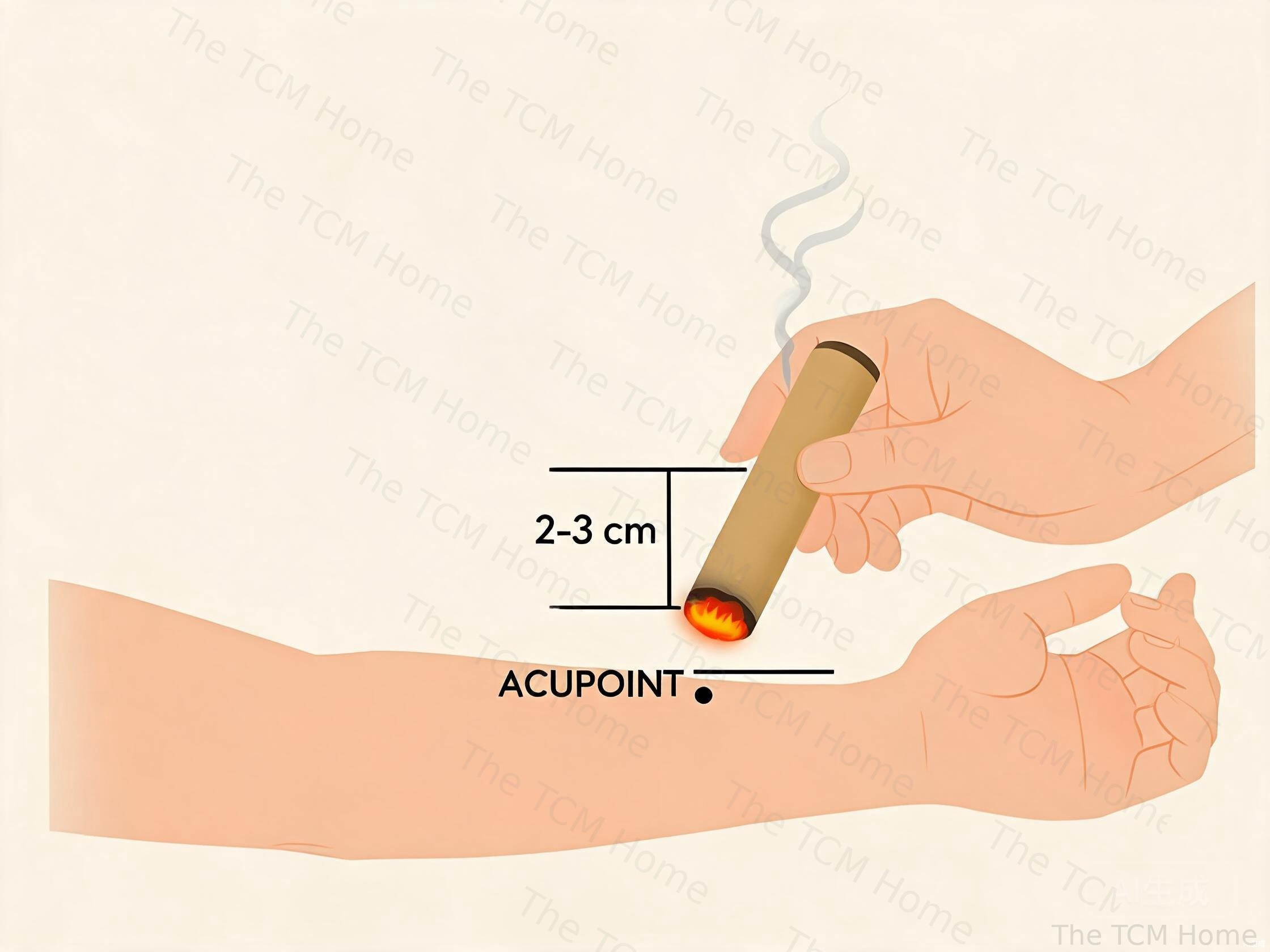
1. Begin with Guanyuan (CV4): Lie on your back. Hold the lit moxa stick 2 to 3 cm above the point, three finger-widths below your navel. Use circular or sparrow-pecking motions for 10 to 15 minutes. This warms the core and strengthens kidney yang.
2. Treat Zusanli (ST36): Sit up or use a partner. Apply moxa to Zusanli on each leg for 5 to 10 minutes per side. This strengthens the spleen and improves circulation to the lower limbs.
3. Treat Yongquan (KD1): This point is on the sole and is best done with a partner or by bending the knee to reach your own foot. Apply moxa for 10 minutes on each foot. Use gentle circular motions. You should feel warmth spreading through the sole and up the leg.
4. For cold hands specifically: After treating the above points, use the moxa stick to warm the back of each hand and the fingers with gentle circular motions for 3 to 5 minutes per hand. The warmth from the core treatment will have already begun to improve circulation, and direct warming of the hands provides immediate comfort.
Always keep the moxa stick at least 2 cm from the skin and keep it moving. The soles of the feet can be less sensitive than other areas, so check the skin frequently to ensure it is not becoming too hot. Never apply moxa to broken skin or areas of numbness. Have water nearby for extinguishing. Do not use moxibustion during pregnancy, fever, or if you have heat-type symptoms. Never leave burning moxa unattended.
Session Frequency and Timeline
The frequency of treatment depends on whether your cold extremities are a new or chronic problem.
Acute Cold Extremities
If your cold hands and feet have started recently, perhaps due to seasonal changes or a period of overwork and poor diet, moxa daily for 7 to 10 days. You should notice significant improvement within the first week. After the acute phase, reduce to 2 to 3 times per week for 2 more weeks to consolidate the results.
Chronic Cold Extremities
If you have had cold hands and feet for months or years, the underlying yang deficiency is deeply rooted. Moxa 2 to 3 times per week for 3 to 4 weeks. Be patient, as chronic deficiency requires time to rebuild. After noticeable improvement, continue with maintenance sessions once or twice per week. Some people benefit from a preventive moxibustion routine during the autumn and winter months when cold extremities are worst.
Lifestyle Tips to Enhance Warming
Moxibustion is most effective when combined with lifestyle changes that support yang qi. The following practices complement moxibustion and help maintain warmth between sessions.
Mugwort Foot Soaks
Soaking your feet in warm mugwort tea before moxibustion is one of the most effective complementary practices. Boil a handful of dried mugwort in water for 10 minutes, cool to about 40 degrees Celsius, and soak your feet for 15 to 20 minutes. This warms the meridians, opens the kidney channel, and makes the subsequent moxibustion on Yongquan more effective. For best results, do the foot soak immediately before your moxibustion session.
Warming Foods and Diet
Your diet directly affects your body's ability to generate yang qi. Emphasize warm, cooked foods and avoid cold, raw foods and ice-cold beverages. Warming foods include lamb, beef, chicken, ginger, cinnamon, walnuts, chestnuts, Chinese dates, and brown sugar. A daily cup of ginger tea or a bowl of warm lamb soup with ginger and dates supports the warming process from within. Avoid excessive consumption of watermelon, cucumber, and mung beans, which are cooling in nature.
Physical Movement
Yang qi is stimulated by movement. Gentle exercises like qigong, tai chi, or brisk walking help circulate qi and blood and warm the extremities. Avoid sitting for long periods, especially in cold environments. If you work at a desk, stand up every 30 minutes and move around to prevent qi stagnation in the limbs.
Keep the Lower Back and Abdomen Warm
In TCM, the lower back is the home of the kidneys, and the lower abdomen is where kidney yang is stored. Keep these areas warm, especially in cold weather. Avoid wearing crop tops or low-rise pants that expose the lower back and abdomen to cold. A warm water bottle on the lower back in the evening can help support kidney yang.
The most effective protocol for cold extremities is: (1) mugwort foot soak for 15 minutes, (2) moxibustion on Guanyuan, Zusanli, and Yongquan for 25 to 35 minutes, (3) drink a cup of ginger and date tea, (4) keep warm and rest for 30 minutes. Do this daily for acute coldness, or 2 to 3 times per week for chronic cases. Results are typically noticeable within one to two weeks.
When Cold Extremities Need Medical Attention
While moxibustion is excellent for cold extremities caused by yang deficiency, some causes of cold hands and feet require medical evaluation. See a healthcare provider if you experience any of the following: sudden onset of cold extremities with color changes in the fingers or toes, cold extremities accompanied by numbness or loss of sensation, coldness in one limb but not the other, or cold extremities associated with chest pain, dizziness, or severe fatigue. These could indicate vascular, neurological, or endocrine conditions that require conventional medical treatment.
Moxibustion can be safely combined with conventional medical treatment in many cases, but always inform your healthcare provider about all therapies you are using. If your cold extremities do not improve after 2 to 4 weeks of consistent moxibustion, consult a qualified TCM practitioner for a more comprehensive assessment.
Frequently Asked Questions
How long does it take for moxibustion to warm cold hands and feet?
Most people notice improvement within 7 to 10 days of daily moxibustion on Yongquan (KD1) and Zusanli (ST36). However, chronic cold extremities caused by longstanding yang deficiency may require 2 to 4 weeks of consistent treatment. Maintenance sessions 2 to 3 times per week help sustain results long term.
Which acupoints are best for cold hands and feet?
The three primary points are Yongquan (KD1) on the soles, which draws yang qi downward to warm the extremities; Zusanli (ST36) below the knees, which tonifies overall yang qi and improves circulation; and Guanyuan (CV4) on the lower abdomen, which warms kidney yang. Treat all three for the best results.
Can moxibustion help with Raynaud syndrome?
Moxibustion may help improve circulation and reduce the frequency of cold-induced episodes in Raynaud syndrome by warming yang qi and promoting blood flow. However, Raynaud is a vascular condition that requires medical supervision. Always consult your healthcare provider before using moxibustion for a diagnosed medical condition.
Should I avoid any foods if I have cold hands and feet?
Yes, avoid ice-cold beverages, raw foods, excessive watermelon and cucumber, and large amounts of dairy, as these are cooling in TCM and can worsen cold extremities. Instead, emphasize warm cooked foods, ginger tea, lamb, walnuts, cinnamon, and Chinese dates to support yang qi from within.
This article is for educational and informational purposes only and is not a substitute for professional medical advice, diagnosis, or treatment. Always consult a qualified healthcare provider before beginning any new wellness practice, especially if you are pregnant, nursing, taking medication, or have a medical condition. Read our full disclaimer →