Key Takeaways
- In TCM, joint pain that worsens in cold or damp weather is caused by cold-damp bi syndrome, where cold and dampness lodge in the joints causing stagnation, stiffness, and pain.
- Moxibustion is the primary TCM therapy for cold-damp joint pain, using penetrating heat to dispel cold, dry dampness, and restore circulation to the affected joints.
- Key points include local Ashi points (the painful area itself), Yanglingquan (GB34) for tendons, and Shenshu (BL23) for kidney yang support.
- Technique varies by joint: circular moxa for knees and shoulders, moxa box for the lower back, and direct local application for small joints.
- Moxibustion is contraindicated for hot, red, swollen, inflamed joints. Only use moxa for cold-type joint pain that improves with warmth.
Cold-Damp Bi Syndrome: The TCM Explanation for Joint Pain
In Traditional Chinese Medicine, joint pain is categorized under bi syndrome, which literally means blockage or painful obstruction. Bi syndrome occurs when external pathogenic factors, wind, cold, dampness, or heat, invade the body's meridians and joints, obstructing the flow of qi and blood. When qi and blood cannot flow freely through a joint, pain, stiffness, and reduced range of motion result.
Cold-damp bi syndrome is the most common type of joint pain seen in TCM practice, especially during autumn and winter. Cold has a contracting nature that causes tissues to tighten and blood vessels to constrict, reducing blood flow to the joints. Dampness is heavy, sticky, and lingering, causing swelling, heaviness, and a feeling of sluggishness in the affected joints. Together, cold and dampness create a particularly stubborn pattern of joint pain that worsens in cold, damp weather and improves with warmth and movement.
Recognizing Cold-Damp Joint Pain
Before using moxibustion for joint pain, it is essential to confirm that your pain is the cold-damp type. Moxibustion is a warming therapy and is only appropriate for cold-pattern joint pain. Using moxa on hot, inflamed joints will worsen the condition.
Signs of Cold-Damp Joint Pain (Use Moxa)
- Joint pain that worsens in cold or damp weather
- Stiffness that improves with movement and warmth
- Joints that feel cold to the touch
- Pain that is aching and heavy rather than sharp and burning
- Reduced range of motion that improves after warming up
- No significant redness, heat, or acute swelling in the joint
- A pale or purple tongue with a white coating
Signs of Heat-Type Joint Pain (Do Not Use Moxa)
- Joints that are red, hot, and swollen
- Burning pain that is worsened by heat
- Pain that is sharp and severe
- Fever or feeling of heat in the body
- A red tongue with a yellow coating
Never use moxibustion on joints that are red, hot, swollen, or acutely inflamed. If you have rheumatoid arthritis with active inflammation, gout with acute flare-up, or any hot-type joint condition, moxibustion is contraindicated and will worsen inflammation. If you are unsure whether your joint pain is cold or heat type, consult a qualified TCM practitioner before beginning treatment.
Key Acupoints for Joint Pain
The treatment of cold-damp joint pain in TCM follows the principle of treating both the local area (the painful joint itself) and the underlying systemic factors (kidney yang deficiency and spleen dampness) that allow cold and dampness to take hold.
Local Ashi Points (Painful Areas)
Ashi points are tender points that are not necessarily named acupoints but are areas of pain or sensitivity. In TCM, where there is pain, there is stagnation, and moxibustion applied directly to the painful area is the most direct way to dispel cold and restore circulation. For joint pain, apply moxa in circular motions over the entire painful joint area for 15 to 20 minutes. The broad, warming coverage helps melt the cold-damp accumulation.
Yanglingquan (GB34) - The Tendon Point
Location: On the outer side of the lower leg, below the knee, in the depression below the head of the fibula (the smaller of the two lower leg bones).
Benefits: Yanglingquan is the influential point for tendons and sinews, meaning it has a generalized strengthening effect on all tendons and ligaments in the body. It is particularly useful for joint pain involving tendons, ligaments, and restricted movement. Moxibustion here helps relax tendons, improve joint mobility, and relieve stiffness.
Duration: 5 to 10 minutes per leg.
Shenshu (BL23) - The Kidney Back Point
Location: On the lower back, at the level of the second lumbar vertebra, about one and a half finger-widths to the side of the spine. To find this level, locate the lowest rib and trace it to the spine; the point is just below this level.
Benefits: Shenshu is the back shu point of the kidney, meaning it directly tonifies kidney function. In TCM, the kidneys govern the bones and marrow, so strengthening kidney yang supports the health of the skeletal system and joints from within. This point addresses the root cause of why cold-damp settles in the joints in the first place: weak kidney yang cannot warm the body adequately, allowing cold and dampness to accumulate. This point requires a partner or a moxa box for treatment.
Duration: 10 to 15 minutes.
Technique for Different Joints
Different joints require slightly different approaches to moxibustion, based on their size, accessibility, and the typical patterns of cold-damp accumulation.
Knee Pain
The knees are one of the most common sites of cold-damp joint pain, especially in older adults. The knees bear the body's weight and are exposed to cold, making them vulnerable.
Technique: Use a moxa stick to warm the entire knee area in circular motions for 15 to 20 minutes. Cover the front, sides, and back of the knee. Alternatively, use a moxa box placed over the knee for hands-free, even heat. After treating the knee itself, apply moxa to Yanglingquan (GB34) for 5 to 10 minutes to support tendon health. For best results, warm the knee before activity and again before bed.
Shoulder Pain
Shoulder pain from cold-damp often presents as stiffness and aching that worsens in cold weather. It may be difficult to raise the arm or reach behind the back.
Technique: Use a moxa stick in circular motions over the entire shoulder joint and surrounding muscles for 15 to 20 minutes. Pay special attention to the front of the shoulder (where the deltoid meets the chest) and the top of the shoulder. This area is best treated with a partner, but you can reach much of the shoulder yourself. Keep the shoulder covered and warm after treatment.
Lower Back Pain
Lower back pain from cold-damp is characterized by aching, stiffness, and a feeling of coldness in the lower back that worsens in damp weather.
Technique: Use a moxa box placed over the lower back for 15 to 20 minutes. This is the most practical method for the back, as it provides hands-free, even heat over a broad area. If using a moxa stick, have a partner apply circular moxibustion over the lower back and specifically on Shenshu (BL23) for 10 to 15 minutes. After treatment, keep the lower back warm with a belt or warm wrap.
Small Joints (Fingers and Toes)
Small joints in the hands and feet can also be affected by cold-damp, especially in cold weather. These joints are easily treated with a moxa stick using gentle, small circular motions.
Technique: Apply moxa to each affected finger or toe joint for 3 to 5 minutes using small, gentle circles. Be extra careful with these areas, as the skin is thinner and more sensitive. Use a greater distance (4 cm) and check the skin frequently. Soaking the hands or feet in warm water before moxibustion can enhance the effect.
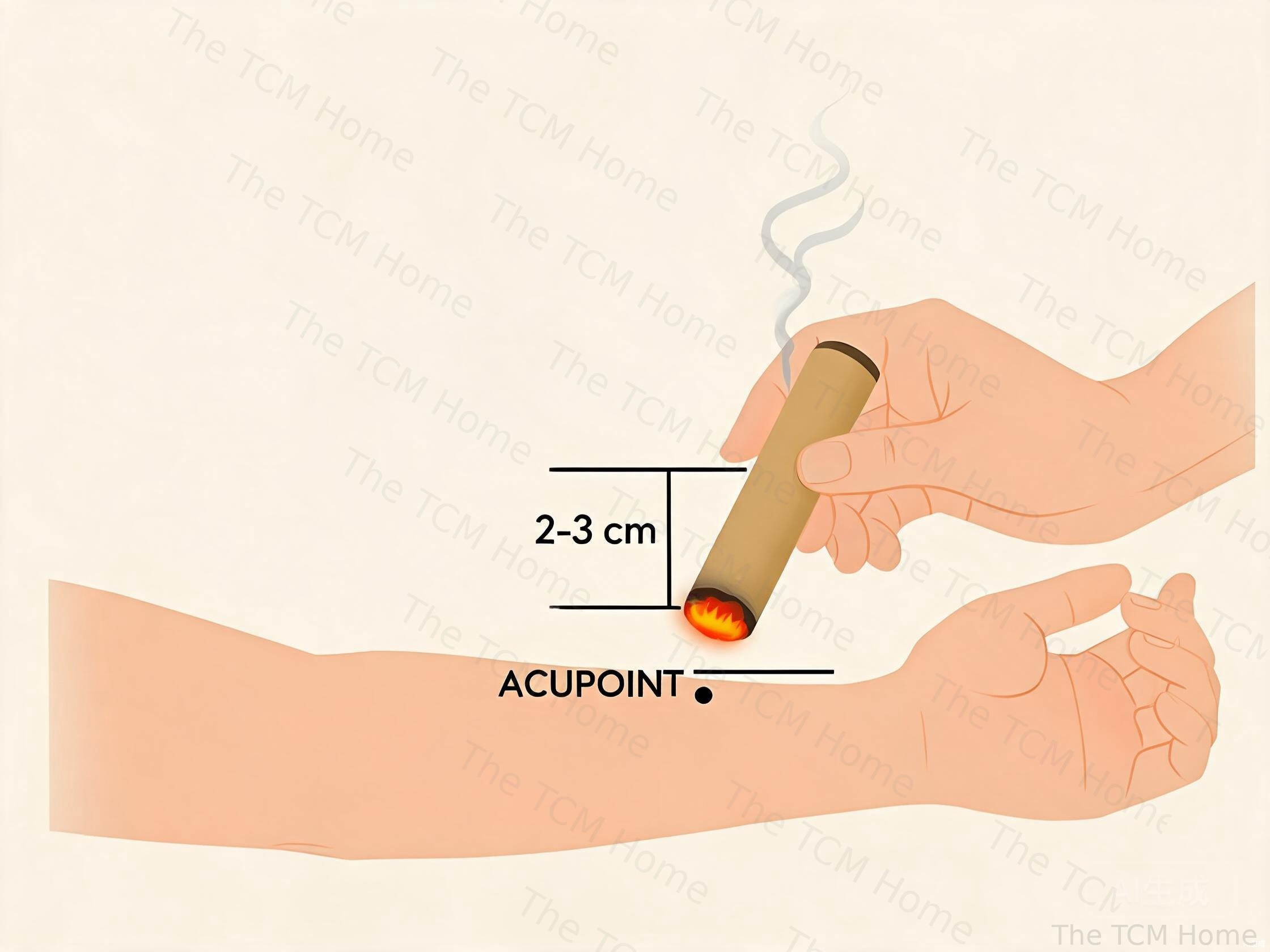
Always maintain proper distance from the skin (at least 2 to 3 cm, or 4 cm for sensitive areas). Keep the moxa stick moving at all times. Have water nearby for extinguishing. Never moxa over broken skin, rashes, or areas of numbness. If the joint is hot, red, or acutely swollen, do not use moxibustion. Never leave burning moxa unattended.
The Winter Protocol
Cold-damp joint pain is a seasonal condition that peaks during autumn and winter. A proactive winter protocol can prevent or minimize flare-ups and keep joints mobile throughout the cold season.
Pre-Winter Preparation
Begin regular moxibustion on affected joints and supporting points (Yanglingquan, Shenshu) 2 to 3 times per week starting in early to mid-autumn, before the cold weather arrives. This preventive approach warms the joints and strengthens kidney yang before cold and dampness can take hold. Think of it as winterizing your body.
Active Winter Treatment
During winter, continue moxibustion 2 to 3 times per week on affected joints. Increase to daily treatment during acute flare-ups for 5 to 7 days. On particularly cold or damp days, apply moxa to the affected joints before going outdoors and again in the evening before bed. Keep joints covered and warm with appropriate clothing, especially protecting the knees, lower back, and neck from cold wind.
Maintenance During Remission
During warmer months when joint pain is minimal, maintain a basic moxibustion routine of once per week on Zusanli (ST36) and Shenshu (BL23) to support overall yang qi and prevent the recurrence of cold-damp accumulation. This year-round maintenance approach is more effective than treating only when pain flares up.
Combining with Warming Herbs and Therapies
Moxibustion works best for joint pain when combined with complementary warming therapies that address cold and dampness from multiple angles.
Ginger Foot Soaks
Before moxibustion on lower body joints, soak your feet in warm ginger water for 15 minutes. Boil a handful of fresh ginger slices in water for 10 minutes, cool to 40 degrees Celsius, and soak. Ginger is warming and dispersing, and the foot soak warms the meridians of the lower body, making subsequent moxibustion more effective. This is particularly helpful for knee and lower back pain.
Mugwort Foot Soaks
For a stronger warming effect, use mugwort instead of or in addition to ginger. Mugwort (the same herb used in moxibustion) has specific properties for dispelling cold-damp from the meridians. Boil a handful of dried mugwort in water for 10 minutes, cool to 40 degrees Celsius, and soak for 15 to 20 minutes. This is excellent for cold-damp conditions throughout the body.
Warming Herbal Teas
Drinking warming herbal teas supports the internal warming process. A tea of ginger, cinnamon, and brown sugar warms the body from within and dispels cold. For joint pain specifically, a tea made from du huo (Angelica pubescens) and morinda root is a traditional TCM remedy for cold-damp bi syndrome, though these should be used under the guidance of a qualified practitioner.
TCM Herbal Patches and Liniments
Warming herbal patches and liniments applied to the affected joints can complement moxibustion. Look for products containing warming and dispelling herbs such as capsicum (cayenne), ginger, cinnamon, and menthol. Apply after moxibustion while the joint is still warm, as the increased blood flow enhances absorption of the herbal compounds. Always patch-test for skin sensitivity first.
The most effective winter joint care routine combines: (1) mugwort or ginger foot soak for 15 minutes, (2) moxibustion on the affected joint for 15 to 20 minutes, (3) moxa on Yanglingquan (GB34) and Shenshu (BL23) for 10 minutes each, (4) application of a warming herbal liniment to the joint, (5) drinking a cup of ginger and cinnamon tea, (6) keeping the joint warm with appropriate clothing or a wrap. Do this 2 to 3 times per week throughout the cold season.
When to Seek Professional Help
While moxibustion is excellent for cold-damp joint pain, it is important to recognize when professional evaluation is needed. Consult a healthcare provider if you experience: sudden severe joint pain with no history of injury, joint pain accompanied by fever, joints that are hot, red, and swollen (signs of acute inflammation), joint pain following an injury that does not improve, progressive loss of joint mobility, or joint deformity. These may indicate conditions such as rheumatoid arthritis, gout, septic arthritis, or structural damage that require medical diagnosis and treatment.
Moxibustion can be safely used alongside conventional treatment for many joint conditions, but it should never replace proper medical evaluation. A qualified TCM practitioner can provide a comprehensive assessment and develop a treatment plan that may include herbal medicine, acupuncture, and dietary therapy alongside moxibustion for more complex or chronic joint conditions.
Frequently Asked Questions
Can moxibustion help with arthritis joint pain?
Yes, moxibustion can be very effective for cold-type arthritis pain, where the joints ache and stiffen in cold or damp weather. The warming heat of moxa dispels cold and dampness from the joints, improves blood circulation, and reduces stiffness. However, moxibustion is contraindicated for hot, red, swollen, inflamed joints (heat-type arthritis), as it will worsen inflammation. If your joints are hot and swollen, do not use moxa.
Which acupoints are best for knee pain?
For knee pain, apply moxibustion directly to the painful area around the knee (Ashi points) for 15 to 20 minutes using circular motions. Additionally, treat Yanglingquan (GB34) below the knee, which is the influential point for tendons and sinews, and Zusanli (ST36) for overall leg strength. Use a moxa box over the knee for hands-free, even heat distribution.
How long should I moxa a painful joint?
Apply moxibustion to the affected joint area for 15 to 20 minutes per session. Use circular motions with a moxa stick, or place a moxa box over the joint for hands-free treatment. For acute cold-damp joint pain, moxa daily for 5 to 7 days. For chronic winter joint pain, 2 to 3 times per week throughout the cold season is recommended.
Can I combine moxibustion with warming herbs for joint pain?
Yes, combining moxibustion with warming herbal therapies is very effective for cold-damp joint pain. A ginger foot soak or mugwort foot bath before moxibustion warms the meridians. Drinking ginger and cinnamon tea supports the warming process internally. TCM herbal formulas that dispel cold-damp, such as those containing du huo and qiang huo, may be prescribed by a qualified practitioner. Always inform your healthcare provider about all therapies you use.
This article is for educational and informational purposes only and is not a substitute for professional medical advice, diagnosis, or treatment. Always consult a qualified healthcare provider before beginning any new wellness practice, especially if you are pregnant, nursing, taking medication, or have a medical condition. Read our full disclaimer →