Key Takeaways
- Direct moxibustion places burning moxa directly on the skin (scarring or non-scarring), while indirect moxibustion uses a barrier or holds the moxa above the skin.
- Indirect moxibustion methods include ginger-separated, salt-separated, garlic-separated, moxa stick, and moxa box techniques, each with specific therapeutic applications.
- Scarring moxibustion should never be attempted at home. It requires professional training and carries risks of infection and permanent scarring.
- For home use, moxa sticks and moxa boxes are the safest and most practical choices. Barrier-separated methods (ginger, salt) are suitable for intermediate practitioners.
- Different conditions benefit from different methods: moxa sticks for general warming, ginger moxa for cold-damp pain, salt moxa for abdominal cold, and moxa boxes for large areas.
The Two Main Categories of Moxibustion
Moxibustion encompasses a family of techniques that all use the heat from burning mugwort (Artemisia vulgaris) to warm acupoints and dispel cold, but they differ significantly in how the moxa is applied to the body. Understanding the distinction between direct and indirect moxibustion, and the various sub-methods within each category, is essential for choosing the right approach for your needs and skill level.
The choice of method affects the intensity of heat, the depth of penetration, the safety profile, and the specific therapeutic properties delivered. Some methods are suitable for home use with minimal training, while others require years of professional study. This guide provides a comprehensive comparison to help you make an informed decision.
Direct Moxibustion
Direct moxibustion involves placing a small, cone-shaped piece of burning moxa directly on the skin at the acupoint. The cone is typically the size of a grain of rice to half a peanut. This is the oldest and most traditional form of moxibustion, described in classical texts dating back over 2,000 years.
Scarring Direct Moxibustion (Hua Niu Jiu)
In scarring moxibustion, the moxa cone is placed directly on the skin and allowed to burn completely down to the skin surface. This intentionally creates a burn that blisters and eventually forms a scar. The treatment is typically repeated over several sessions on the same point to create a lasting suppurating (weeping) wound, which was traditionally believed to provide prolonged therapeutic stimulation.
Historical use: Scarring moxibustion was used in ancient China for serious chronic diseases, including asthma, tuberculosis, and chronic digestive disorders. The resulting scar was considered a form of sustained acupoint stimulation.
Modern status: Scarring moxibustion is rarely used in modern practice, even by professionals, due to the pain, risk of infection, permanent scarring, and the availability of equally effective non-scarring methods. It is almost never practiced in Western countries.
Home use: Absolutely not. Scarring moxibustion should never be attempted at home. It carries serious risks of infection, delayed healing, and permanent disfigurement. This method requires specialized professional training and is not recommended for any home practitioner.
Non-Scarring Direct Moxibustion (Wu Hua Niu Jiu)
In non-scarring direct moxibustion, the moxa cone is placed directly on the skin but is removed before it burns down completely to the skin. The practitioner or patient watches the cone burn and removes it when the heat becomes intense but before it causes a burn. The skin becomes warm and red but does not blister.
Therapeutic use: Non-scarring direct moxibustion provides concentrated, focused heat to a single point. It is more intense than indirect methods and is used for specific conditions where deep, focused warming is needed.
Home use: Not recommended for beginners. While safer than scarring moxibustion, non-scarring direct moxa requires skill and quick reflexes to remove the cone at the right moment. The risk of burns is significant without proper training. Intermediate-level home practitioners may attempt this method after gaining experience with indirect methods, but should start with very small cones and practice on less sensitive areas.
All forms of direct moxibustion carry a significant risk of burns. Scarring moxibustion should never be attempted at home under any circumstances. Non-scarring direct moxibustion requires experience and quick reflexes. If you are new to moxibustion, always start with indirect methods (moxa sticks, moxa boxes, or barrier-separated techniques) which provide a safe and effective alternative with a much lower risk profile.
Indirect Moxibustion
Indirect moxibustion encompasses all methods where the burning moxa does not touch the skin directly. This includes methods that use a barrier material between the moxa and the skin, as well as methods that hold the moxa above the skin. Indirect methods are safer, easier to control, and are the recommended approach for all home practitioners.
Ginger-Separated Moxibustion (Ge Jiang Jiu)
A slice of fresh ginger, about 3 mm thick, is placed on the acupoint. Several small holes are poked through the ginger slice with a toothpick to allow heat to pass through. A moxa cone is placed on top of the ginger slice and lit. The ginger moderates the heat, creating a warm, even penetration, while also delivering the therapeutic properties of ginger, which in TCM is warming, dispersing, and particularly effective against cold-damp.
Best for: Cold-damp joint pain, cold abdominal pain, digestive weakness with cold, and cold-type diarrhea. The combination of moxa heat and ginger's properties is especially effective for conditions involving both cold and dampness.
How to perform: Cut a fresh ginger slice 3 mm thick. Poke 5 to 7 holes through it. Place on the acupoint. Place a small moxa cone (rice-grain to half-peanut size) on the ginger. Light the top of the cone. Let it burn down until the heat becomes intense, then remove the cone and replace it with a fresh one. Do 3 to 5 cones per session. Never let the cone burn down to the skin.
Home use: Suitable for intermediate-level home practitioners. Requires moxa cones and fresh ginger, and the ability to monitor and remove cones at the right time.
Salt-Separated Moxibustion (Ge Yan Jiu)
This method is traditionally performed on Shenque (CV8), the navel. Fine, dry sea salt is used to fill the navel completely, creating a flat surface. A moxa cone is placed on top of the salt and lit. The salt moderates the heat and provides a gentle, even, deeply penetrating warmth. In TCM theory, salt has a cooling nature that balances the heat of moxa, making this method suitable for the sensitive navel area.
Best for: Abdominal coldness, chronic diarrhea, spleen yang deficiency, cold in the middle jiao, and digestive weakness. This is one of the most powerful methods for warming the core.
How to perform: Fill the navel completely with fine, dry sea salt (not iodized table salt). Level the salt surface. Place a moxa cone on top and light it. Let it burn down, then replace with a new cone. Do 3 to 5 cones per session. Remove the salt after the session.
Home use: Suitable for intermediate-level practitioners. Can also be done with a moxa stick held above the navel for a simpler approach.
Garlic-Separated Moxibustion (Ge Suan Jiu)
A slice of fresh garlic, about 2 to 3 mm thick with holes poked through, is placed on the acupoint. A moxa cone is placed on top and lit. Garlic in TCM is warming, dispersing, and has specific properties for resolving toxicity and swelling. It is used for specific conditions and is less commonly used at home than ginger or salt methods.
Best for: Early-stage boils and swellings (to draw out toxicity), chronic cough, and certain skin conditions. Garlic moxa is more stimulating than ginger moxa and can cause skin irritation, so it should be used with caution.
Home use: Suitable for experienced practitioners only. The strong, pungent nature of garlic can cause skin irritation, and this method should be used sparingly and with careful monitoring.
Moxa Stick (Cigar) Method
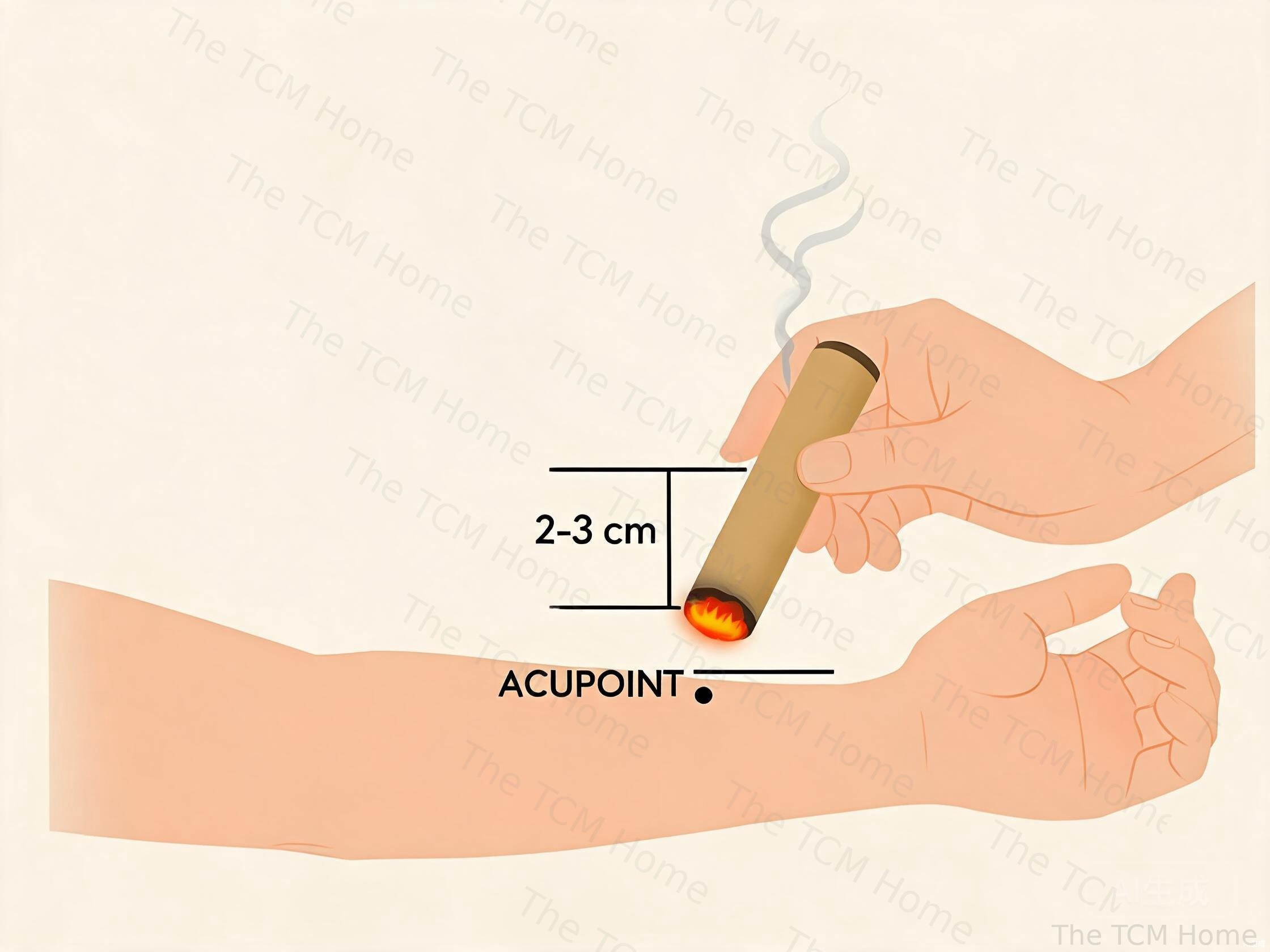
The moxa stick is the most popular and beginner-friendly method. A tightly rolled stick of mugwort, shaped like a cigar, is lit at one end and held above the acupoint. The stick is moved in circular, pecking, or sweeping motions over the treatment area. No material touches the skin, and the distance can be adjusted in real time based on comfort.
Best for: General warming, all acupoints, large areas, beginners. This is the most versatile method and is recommended as the starting point for all home practitioners.
How to perform: Light the tip of the moxa stick until it glows red. Hold it 2 to 3 cm above the acupoint. Use sparrow-pecking (up-and-down) or circular motions. Continue for 5 to 15 minutes per point until the skin is warm and pink.
Home use: Highly recommended for all levels, especially beginners. Safe, easy to control, and effective for virtually all home moxibustion applications.
Moxa Box Method (Wen Jiu He)
A moxa box is a wooden or bamboo box with a metal mesh inside. Lit moxa sticks or pieces are placed on the mesh, and the box is positioned over the treatment area. The box maintains a consistent distance between the moxa and the skin, providing hands-free, even heat over a larger area.
Best for: Large areas such as the back, abdomen, and knees. Ideal for hands-free treatment and for maintaining consistent heat over an extended period.
How to perform: Place lit moxa pieces or a lit moxa stick (cut to size) on the mesh inside the box. Place the box over the treatment area. Adjust the number of moxa pieces to control the heat level. Treatment time is typically 15 to 30 minutes.
Home use: Highly recommended for all levels. Very safe because the mesh prevents direct contact and falling ash from reaching the skin. Ideal for treating the back (which is hard to reach with a stick) and for longer sessions.
Comparison Table
The following table summarizes the key differences between the main moxibustion methods to help you choose the right one for your needs.
- Moxa Stick: Safety: High. Skill level: Beginner. Best for: General use, all points, large areas. Heat type: Moving, adjustable. Hands-free: No.
- Moxa Box: Safety: High. Skill level: Beginner. Best for: Large areas (back, abdomen, knees). Heat type: Even, consistent. Hands-free: Yes.
- Ginger-Separated: Safety: Medium. Skill level: Intermediate. Best for: Cold-damp joint pain, cold abdominal pain. Heat type: Penetrating, moderate. Hands-free: No.
- Salt-Separated: Safety: Medium. Skill level: Intermediate. Best for: Abdominal cold, diarrhea, spleen cold. Heat type: Deep, even. Hands-free: No.
- Garlic-Separated: Safety: Low-Medium. Skill level: Advanced. Best for: Toxic swellings, chronic cough. Heat type: Strong, pungent. Hands-free: No.
- Non-Scarring Direct: Safety: Low. Skill level: Advanced. Best for: Focused, deep warming of single points. Heat type: Intense, concentrated. Hands-free: No.
- Scarring Direct: Safety: Very Low. Skill level: Professional only. Best for: Not for home use. Heat type: Extreme. Hands-free: No.
Which Conditions Suit Which Method
Different conditions respond better to different moxibustion methods. Here is a practical guide to matching methods to common conditions.
For General Wellness and Prevention
Use the moxa stick on Zusanli (ST36) and Guanyuan (CV4), 2 to 3 times per week. This is the simplest and safest approach for maintaining health and building yang qi.
For Cold Hands and Feet
Use the moxa stick on Yongquan (KD1), Zusanli (ST36), and Guanyuan (CV4). The stick method allows you to treat the soles of the feet and the legs easily. Combine with a mugwort foot soak for enhanced effect.
For Digestive Problems (Cold Type)
Use ginger-separated moxibustion on Zhongwan (CV12) for cold-damp digestive issues, or salt-separated moxibustion on Shenque (CV8) for abdominal coldness and diarrhea. The moxa stick on all three digestive points (Zhongwan, Shenque, Zusanli) is also effective and simpler.
For Menstrual Pain (Cold Type)
Use the moxa stick on Sanyinjiao (SP6), Guanyuan (CV4), and Qihai (CV6). The stick method is ideal for the lower abdomen and legs. A moxa box over the lower abdomen can also be used for sustained, hands-free warmth.
For Joint Pain (Cold-Damp Type)
Use the moxa stick in circular motions over the affected joint, or a moxa box for larger joints like the knee or lower back. Ginger-separated moxibustion on specific painful joints is excellent for cold-damp conditions. Add Yanglingquan (GB34) for tendon support.
For Immunity Building
Use the moxa stick on Zusanli (ST36) and Guanyuan (CV4) as a regular preventive practice. A moxa box on the lower back (over Shenshu, BL23) can be added during cold and flu season for additional kidney yang support.
If you are new to moxibustion, start with a moxa stick and a moxa box. These two tools cover virtually all home treatment needs and provide the highest safety margin. As you gain experience and confidence, you can explore ginger-separated and salt-separated methods for specific conditions. Never attempt direct moxibustion (scarring or non-scarring) at home without professional training. The right method is the one that is safe, appropriate for your condition, and within your skill level.
Making Your Choice
Choosing the right moxibustion method depends on three factors: your experience level, the condition you are treating, and your personal comfort with the technique. For most home practitioners, the moxa stick and moxa box will cover 90 percent of treatment needs. These methods are safe, effective, and versatile.
As you progress in your moxibustion practice, you may want to explore the barrier-separated methods (ginger, salt, garlic) for their specific therapeutic properties. These methods add an extra dimension of treatment by combining the properties of the barrier material with the moxa heat. However, they require more preparation and carry a slightly higher risk profile.
Remember that the quality of your technique matters more than the specific method you choose. Proper distance, continuous movement, careful skin monitoring, and awareness of contraindications are the foundation of safe and effective moxibustion, regardless of the method. Start simple, practice consistently, and always prioritize safety. The warmth of moxa, applied correctly and regularly, is one of the most powerful tools in the TCM home wellness toolkit.
Frequently Asked Questions
What is the difference between direct and indirect moxibustion?
Direct moxibustion involves placing a small cone of burning moxa directly on the skin. It can be scarring (the cone burns down completely, causing a blister and scar) or non-scarring (the cone is removed before it burns the skin). Indirect moxibustion uses a barrier between the moxa and the skin, such as ginger, salt, or garlic, or uses a moxa stick held above the skin without touching it. Indirect methods are much safer and are recommended for home use.
Is scarring moxibustion safe for home use?
No, scarring moxibustion should never be attempted at home. This method intentionally creates a burn and blister on the skin, which requires professional training to perform safely and carries risks of infection, scarring, and delayed healing. It is a specialized technique used only by experienced practitioners for specific chronic conditions. For home use, always use indirect methods like moxa sticks, moxa boxes, or barrier-separated moxa.
Which moxa method is best for beginners?
For beginners, the moxa stick (cigar) method is the best choice. It is the easiest to control, allows you to adjust the distance and intensity in real time, and carries the lowest risk of burns. The moxa box method is also beginner-friendly for treating larger areas like the back or abdomen, as it provides hands-free, consistent heat. Start with one of these methods before attempting more advanced techniques.
When should I use ginger-separated moxibustion?
Ginger-separated moxibustion is ideal for cold-damp conditions such as joint pain, cold-type digestive problems, and cold abdominal pain. The ginger slice adds its own warming, dispersing properties to the moxa heat. Cut a 3 mm thick slice of fresh ginger, poke several holes in it, place it on the acupoint, then place a moxa cone on top and light it. Replace the cone 3 to 5 times per session. This method is suitable for intermediate-level home practitioners.
This article is for educational and informational purposes only and is not a substitute for professional medical advice, diagnosis, or treatment. Always consult a qualified healthcare provider before beginning any new wellness practice, especially if you are pregnant, nursing, taking medication, or have a medical condition. Read our full disclaimer →