Key Takeaways
- In TCM, acupressure points work synergistically — combining points produces effects far greater than the sum of their individual actions.
- Each combination pairs points that address different aspects of a condition: some treat the root cause, others the symptom, and some harmonize the whole system.
- The six combinations cover the most common self-care needs: headache, anxiety, digestion, insomnia, fatigue, and PMS.
- Press each point for 1 to 3 minutes per side. Some points can be pressed simultaneously; others are pressed in sequence.
- Points that strongly move Qi and Blood — Hegu (LI4), Taichong (LR3), Sanyinjiao (SP6) — are contraindicated during pregnancy.
How Acupressure Points Work Together
In clinical TCM practice, points are almost never used in isolation. A typical acupuncture prescription contains 4 to 12 points, carefully chosen to work as a team. The same principle applies to self-care acupressure: combinations are dramatically more effective than single points alone. This is because TCM conditions are rarely simple — they involve multiple organs, multiple meridians, and both root causes and branch symptoms.
Points in a combination serve different roles. Root points address the underlying organ imbalance — for example, tonifying the Spleen for chronic digestive issues. Symptomatic points address the immediate complaint — for example, pressing a local point at the site of a headache. Harmonizing points tie the formula together and ensure Qi flows smoothly between the other points. When all three roles are filled, the combination works synergistically — the total effect exceeds what each point could achieve alone.
The six combinations below address the most common conditions people treat with self-care acupressure. Each includes the point locations, the technique for pressing, and the recommended timing and duration.
Press firmly but not painfully — aim for a strong, dull ache (the Deqi sensation). Breathe slowly through the nose with a longer exhale than inhale. Increase pressure gradually over the first 30 seconds. Never press on broken skin, bruises, or over wounds. If pregnant, avoid all combinations containing Hegu (LI4), Taichong (LR3), or Sanyinjiao (SP6).
1. Headache Relief: Hegu LI4 + Taiyang + Fengchi GB20
Best for: Tension headaches, frontal headaches, stress-related headaches, mild migraines.
Point Locations
- Hegu (LI4): On the back of the hand, in the fleshy web between the thumb and index finger. Squeeze the thumb and index finger together — the point is at the highest point of the muscle bulge. Press with the opposite thumb, angled toward the index finger bone.
- Taiyang (EX-HN5): In the soft depression at the temple, approximately one finger-width lateral to the outer end of the eyebrow. This is an extra point not on a named meridian, but it is one of the most effective local points for head pain.
- Fengchi (GB20): At the base of the skull, in the soft depression between the two vertical neck muscles, at the level of the earlobes. The point lies in the hollow on both sides of the neck where the muscles attach to the skull.
Technique and Timing
Press Hegu on each hand for 1 minute. Use the thumb of the opposite hand, angled toward the index finger bone. Then press Taiyang on both temples simultaneously with your index or middle fingers, using small circular motions for 1 minute. Finally, press Fengchi on both sides with your thumbs, tilting the head slightly back to open the point, for 1 minute. Total: 3 minutes. For acute headaches, repeat the full sequence 2 to 3 times.
Why It Works
Hegu moves Qi and Blood throughout the upper body and is the master point for head and face conditions. Taiyang is a local point that directly relieves pain at the site of the headache, especially tension-type pain at the temples. Fengchi releases the neck and suboccipital muscles — tension here is one of the most common underlying causes of chronic headaches. Together, the three points address Qi stagnation, local pain, and muscular tension simultaneously.
2. Anxiety Relief: Shenmen HT7 + Neiguan PC6 + Yintang
Best for: Generalized anxiety, nervousness, panic feelings, racing thoughts, emotional agitation.
Point Locations
- Shenmen (HT7): On the wrist crease, on the little-finger side, in the small depression at the base of the pinky-side wrist bone (the pisiform). The name means "Spirit Gate" — it calms the Shen (spirit) and is the premier point for anxiety and insomnia.
- Neiguan (PC6): On the inner forearm, 2 cun (about three finger-widths) above the wrist crease, between the two central tendons (palmaris longus and flexor carpi radialis). The name means "Inner Gate" — it opens the chest, calms the heart, and settles the mind.
- Yintang (EX-HN3): On the forehead, midway between the inner ends of the eyebrows. This is the "third eye" point — it calms the spirit, clears the mind, and is deeply soothing for anxiety. It also releases the frontal tension that accompanies worry.
Technique and Timing
Press Neiguan on both wrists simultaneously using your thumbs for 2 minutes. Then press Shenmen on both wrists for 1 minute each. Finally, press Yintang with your index or middle finger, pressing gently inward and slightly upward toward the crown, for 2 minutes. Breathe slowly — make each exhale twice as long as each inhale. Total: 6 minutes. This combination is ideal before bed or during an anxiety episode.
Why It Works
Shenmen is the Spirit Gate — it directly calms the Shen housed in the Heart and is used in TCM for all anxiety, insomnia, and emotional disturbance. Neiguan opens the chest and regulates the Heart meridian, addressing the physical tightness and palpitations that accompany anxiety. Yintang, the third eye point, settles the frontal lobes and induces a meditative calm. The three points together address anxiety at the level of the Heart (Shenmen), chest (Neiguan), and mind (Yintang).
3. Digestive Support: Zusanli ST36 + Zhongwan CV12 + Neiguan PC6
Best for: Indigestion, bloating, nausea, poor appetite, weak digestion, post-meal discomfort.
Point Locations
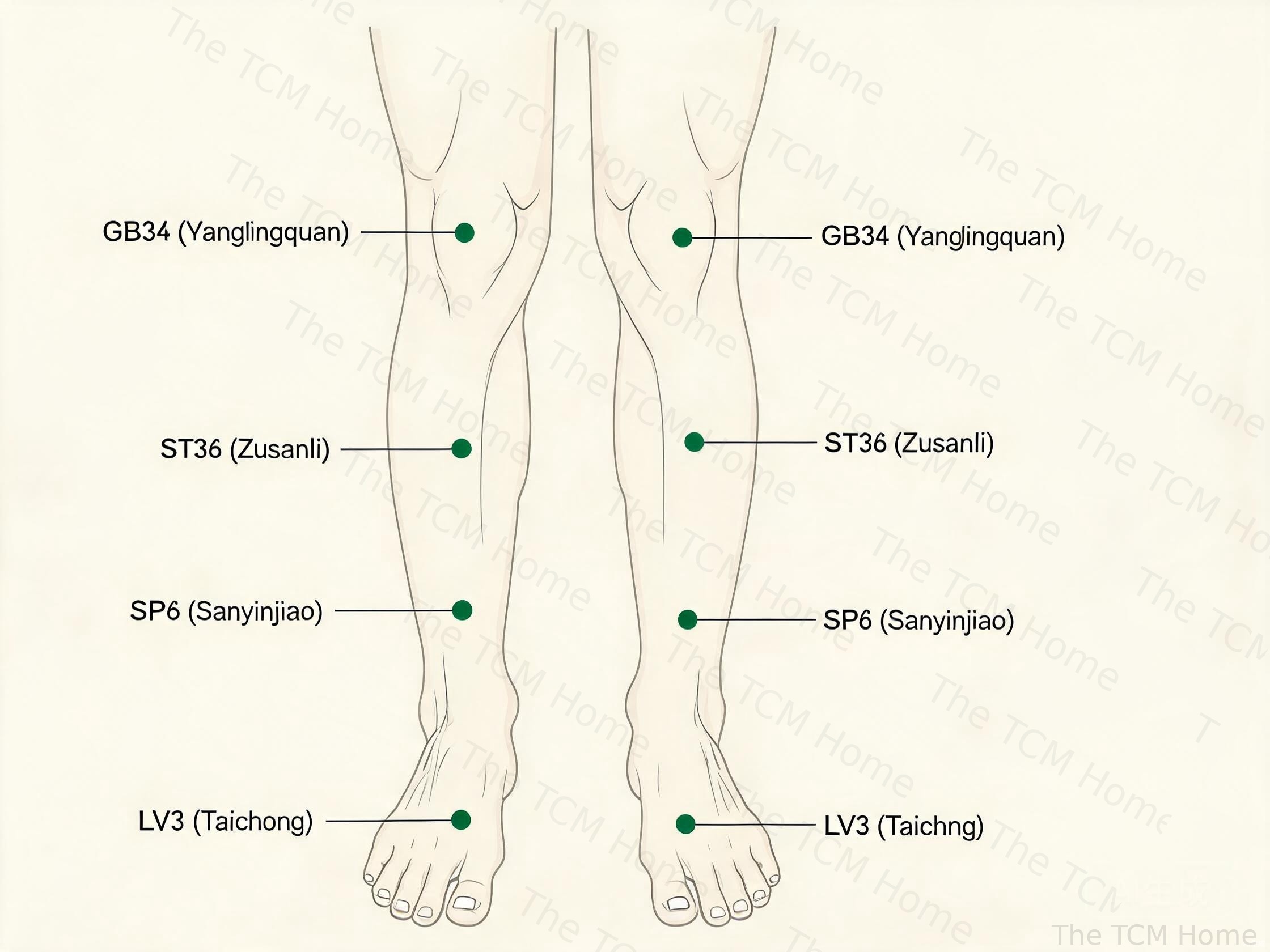
- Zusanli (ST36): On the outer lower leg, one finger-width lateral to the shin bone (tibial crest), about four finger-widths below the kneecap. This is the most famous point in all of TCM for digestive health and overall vitality. The name means "Leg Three Miles" — pressing it is said to give you the energy to walk three more miles.
- Zhongwan (CV12): On the midline of the abdomen, midway between the lower end of the sternum (xiphoid process) and the navel. This is the Front-Mu (alarm) point of the Stomach and the master point for all digestive issues.
- Neiguan (PC6): On the inner forearm, 2 cun above the wrist crease, between the two central tendons. Beyond its calming effect, Neiguan is the premier point in TCM for nausea and vomiting.
Technique and Timing
Press Neiguan on both wrists for 1 minute to settle nausea. Then press Zusanli on both legs for 2 minutes each — use your thumb or knuckle, pressing firmly inward toward the bone. Finally, press Zhongwan with the palm of your hand flat on the abdomen, using gentle circular pressure clockwise (following the direction of the large intestine) for 2 minutes. Total: 6 minutes. Best performed 30 minutes before or after meals.
Why It Works
Zusanli tonifies the Spleen and Stomach, improves digestion and absorption, and is the single most important point for chronic digestive weakness. Zhongwan is the local point for the stomach itself — it directly regulates stomach function and relieves bloating and fullness. Neiguan addresses the nausea and anxiety that often accompany digestive upset. The combination treats the organ system (Zusanli), the local stomach (Zhongwan), and the symptom (Neiguan) all at once.
4. Insomnia Relief: Shenmen HT7 + Anmian + Yongquan KD1
Best for: Difficulty falling asleep, waking during the night, restless sleep, insomnia with racing thoughts.
Point Locations
- Shenmen (HT7): On the wrist crease, little-finger side, in the depression at the base of the pisiform bone. The Spirit Gate — calms the Shen and induces sleep.
- Anmian (EX-HN22): An extra point located behind the ear, in the small depression midway between the earlobe attachment (Yifeng, TE17) and the mastoid bone. The name literally means "Peaceful Sleep" — it is a specific point for insomnia.
- Yongquan (KD1): On the sole of the foot, in the depression that appears when the toes are curled, at the junction of the front third and back two-thirds of the foot. The name means "Gushing Spring" — it draws excess heat and energy down from the head and grounds the body for sleep.
Technique and Timing
Press Shenmen on both wrists for 1 minute each. Then press Anmian on both sides behind the ears with your index fingers for 1 minute. Finally, press and rub Yongquan on the soles of both feet for 2 minutes each — use your thumb to press firmly into the point and rub in small circles. Perform this sequence in bed, just before sleep. Total: 6 minutes.
Why It Works
Insomnia in TCM is often caused by the Shen (spirit) being unable to settle because excess heat or energy has risen to the head. Shenmen calms the Shen directly. Anmian is a specific point for sleep that few outside of TCM know about — its name says it all. Yongquan is the key to grounding: by drawing Qi down to the feet, it pulls the excess energy out of the head where it keeps you awake. The combination calms the spirit (Shenmen), induces sleep (Anmian), and grounds the energy (Yongquan).
5. Fatigue and Energy: Zusanli ST36 + Guanyuan CV4 + Baihui GV20
Best for: Chronic fatigue, low energy, mental exhaustion, post-illness weakness, adrenal burnout.
Point Locations
- Zusanli (ST36): On the outer lower leg, one finger-width lateral to the shin bone, four finger-widths below the kneecap. The premier tonification point in TCM.
- Guanyuan (CV4): On the midline of the lower abdomen, 3 cun (about four finger-widths) below the navel. This is the "Gate of the Source Qi" — it tonifies the Kidney, strengthens the original Qi, and is one of the most nourishing points in the entire system.
- Baihui (GV20): On the crown of the head, at the midpoint of the line connecting the two ear apices. The name means "Hundred Meetings" — all Yang energy gathers here. It lifts the spirit, clears the mind, and counteracts the "heaviness" of fatigue.
Technique and Timing
Press Zusanli on both legs firmly for 2 minutes each. Then place your palm flat over Guanyuan on the lower abdomen and press gently but firmly, holding steady pressure for 2 minutes while breathing deeply into the abdomen. Finally, press Baihui on the crown with your middle finger, pressing gently downward, for 1 minute. Total: 7 minutes. Best performed in the morning to set the day's energy, or during an afternoon slump.
Why It Works
Zusanli tonifies Qi and Blood and strengthens the Spleen — the organ responsible for extracting energy from food. Guanyuan nourishes the Kidney and original Qi, addressing the deep, foundational exhaustion that underlies chronic fatigue. Baihui lifts the spirit and brings Yang energy to the brain, counteracting the mental fog and heaviness of fatigue. Together, the combination tonifies the Spleen (Zusanli), the Kidney (Guanyuan), and the brain and spirit (Baihui) — the three pillars of energy in TCM.
6. PMS and Hormonal Balance: Sanyinjiao SP6 + Taichong LR3 + Hegu LI4
Best for: Premenstrual syndrome, breast tenderness, mood swings, menstrual cramps, hormonal headaches, irritability before menstruation.
This combination contains three points that are strongly contraindicated during pregnancy: Sanyinjiao (SP6), Taichong (LR3), and Hegu (LI4). All three can stimulate uterine contractions. Never use this combination if you are pregnant or suspect you may be pregnant. If you are trying to conceive, avoid pressing these points after ovulation.
Point Locations
- Sanyinjiao (SP6): On the inner lower leg, 3 cun (about four finger-widths) above the inner ankle bone, just behind the shin bone. The name means "Three Yin Intersection" — it is the meeting point of the Spleen, Kidney, and Liver meridians. It is the most important point for women's health and hormonal regulation.
- Taichong (LR3): On the top of the foot, in the web between the big toe and second toe, about 2 cun up from the toe web. Press where the bones of the two toes meet — the point is quite tender. This is the premier Liver point for releasing anger, frustration, and the emotional component of PMS.
- Hegu (LI4): On the back of the hand, in the web between the thumb and index finger. Moves Qi and Blood throughout the upper body, relieves pain, and — in combination with Taichong — forms the "Four Gates" that powerfully release emotional and physical tension.
Technique and Timing
Press Sanyinjiao on both legs for 2 minutes each — use your thumb, pressing firmly toward the shin bone. Then press Taichong on both feet for 1 minute each — press firmly into the tender point between the toes. Finally, press Hegu on both hands for 1 minute each. Total: 8 minutes. Begin pressing this combination 5 to 7 days before your expected period and continue through the first day or two of menstruation.
Why It Works
PMS in TCM is primarily understood as Liver Qi stagnation — the Liver is responsible for the smooth flow of Qi and Blood, and when it stagnates (often worsened premenstrually), symptoms like mood swings, breast tenderness, cramps, and headaches result. Sanyinjiao regulates all three Yin meridians of the lower body — Spleen (digestion and blood production), Kidney (hormones and reproduction), and Liver (Qi flow). Taichong directly moves stagnant Liver Qi and releases the emotional frustration and irritability of PMS. Hegu moves Qi and Blood in the upper body and relieves headaches. The combination addresses the hormonal root (Sanyinjiao), the Liver stagnation (Taichong), and the symptomatic pain (Hegu).
Summary Table
| Condition | Points | Duration | Best Time |
|---|---|---|---|
| Headache | Hegu LI4 + Taiyang + Fengchi GB20 | 3 min | At onset of pain |
| Anxiety | Shenmen HT7 + Neiguan PC6 + Yintang | 6 min | Before bed or during episode |
| Digestion | Zusanli ST36 + Zhongwan CV12 + Neiguan PC6 | 6 min | 30 min before/after meals |
| Insomnia | Shenmen HT7 + Anmian + Yongquan KD1 | 6 min | In bed before sleep |
| Fatigue | Zusanli ST36 + Guanyuan CV4 + Baihui GV20 | 7 min | Morning or afternoon slump |
| PMS | Sanyinjiao SP6 + Taichong LR3 + Hegu LI4 | 8 min | 5-7 days before period |
Frequently Asked Questions
Can I press all the points in a combination at the same time?
Yes, many combinations are designed to be pressed simultaneously. For example, you can press Hegu on one hand while pressing Taiyang on the temple with the other, or press Neiguan on both wrists at the same time. However, some combinations require pressing points in sequence because they are on the same limb or because the order matters (such as pressing root points before symptomatic points). Press each point for the recommended duration, then move to the next. Whether simultaneous or sequential, the combined effect is greater than pressing any single point alone.
How do acupressure points work together synergistically?
In TCM, points work synergistically through several mechanisms. First, some points address the root cause while others address the symptom — together they provide comprehensive treatment. Second, some points move Qi while others nourish Blood or Yin, creating a balanced therapeutic effect. Third, points on different meridians can address different aspects of the same condition — for example, in the headache combination, Hegu moves Qi in the head while Fengchi releases the neck and Taiyang relieves local pain. The synergy is not just additive (1+1=2) but multiplicative — the combined effect is greater than the sum of the individual effects.
How long should I hold each point in a combination?
Press each point for 1 to 3 minutes per side. For a three-point combination, the full session takes 6 to 18 minutes. It is better to press all points briefly and completely than to press one point for a long time and skip the others — the synergy depends on all points being activated within the same session. If you are short on time, press each point for 1 minute per side rather than skipping any. Consistency and completeness matter more than duration.
Are acupressure combinations safe to use daily?
For non-pregnant adults, most combinations are safe for daily use. However, points that strongly move Qi and Blood — such as Hegu (LI4), Taichong (LR3), and Sanyinjiao (SP6) — should be used with care and should not be pressed if you are pregnant, as they can stimulate uterine contractions. If points become sore from daily use, give them a rest day. Always start with gentle pressure and increase gradually. Educational content only. Not medical advice.
This article is for educational and informational purposes only and is not a substitute for professional medical advice, diagnosis, or treatment. Educational content only. Not medical advice. The acupressure combinations described here are traditional self-care practices and are not intended to treat, cure, or prevent any disease. Always consult a qualified healthcare provider before beginning any new wellness practice, especially if you are pregnant, nursing, taking medication, or have a medical condition. Read our full disclaimer →