Key Takeaways
- The TCM body clock divides the 24-hour day into 12 two-hour periods, each governed by one of the 12 primary meridians and their associated organs.
- During its assigned window, a meridian is at peak energetic activity — this is the optimal time to press points on that meridian for maximum effect.
- The clock also has a minimum period (six hours after the peak) when the meridian is at its lowest — pressing points during this time can tonify a deficient organ.
- Recurring symptoms at specific times of day are diagnostic clues in TCM — they reveal which organ system is out of balance.
- This guide includes a complete daily acupressure schedule showing which points to press at each time of day.
The TCM Body Clock: An Ancient Timekeeping System
Long before chronobiology became a field of modern science, Traditional Chinese Medicine had already mapped the body's daily rhythms in extraordinary detail. The TCM Body Clock — also called the Chinese Organ Clock or Meridian Clock — is a system that assigns each of the 12 primary organs and their meridians a specific two-hour period of the day when that organ's Qi is at its peak.
The system is based on the Chinese double-hour (时辰, shichen), which divides the day into 12 segments corresponding to the 12 Earthly Branches of the Chinese zodiac. The clock begins at 3:00 AM with the Lung meridian and cycles through all 12 meridians in a specific sequence determined by the flow of Qi through the body. This sequence is not random — it follows the natural circulation pathway of Qi through the meridian system, moving from one organ to the next in a continuous loop.
Modern chronobiology has confirmed what TCM practitioners observed thousands of years ago: the body does indeed follow circadian rhythms that affect organ function, hormone secretion, and energy levels. Cortisol peaks in the early morning (matching the Large Intestine's 5-7 AM window), liver detoxification is most active at night (matching the Liver's 1-3 AM window), and lung function varies throughout the day. The TCM body clock is not superstition — it is a sophisticated mapping of biological rhythms that has stood the test of millennia.
Each meridian has a peak time (when Qi flows most strongly) and a minimum time (exactly 12 hours later, when Qi is at its weakest). Pressing points during the peak time clears excess conditions. Pressing during the minimum time tonifies deficiency. Both approaches are clinically useful and explained below.
The 12 Two-Hour Periods: Complete Guide
Below is the complete TCM body clock, presented in order beginning with the Lung at 3-5 AM. For each period, you will find the governing organ, the element, the key acupressure point to press during that window, and the conditions it addresses.
| Time | Organ / Meridian | Element | Key Point | Best For |
|---|---|---|---|---|
| 3–5 AM | Lung (LU) | Metal | Lu1 (Zhongfu) | Respiratory health, grief, asthma, cough |
| 5–7 AM | Large Intestine (LI) | Metal | LI4 (Hegu) | Constipation, elimination, skin, immunity |
| 7–9 AM | Stomach (ST) | Earth | ST36 (Zusanli) | Digestion, appetite, energy, nausea |
| 9–11 AM | Spleen (SP) | Earth | SP6 (Sanyinjiao) | Blood production, digestion, worry, fatigue |
| 11 AM–1 PM | Heart (HT) | Fire | HT7 (Shenmen) | Anxiety, palpitations, sleep, emotional calm |
| 1–3 PM | Small Intestine (SI) | Fire | SI3 (Houxi) | Neck pain, absorption, mental clarity |
| 3–5 PM | Bladder (BL) | Water | BL40 (Weizhong) | Back pain, urinary health, fatigue, immunity |
| 5–7 PM | Kidney (KD) | Water | KD1 (Yongquan) | Energy, fear, grounding, sleep preparation |
| 7–9 PM | Pericardium (PC) | Fire | PC6 (Neiguan) | Chest, anxiety, nausea, emotional release |
| 9–11 PM | Triple Burner (TB) | Fire | TB5 (Waiguan) | Circulation, fluid metabolism, relaxation |
| 11 PM–1 AM | Gallbladder (GB) | Wood | GB20 (Fengchi) | Decision-making, neck tension, headaches |
| 1–3 AM | Liver (LR) | Wood | LR3 (Taichong) | Anger, stress, detox, menstrual issues |
Detailed Guide to Each Time Period
3–5 AM: Lung Meridian (Metal)
The body clock begins with the Lung meridian. In TCM, the Lung governs Qi and respiration. During this early morning window, the lungs are most active in processing and distributing Qi throughout the body. This is why many people with asthma or chronic cough experience symptoms worst in the pre-dawn hours. The emotion associated with the Lung is grief — unresolved sadness can surface during this time.
Point to press: Zhongfu (LU1) — located below the collarbone, in the depression lateral to the sternum, about 6 cun lateral to the midline. Press both sides simultaneously with your index fingers for 2 minutes. This point regulates Lung Qi and is especially effective for cough, asthma, and chest tightness. Best for: respiratory conditions, processing grief, and strengthening the immune system.
5–7 AM: Large Intestine Meridian (Metal)
The Large Intestine is the paired Yang organ of the Lung. Its peak time corresponds to the body's natural elimination rhythm — this is when the body is physiologically ready to release waste. TCM recommends waking and having a bowel movement during this window for optimal health. The Large Intestine also governs the skin and the body's defense (Wei Qi) against external pathogens.
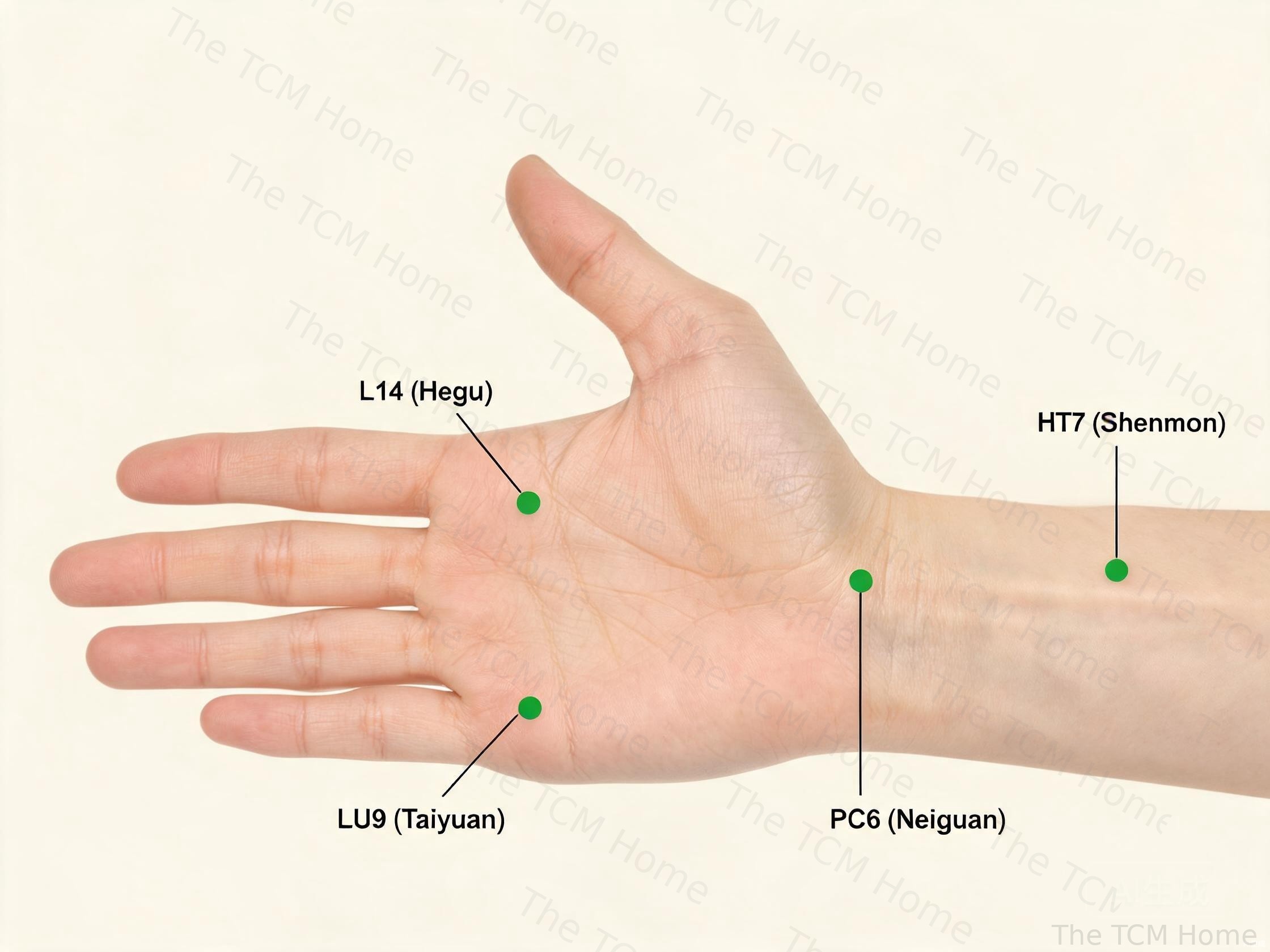
Point to press: Hegu (LI4) — in the web between the thumb and index finger. Press each hand for 1 to 2 minutes. This point promotes elimination, strengthens the immune system, and releases the exterior during colds. Best for: constipation, skin conditions, cold prevention, and morning energy. Note: Do not press Hegu if pregnant.
7–9 AM: Stomach Meridian (Earth)
The Stomach's peak period coincides with breakfast time. In TCM, the Stomach is responsible for receiving and "ripening" food — it works best when given a warm, nourishing meal during this window. The Stomach is paired with the Spleen, and together they are the "postnatal foundation" of Qi and Blood production. Skipping breakfast during this time weakens the Stomach over time.
Point to press: Zusanli (ST36) — on the outer lower leg, one finger-width lateral to the shin bone, four finger-widths below the kneecap. Press each leg for 2 to 3 minutes. This is the most important tonification point in the entire system. Best for: digestive weakness, low energy, nausea, and building overall vitality. Press ST36 every morning for a month and notice the difference in your energy.
9–11 AM: Spleen Meridian (Earth)
The Spleen's peak follows the Stomach — it receives the food the Stomach has prepared and transforms it into Qi and Blood. The Spleen governs thought and intellect, and this is the time of day when mental capacity is naturally highest. The emotion of the Spleen is worry and overthinking. People with Spleen Qi deficiency often experience mental fog and fatigue during late morning.
Point to press: Sanyinjiao (SP6) — on the inner lower leg, four finger-widths above the inner ankle bone, just behind the shin bone. Press each leg for 2 minutes. This point tonifies the Spleen, nourishes Blood, and regulates the Liver and Kidney meridians that also pass through it. Best for: digestive weakness, blood deficiency, menstrual issues, and fatigue. Note: Do not press SP6 if pregnant.
11 AM–1 PM: Heart Meridian (Fire)
The Heart's peak coincides with midday — the time of maximum Yang energy. The Heart houses the Shen (spirit) and governs Blood and blood vessels. This is the optimal time for a calming practice. In TCM, it is recommended to rest during this period, especially a short nap, to protect the Heart. The emotion of the Heart is joy — but excess joy (overstimulation) can injure the Heart.
Point to press: Shenmen (HT7) — on the wrist crease, little-finger side. Press each wrist for 1 to 2 minutes. This point calms the Shen, reduces anxiety, and prepares the body for rest. Best for: anxiety, palpitations, insomnia, and emotional agitation. Press HT7 at noon for a midday calming reset.
1–3 PM: Small Intestine Meridian (Fire)
The Small Intestine receives food from the Stomach and separates the pure (usable) from the impure (waste) — both physically and mentally. In TCM, the Small Intestine also "separates clarity from turbidity" in the mind, meaning it helps with discernment and decision-making. This period is ideal for mental work that requires sorting and prioritizing.
Point to press: Houxi (SI3) — on the side of the hand, at the end of the major crease when you make a loose fist. Press each hand for 1 to 2 minutes. This point is famous for releasing the neck and is also on the Governing Vessel pathway. Best for: neck stiffness, cervical spine pain, and mental clarity.
3–5 PM: Bladder Meridian (Water)
The Bladder's peak is the time of day when many people experience an energy crash — the classic afternoon slump. The Bladder meridian is the longest in the body, running from the inner eye, over the head, down the entire back, through the legs, to the little toe. It contains the Back Shu points that connect to every internal organ. When the Bladder's energy is strong, the entire back is supported and all organs receive nourishment.
Point to press: Weizhong (BL40) — at the center of the back of the knee crease. Press each leg for 1 to 2 minutes by sitting and crossing the ankle over the opposite knee. This is the "command point of the back." Best for: back pain, fatigue, urinary issues, and releasing the entire spine. The afternoon energy crash during this window often indicates Kidney deficiency (the Bladder's paired organ).
5–7 PM: Kidney Meridian (Water)
The Kidney is the most important organ in TCM for longevity and vitality. It stores the body's original Qi (Yuan Qi) — the constitutional energy inherited from your parents. The Kidney governs the bones, marrow, brain, and the lower back. The emotion of the Kidney is fear. This evening window is the optimal time to nourish and restore the Kidney's reserves after a day of activity.
Point to press: Yongquan (KD1) — on the sole of the foot, in the depression that appears when the toes are curled. Press each foot for 2 to 3 minutes. This point draws energy downward, grounds the body, and nourishes the Kidney. Best for: fatigue, fear, insomnia, headaches (by drawing energy down from the head), and preparing for sleep. Press KD1 every evening to build your foundational energy reserves.
7–9 PM: Pericardium Meridian (Fire)
The Pericardium is the "Heart Protector" — it shields the Heart from external pathogens and excessive emotional impact. This evening window is ideal for gentle emotional release and intimacy. The Pericardium also regulates circulation in the chest and influences the nervous system's shift from daytime (sympathetic) to nighttime (parasympathetic) mode.
Point to press: Neiguan (PC6) — on the inner forearm, three finger-widths above the wrist crease, between the two central tendons. Press each arm for 2 minutes. Best for: chest tightness, anxiety, nausea, palpitations, and emotional release. Press PC6 during this evening window to help the nervous system transition into rest mode.
9–11 PM: Triple Burner Meridian (Fire)
The Triple Burner (San Jiao) is not a physical organ but a functional system that regulates the body's fluid metabolism and the communication between the three body cavities — chest, abdomen, and pelvis. This is the time when the body begins to wind down, and it is the ideal time to prepare for sleep. TCM recommends going to bed before 11 PM to align with the body's natural transition into Yin (rest) mode.
Point to press: Waiguan (TB5) — on the outer forearm, two finger-widths above the wrist crease, between the radius and ulna bones. Press each arm for 1 to 2 minutes. This point regulates the Triple Burner, promotes relaxation, and benefits the ears. Best for: insomnia, fluid retention, tinnitus, and preparing the body for sleep.
11 PM–1 AM: Gallbladder Meridian (Wood)
The Gallbladder's peak occurs during the first half of the night. In TCM, the Gallbladder is responsible for decision-making and courage — its partner, the Liver, is responsible for planning. The Gallbladder also stores the Liver's bile. This is a critical time for the body's repair and regeneration processes. Being awake during this window on a regular basis can deplete Gallbladder Qi and lead to indecision, timidity, and neck tension.
Point to press: Fengchi (GB20) — at the base of the skull, in the soft depression between the two neck muscles. Press both sides for 1 to 2 minutes. Best for: neck tension, headaches, eye strain, and releasing the suboccipital muscles. If you wake during this window, press GB20 gently to help settle back to sleep.
1–3 AM: Liver Meridian (Wood)
The Liver's peak is deep in the night. The Liver is the body's primary detoxification organ, and this is when it performs its most intensive cleansing work. The Liver also ensures the smooth flow of Qi throughout the body and stores Blood. The emotion of the Liver is anger — and indeed, recurring wakefulness between 1 and 3 AM is one of the classic diagnostic signs of Liver Qi stagnation in TCM.
Point to press: Taichong (LR3) — on the top of the foot, in the web between the big toe and second toe. Press each foot for 2 minutes. This point moves stagnant Liver Qi, releases anger and frustration, and is the premier point for stress. Best for: stress, anger, menstrual issues, headaches, and the pattern of waking at 1-3 AM. Press LR3 during the day (not at night when you should be sleeping) to prevent nocturnal waking. Note: Do not press LR3 if pregnant.
Each meridian also has a minimum time — exactly 12 hours opposite its peak. For example, the Liver peaks at 1-3 AM and is at its minimum at 1-3 PM. Pressing Liver points (like LR3) during the 1-3 PM minimum time is ideal for tonifying a deficient Liver, while pressing during the 1-3 AM peak is ideal for clearing excess. Since most people cannot press points at 2 AM, the minimum time (early afternoon) is the practical choice for Liver tonification.
Practical Applications: Matching Points to Times
Here are the most practical applications of the body clock for everyday self-care:
- Waking 1–3 AM (Liver): Press Taichong (LR3) during the day and reduce evening stress. This is the most common nocturnal waking pattern and almost always indicates Liver Qi stagnation from stress or repressed emotion.
- Waking 3–5 AM (Lung): Press Zhongfu (LU1) during the day. This often indicates unresolved grief or respiratory weakness. It is also common during the early stages of a cold.
- Morning fatigue (7–9 AM, Stomach): Press Zusanli (ST36) and eat a warm breakfast. Missing this window depletes Stomach Qi.
- Afternoon energy crash (3–5 PM, Bladder): Press Weizhong (BL40) and Yongquan (KD1). This indicates Kidney deficiency. Rest briefly during this window.
- Anxiety and insomnia: Press Shenmen (HT7) at noon (Heart peak) and Yongquan (KD1) at 5-7 PM (Kidney peak) to calm the mind and ground energy.
- Digestive issues: Press ST36 at 7-9 AM (Stomach peak) before breakfast, and SP6 at 9-11 AM (Spleen peak) after breakfast.
Daily Acupressure Schedule Chart
For a complete daily practice that follows the body clock, follow this simple schedule. Each session takes only 2 to 3 minutes:
| Time | Action | Duration |
|---|---|---|
| Upon waking (5–7 AM) | Press Hegu (LI4) — both hands, to stimulate elimination and immunity | 2 min |
| After breakfast (7–9 AM) | Press Zusanli (ST36) — both legs, to support digestion and energy | 3 min |
| Mid-morning (9–11 AM) | Press Sanyinjiao (SP6) — both legs, to support Blood and mental clarity | 2 min |
| Noon (11 AM–1 PM) | Press Shenmen (HT7) — both wrists, for a midday calming reset | 2 min |
| Afternoon (3–5 PM) | Press Weizhong (BL40) — both knees, to release the back and combat fatigue | 2 min |
| Early evening (5–7 PM) | Press Yongquan (KD1) — both feet, to ground energy and build reserves | 3 min |
| Before bed (9–11 PM) | Press Neiguan (PC6) — both arms, to calm the chest and prepare for sleep | 2 min |
Total daily time: approximately 16 minutes. This schedule covers seven of the twelve meridians at their optimal times. You do not need to follow it perfectly every day — even pressing two or three points at their correct times will produce noticeable benefits. The key is consistency and working with your body's natural rhythm rather than against it.
Frequently Asked Questions
What is the TCM body clock and how does it work?
The TCM body clock, also called the Chinese organ clock or meridian clock, divides the 24-hour day into 12 two-hour periods. Each period is governed by one of the 12 primary meridians and their associated organs. During its assigned two-hour window, a meridian is at peak energetic activity — Qi and Blood flow most strongly through it. This makes it the optimal time to press points on that meridian for maximum therapeutic effect. The clock also explains why certain symptoms appear at specific times: the organ governing that time period is under stress, and its peak activity amplifies the imbalance, making symptoms noticeable. The clock begins at 3 AM with the Lung and cycles through all 12 meridians in a specific Qi circulation sequence.
Why do I always wake up between 1am and 3am?
In TCM, the 1 AM to 3 AM period is governed by the Liver meridian. Waking during this time is a classic sign of Liver Qi stagnation — often caused by stress, anger, frustration, or emotional pressure that has built up during the day. The Liver's energy peaks during this window, and if there is stagnation or blockage, the surge of Qi creates internal turbulence that wakes you. Other signs of Liver Qi stagnation include dreaming of anger, waking with a dry mouth, tension headaches at the temples, and feeling unrefreshed in the morning. Pressing Taichong (LR3) on the foot during the day, reducing evening stress, and practicing the Liver-soothing qigong movements can all help resolve this pattern.
Do I need to follow the body clock exactly for acupressure to work?
No. The body clock enhances the effectiveness of acupressure but is not required. Pressing the correct points at any time of day will still produce therapeutic benefits — the meridians are always active, just not at peak intensity. However, pressing points during their meridian's peak time (to clear excess) or during their minimum time (to tonify deficiency) can amplify results significantly. Think of it as surfing a wave rather than swimming against it: you will reach the shore either way, but timing your effort with the wave makes the journey faster and easier. For most people, simply pressing points at a consistent daily time is more important than matching the clock precisely.
What does it mean if I always feel tired between 3pm and 5pm?
The 3 PM to 5 PM period is governed by the Bladder meridian, and its paired organ system is the Kidney. In TCM, the Kidney stores the body's foundational energy — the original Qi inherited at birth. An afternoon energy crash during this window is one of the most common signs of Kidney Qi deficiency. Other signs include lower back weakness, frequent urination, cold hands and feet, and a feeling of deep, bone-level exhaustion. Pressing Yongquan (KD1) on the soles of the feet and Weizhong (BL40) behind the knees during this window can help. Longer-term, nourishing the Kidney with warm foods, adequate sleep before midnight, and reducing stimulants will rebuild the reserves. Educational content only. Not medical advice.
This article is for educational and informational purposes only and is not a substitute for professional medical advice, diagnosis, or treatment. Educational content only. Not medical advice. The acupressure points and schedules described here are traditional self-care practices and are not intended to treat, cure, or prevent any disease. Always consult a qualified healthcare provider before beginning any new wellness practice, especially if you are pregnant, nursing, taking medication, or have a medical condition. Recurring sleep disturbances, chronic fatigue, or persistent symptoms may indicate underlying medical conditions that require professional evaluation. Read our full disclaimer →