Key Takeaways
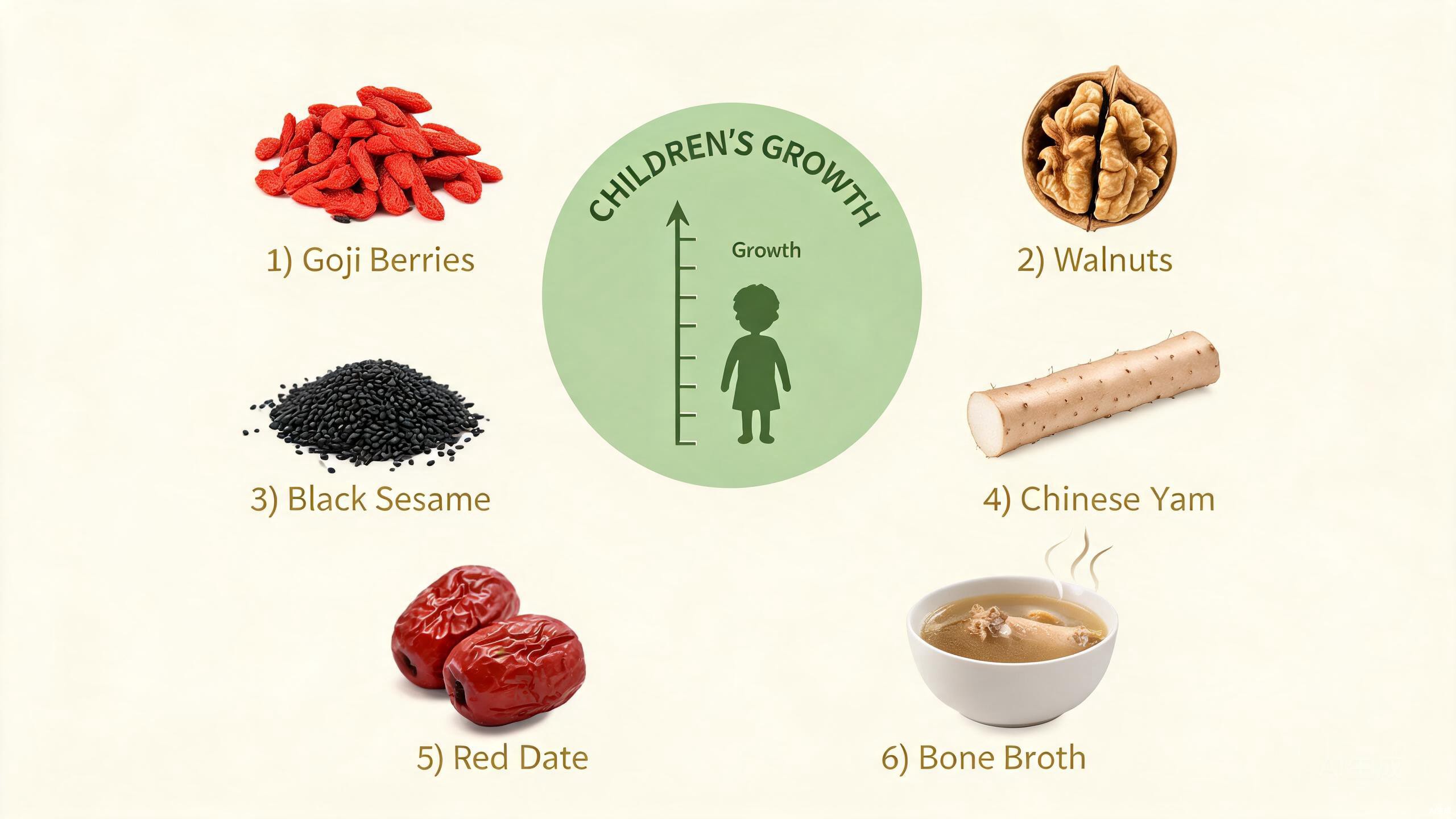
- TCM teaches that "the kidney governs bones and produces marrow" — kidney-supporting foods are traditionally used to promote bone development and growth in children.
- The spleen (digestion) and kidney (growth and development) are the two most important organs for children's growth in TCM theory.
- Five traditional food remedies — from black bean pork rib soup to astragalus chicken soup — use ingredients available at Western supermarkets or online.
- Height is primarily determined by genetics, nutrition, and sleep. TCM foods may support the body's natural growth processes but cannot override genetic factors.
- These are traditional wellness foods, not medical treatments. Consult your pediatrician for growth concerns.
This article is for educational purposes only and is not medical advice. The foods described here are traditional Chinese dietary therapy for wellness support, not a replacement for professional pediatric care. A child's height and growth are primarily determined by genetics, overall nutrition, sleep, and health status. If you have concerns about your child's growth, development, or immune function, consult your pediatrician. Never give honey to infants under 12 months. Always consult your pediatrician before introducing new foods or herbs, especially if your child has allergies or medical conditions.
Every parent wants their child to grow strong, tall, and resilient. In Traditional Chinese Medicine (TCM), children's growth and development are understood through a holistic framework that connects the kidneys, spleen, bones, and immune system. Rather than focusing solely on calcium and vitamins, TCM looks at which foods tonify the kidney (the organ associated with growth and bones), strengthen the spleen (the organ responsible for absorbing nutrients), and support defensive qi (the body's immune resilience).
This guide introduces the TCM theory behind children's growth and five traditional food remedies that use ingredients you can find at a Western supermarket or order online. These are not miracle growth foods — they are nourishing, traditional recipes that may support your child's natural development as part of a balanced lifestyle.
How TCM Views Children's Growth
TCM offers a unique perspective on growth that connects multiple organ systems. Two foundational concepts are key:
The Kidney Governs Bones and Produces Marrow
The most important TCM principle for children's growth is "the kidney governs bones and produces marrow" (肾主骨生髓). In TCM theory, the kidney stores essence (jing) — the inherited constitutional energy that governs growth, development, reproduction, and aging. The kidney essence is said to produce marrow, which fills the bones and brain. When kidney essence is abundant, bones grow strong and the brain develops well. When kidney essence is deficient, growth may be slower and bones weaker.
This is why TCM foods for growth focus heavily on kidney-tonifying ingredients — black beans, black sesame, walnuts, and bone-in meats. The traditional reasoning is that these foods nourish kidney essence, which in turn supports bone development.
The Spleen Is the Source of Nourishment
While the kidney provides the constitutional foundation, the spleen and stomach are responsible for extracting nourishment from food. In TCM, the spleen is called the "postnatal foundation" — the source of all energy and nutrients acquired after birth. Even the best growth-supporting foods are useless if the spleen cannot absorb them. This is why TCM growth foods always include spleen-strengthening ingredients like Chinese yam, and why good digestion is considered essential for growth.
TCM describes children as having a "pure yang body" with abundant growth energy but immature organs. The two priorities for children's wellness are protect the spleen (so nutrients are absorbed) and nourish the kidney (so growth and development proceed smoothly). For more on TCM organ theory, see our guide to zang fu organs.
Immunity and Defensive Qi
TCM also links growth and immunity. The lung governs what TCM calls defensive qi (wei qi) — a protective energy that circulates at the body's surface, analogous to immune function. The kidney provides the deep constitutional foundation for this defensive qi. Astragalus (huang qi), one of the most important TCM herbs for immunity, is traditionally used to strengthen defensive qi and reduce the frequency of illness — because a child who is constantly sick has less energy for growth.
5 Traditional Food Remedies for Children's Growth
The following five recipes use ingredients available at Western supermarkets, Asian grocers, or online retailers like Amazon and iHerb. Each is traditionally classified as supporting the kidney (for bones and growth), the spleen (for nutrient absorption), or defensive qi (for immunity).
1. Black Bean and Pork Rib Soup (Hei Dou Pai Gu Tang)
Suitable age: 2 years and older (cut meat into very small pieces for younger children)
TCM nature and flavor: Sweet, neutral to warm. Enters the Kidney and Spleen meridians.
Traditional use: Tonifies the kidney and strengthens bones, nourishes blood, supports growth. Black beans are one of the most important kidney-tonifying foods in TCM — their dark color is traditionally associated with the kidney. Pork ribs provide protein, minerals, and bone-building nutrients, and simmering them for hours releases nourishing compounds into the broth. This is a classic TCM growth soup for children.
Ingredients:
- 1 pound pork ribs, cut into individual ribs
- 1/2 cup dried black beans (soaked overnight)
- 4 to 5 slices fresh ginger
- 6 to 8 cups water
- Salt to taste
- Optional: 5 to 6 dried red dates, pitted
Preparation: Soak the black beans in water for at least 4 hours or overnight. Blanch the pork ribs in boiling water for 2 to 3 minutes, then drain and rinse. Place the ribs, soaked black beans, ginger, red dates, and water in a large pot. Bring to a boil, then reduce to a low simmer. Cover and cook for 1.5 to 2 hours, until the ribs are very tender and the black beans are soft. Add salt to taste. Remove the meat from the bones and cut into small, age-appropriate pieces for your child. Serve the warm broth with the beans and meat. This soup can be given 1 to 2 times per week.
Dried black beans are available in the bean aisle of any supermarket. Pork ribs are available at any butcher or supermarket meat counter. For a richer broth, you can add a pig bone (ask your butcher) along with the ribs.
Precautions: Black beans can cause gas in some children if not cooked thoroughly — ensure they are very soft. If your child is not used to eating beans, start with a small portion. Always remove all bones before serving to young children.
2. Yam and Goji Chicken Stew (Shan Yao Gou Qi Ji Tang)
Suitable age: 1 year and older (shred or cut chicken into small pieces for younger toddlers)
TCM nature and flavor: Sweet, neutral to warm. Enters the Spleen, Kidney, and Liver meridians.
Traditional use: Strengthens the spleen and tonifies the kidney, supports digestion and growth. This recipe is traditionally made with pigeon in China, but since pigeon is difficult to find in Western countries, chicken is an excellent substitute — it is classified as warm in nature in TCM and is gentle on the digestive system. Chinese yam strengthens the spleen, goji berries nourish the liver and kidney, and together they create a balanced, nourishing stew that supports both nutrient absorption and growth.
Ingredients:
- 1 pound bone-in chicken pieces (thighs or drumsticks work well)
- 50 grams fresh Chinese yam (about 2 inches), peeled and cut into chunks
- 1 tablespoon dried goji berries
- 4 to 5 slices fresh ginger
- 5 dried red dates, pitted
- 6 cups water
- Salt to taste
Preparation: Blanch the chicken in boiling water for 2 minutes, then drain and rinse. Place the chicken, ginger, red dates, and water in a pot. Bring to a boil, then reduce to a simmer. Cook for 45 minutes. Add the Chinese yam chunks and continue simmering for another 30 minutes, until the yam is very soft and the chicken is tender. Add the goji berries in the last 10 minutes (they cook quickly). Add salt to taste. Remove the chicken from the bones and shred or cut into small pieces for your child. Serve the warm broth with the yam, chicken, and goji berries. Give 1 to 2 times per week.
Precautions: Wear gloves when peeling fresh Chinese yam, as it can cause skin irritation in some people. Goji berries should be added near the end of cooking to preserve their nutrients. This stew is gentle and suitable for regular use. For more on goji berries, see our goji tea guide.
3. Walnut and Black Sesame Paste (Hei Tao Hei Zhi Ma Hu)
Suitable age: 1 year and older (grind to a very fine, smooth paste for younger toddlers; do not give whole nuts to children under 4)
TCM nature and flavor: Sweet, warm. Enters the Kidney and Liver meridians.
Traditional use: Tonifies the kidney and strengthens the brain, supports bone development, nourishes blood. Both walnuts and black sesame are premier kidney-tonifying foods in TCM. Walnuts are traditionally said to resemble the brain and are associated with brain development, while black sesame is one of the most valued foods for kidney essence, bones, and hair. Together, they make a rich, nourishing paste that is a beloved traditional snack for children.
Ingredients:
- 1/3 cup black sesame seeds
- 1/4 cup walnuts
- 1 tablespoon glutinous rice flour (or cornstarch as a thickener)
- 1.5 cups water
- 1 to 2 tablespoons rock sugar or maple syrup (no honey for children under 1)
Preparation: Toast the black sesame seeds in a dry pan over low heat for 3 to 5 minutes, stirring constantly, until fragrant and slightly popping. Remove and set aside. Toast the walnuts in the same pan for 2 to 3 minutes until fragrant. Grind the toasted sesame seeds and walnuts in a blender or food processor until they form a fine paste (add a little water to help blend). In a small pot, mix the glutinous rice flour with a little cold water to form a smooth paste. Add the remaining water and the ground sesame-walnut paste. Cook over low heat, stirring constantly, for 5 to 7 minutes until the mixture thickens into a smooth paste. Add rock sugar or maple syrup to taste. Serve warm in small bowls. Give 2 to 3 tablespoons for younger children or a small bowl for older ones, 2 to 3 times per week.
Black sesame seeds are available in the spice or baking aisle of most supermarkets, as well as on Amazon and iHerb. Walnuts are available everywhere. Glutinous rice flour (also called sweet rice flour) is available in the Asian section of most supermarkets or online. For a gluten-free version, use cornstarch as a thickener instead.
Precautions: Never give whole nuts or large nut pieces to children under 4 years old due to choking risk. Always grind walnuts to a fine paste for young children. If your child has a nut or sesame allergy, do not use this recipe. Black sesame is warming and nutrient-dense — keep portions small to avoid digestive overload.
4. Dried Shrimp and Seaweed Egg Soup (Xia Pi Zi Cai Dan Hua Tang)
Suitable age: 2 years and older (ensure dried shrimp are finely chopped; avoid for children with shellfish allergy)
TCM nature and flavor: Salty, warm. Enters the Kidney and Spleen meridians.
Traditional use: Strengthens bones and supports calcium intake, tonifies the kidney. Dried shrimp are naturally rich in calcium and protein, and in TCM they are classified as warm and associated with kidney yang. Seaweed (nori or wakame) is rich in minerals, including iodine, and is traditionally associated with softening masses and supporting thyroid function. Together with eggs, this quick soup is a nutrient-dense, mineral-rich dish that is easy to prepare and easy for children to eat.
Ingredients:
- 1 tablespoon dried baby shrimp (xia pi), finely chopped
- 1 sheet dried nori seaweed (or 2 tablespoons dried wakame)
- 1 egg, beaten
- 2 cups water or light chicken broth
- A few slices of fresh ginger
- A pinch of salt and a few drops of sesame oil
- Optional: 1 teaspoon finely chopped scallions
Preparation: If using nori, tear it into small pieces. If using wakame, soak it in water for 5 minutes. Bring the water or broth to a boil with the ginger slices. Add the finely chopped dried shrimp and seaweed. Simmer for 5 minutes. Slowly pour in the beaten egg while stirring gently to create egg ribbons. Add salt to taste and a few drops of sesame oil. Sprinkle with scallions if desired. Serve warm. This soup is quick to make and can be given 1 to 2 times per week.
Precautions: Do not give dried shrimp to children with shellfish allergies. Always chop dried shrimp very finely for young children to prevent choking. Dried shrimp are naturally salty — do not add extra salt until you have tasted the soup. Use low-sodium broth if available. If your child has a thyroid condition, consult your pediatrician before regularly serving seaweed due to its iodine content.
5. Astragalus and Red Date Chicken Soup (Huang Qi Hong Zao Ji Tang)
Suitable age: 3 years and older (not for infants or toddlers; not during acute illness)
TCM nature and flavor: Sweet, slightly warm. Enters the Spleen and Lung meridians.
Traditional use: Strengthens defensive qi (immunity), tonifies spleen qi, supports overall resilience. Astragalus (huang qi) is arguably the most important TCM herb for immune support. It is traditionally used to strengthen the body's defensive qi — the protective energy that guards against external pathogens. Red dates support spleen qi and blood, and chicken provides nourishing protein. This soup is traditionally given to children who catch colds frequently, to build resilience over time. It is a tonic, meaning it is used to strengthen the body when the child is well — not during acute illness.
Ingredients:
- 1 pound bone-in chicken pieces
- 15 to 20 grams dried astragalus root slices (huang qi)
- 6 to 8 dried red dates, pitted
- 4 to 5 slices fresh ginger
- 6 cups water
- Salt to taste
Preparation: Blanch the chicken in boiling water for 2 minutes, then drain and rinse. Place the chicken, astragalus root slices, red dates, ginger, and water in a pot. Bring to a boil, then reduce to a low simmer. Cover and cook for 1.5 hours, until the chicken is very tender. The astragalus slices will soften but are not typically eaten — remove them before serving (or let older children know not to eat them). Add salt to taste. Remove chicken from bones and cut into small pieces. Serve the warm broth with the chicken and red dates. Give once per week as a tonic soup when the child is healthy.
Dried astragalus root slices (huang qi) are available on Amazon, iHerb, and online TCM herb shops — search for "astragalus root slices" or "huang qi." Look for pale yellow, thick slices with a faint sweet, beany aroma. Dried red dates (jujubes) are available on Amazon, iHerb, and Asian grocery stores. For more on astragalus, see our astragalus tea guide and astragalus soup recipe.
Precautions: Do not give astragalus during an acute illness (cold, fever, or infection). In TCM, tonifying herbs like astragalus are traditionally used when the body is well, to build resilience — not during active illness, when they may "trap" the pathogen. If your child has an autoimmune condition, consult your pediatrician before using astragalus, as it modulates immune function. Do not use astragalus continuously for more than 2 to 3 months without a break. Consult your pediatrician before introducing astragalus to any child.
Quick Comparison of the Five Growth Foods
| Remedy | Suitable Age | Primary Traditional Use | Frequency |
|---|---|---|---|
| Black Bean & Pork Rib Soup | 2+ years | Tonify kidney, strengthen bones | 1-2x per week |
| Yam & Goji Chicken Stew | 1+ years | Strengthen spleen, tonify kidney | 1-2x per week |
| Walnut & Black Sesame Paste | 1+ years | Tonify kidney, support brain | 2-3x per week |
| Dried Shrimp & Seaweed Soup | 2+ years | Support calcium, strengthen bones | 1-2x per week |
| Astragalus & Red Date Chicken Soup | 3+ years | Strengthen immunity (defensive qi) | 1x per week (when well) |
Daily Habits to Support Children's Growth
Food therapy is just one piece of the puzzle. TCM tradition emphasizes that growth depends on the whole lifestyle:
- Sleep is the foundation of growth. In TCM, the body's essence is replenished during sleep, and growth hormone is primarily released during deep sleep. Children need age-appropriate sleep: 10 to 13 hours for ages 3 to 5, 9 to 12 hours for ages 6 to 12. An earlier bedtime (before 9 PM) is traditionally recommended.
- Protect the spleen. Growth requires nutrients, and nutrient absorption depends on a healthy spleen. Feed warm, cooked, easily digestible foods. Avoid overfeeding and excessive cold or raw foods. See our guide on TCM for children's digestion for more.
- Encourage outdoor activity. TCM values movement for promoting qi and blood circulation. Outdoor play, running, jumping, and stretching all support bone development. Sunlight exposure also supports natural vitamin D production, which is essential for calcium absorption.
- Keep the body warm. TCM considers cold harmful to the kidney and spleen. Avoid excessive cold foods, keep the child's back and abdomen warm, and avoid prolonged exposure to cold and damp.
- Manage stress and emotions. In TCM, the liver ensures the smooth flow of qi, and emotional stress can cause liver qi stagnation, which indirectly affects digestion and growth. A calm, supportive home environment is considered essential for healthy growth. See our guide on TCM emotional wellness for more.
Understanding Growth: What TCM Can and Cannot Do
It is important to be honest about what food therapy can and cannot achieve. A child's height is primarily determined by genetics — the height of the parents is the strongest predictor. Nutrition, sleep, exercise, and overall health influence how close a child comes to their genetic potential, but no food can override genetics.
TCM food therapy may support growth in the following ways:
- By strengthening digestion, so the child absorbs more nutrients from all the food they eat
- By providing kidney-tonifying foods that are naturally rich in protein, minerals, and healthy fats
- By supporting immune resilience, so the child is sick less often and has more energy for growth
- By promoting balanced, warm nutrition that is easy on a developing digestive system
TCM food therapy cannot make a child grow significantly beyond their genetic potential, and it should never delay medical evaluation for growth concerns.
When to See a Doctor
Consult your pediatrician if you have any concerns about your child's growth, including:
- Your child's height is consistently below the 3rd percentile or has dropped significantly on the growth chart
- Growth has slowed or stalled for more than 6 months
- Your child is significantly shorter than peers of the same age
- Early or delayed onset of puberty
- Frequent infections or chronic illness that may be affecting growth
- Unexplained weight loss or failure to thrive
- Any developmental concerns
Your pediatrician can evaluate for growth hormone deficiency, thyroid disorders, nutritional deficiencies, and other medical conditions that affect growth. TCM food therapy can complement — but never replace — professional medical evaluation. For related topics, see our guides on TCM for children's digestion and immune-boosting soup.
The Bottom Line
TCM offers a thoughtful, food-based approach to supporting children's growth that has been refined over centuries. Black bean and pork rib soup, yam and goji chicken stew, walnut and black sesame paste, dried shrimp and seaweed soup, and astragalus chicken soup are five traditional recipes that use ingredients you can find at a supermarket or order online. Combined with adequate sleep, outdoor activity, a balanced diet, and a warm, calm home environment, these nourishing foods may support your child's natural growth and resilience. But remember: genetics are the primary determinant of height, and your pediatrician is always your best resource for growth concerns.
This article shares traditional wellness practices for educational purposes only. It is not a substitute for medical advice, diagnosis, or treatment. The foods and practices described here are not intended to treat, cure, or prevent any disease and are not a replacement for professional pediatric care. A child's height and growth are primarily determined by genetics, nutrition, sleep, and overall health. Never give honey to infants under 12 months. Always consult your pediatrician before introducing new foods or herbs to your child, especially if your child has allergies, medical conditions, or takes medication. Seek professional evaluation for any growth or developmental concerns. These statements have not been evaluated by the FDA.