Key Takeaways
- Balance decline in older adults stems from weakening kidney qi, slowing proprioception, reduced leg strength, and impaired inner-ear function, all of which tai chi addresses directly.
- Research consistently shows tai chi reduces falls in seniors by approximately 45 to 50 percent over six months of regular practice.
- Four balance-specific movements, weight shifting, single-leg stance, stepping in four directions, and cloud hands, form the core of a fall-prevention routine.
- Safety comes first: practice near a wall or sturdy chair, wear supportive shoes, and keep stances high to protect the knees.
- A simple daily 10-minute routine, practiced consistently, produces measurable improvements in steadiness within 4 to 8 weeks.
Why Balance Declines with Age
Falls are among the most serious health risks facing older adults. Roughly one in three people over 65 falls each year, and the consequences can be severe: hip fractures, head injuries, loss of independence, and a downward spiral of reduced activity and further decline. Yet falling is not an inevitable part of aging. Balance is a skill, and like any skill it can be trained, maintained, and even recovered after it has diminished.
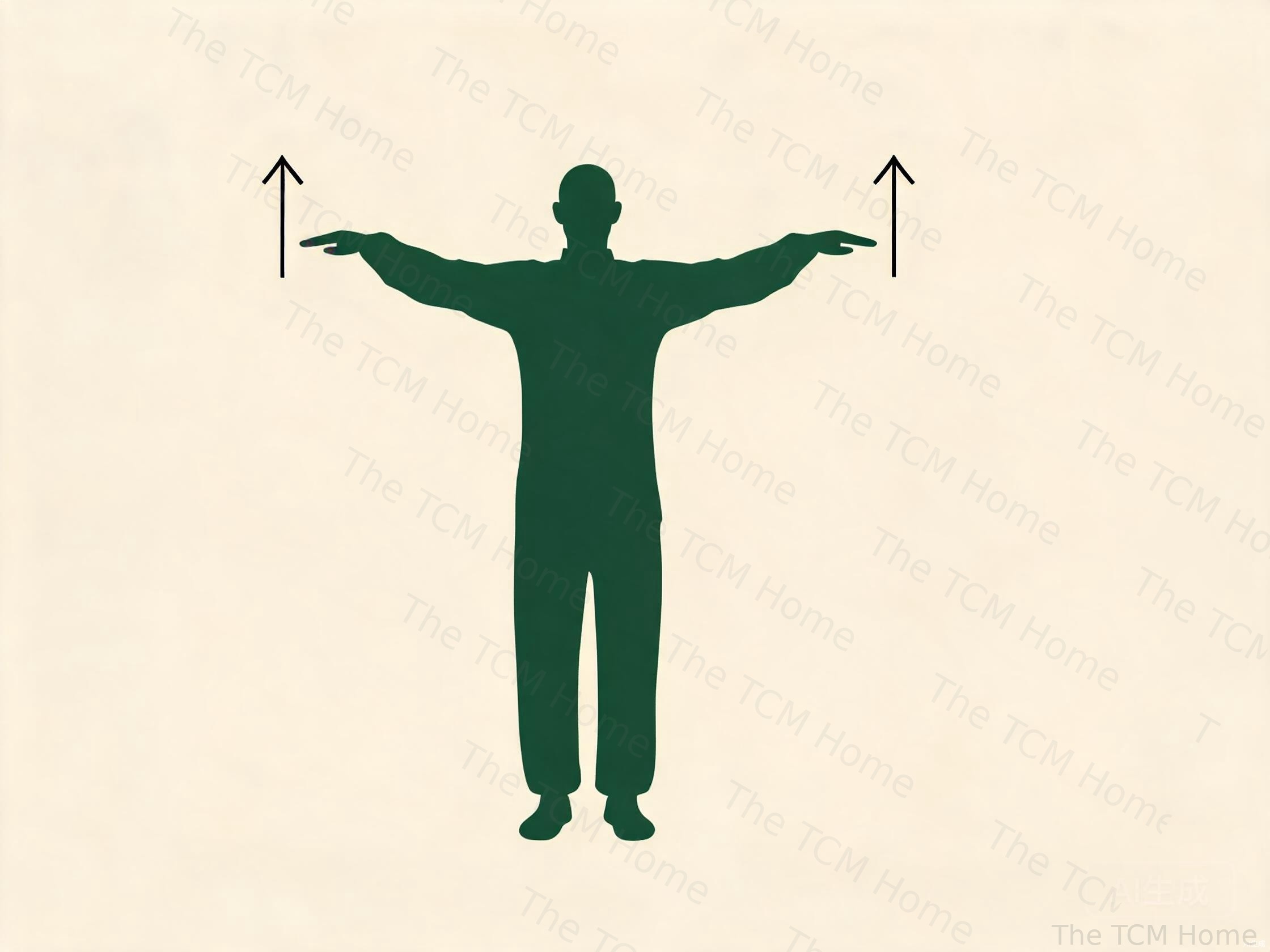
To understand how tai chi helps, it helps to understand why balance falters. Three physiological systems cooperate to keep us upright: proprioception (the body's sense of where its parts are in space, fed by sensors in muscles and joints), vision (which provides a vertical reference), and the vestibular system of the inner ear (which detects head movement and position). As we age, all three degrade. Proprioceptors in the ankles and spine become less sensitive. Vision, particularly the ability to adjust to changes in light and to perceive depth, diminishes. The hair cells of the vestibular system decline in number. Compounding these sensory losses, muscle mass and reaction time worsen, so even when the body detects a loss of balance, it cannot correct quickly enough.
Traditional Chinese Medicine offers a complementary view. In TCM theory, the kidneys store jing (essence) and govern the bones, marrow, and brain. As kidney qi naturally declines with age, the bones weaken, the legs lose their strength, and the mind becomes less anchored in the body. The classical text the Huangdi Neijing observes that in older years the kidney qi is exhausted and the body's ability to move decisively diminishes. This is precisely why practices that nourish kidney qi and strengthen the legs, such as tai chi, are so strongly indicated for seniors. Tai chi does not merely exercise the muscles; it cultivates the deep, rooted energy that TCM associates with stable, grounded movement.
A landmark 1996 study at Emory University, funded by the U.S. National Institute on Aging, found that older adults who practiced tai chi for 15 weeks reduced their fall risk by 47.5 percent compared to a control group. Subsequent trials and meta-analyses have repeatedly confirmed that tai chi, practiced for at least 50 hours total, significantly reduces falls. The World Health Organization and the U.S. Centers for Disease Control both list tai chi among recommended fall-prevention interventions.
How Tai Chi Trains Balance
Tai chi is uniquely well-suited to balance training because it works all the systems involved simultaneously and gently. Four mechanisms stand out:
- Slow weight shifting: Nearly every tai chi movement involves transferring weight from one leg to the other in a controlled, gradual manner. This trains the proprioceptors in the ankles, knees, and hips and teaches the nervous system to manage the body's center of gravity smoothly.
- Single-leg loading: Many tai chi postures briefly place all the body's weight on one leg. This builds the hip abductor and ankle strength needed to recover from a stumble.
- Vertical alignment: Tai chi emphasizes an upright, well-aligned spine with the head suspended and the tailbone tucked. This keeps the center of gravity directly over the base of support, making balance easier and falls less likely.
- Mindful attention: The slow, deliberate pace forces awareness into the feet and legs, sharpening proprioception. Mindful movement also reduces the distraction and divided attention that contribute to many falls.
4 Balance-Specific Movements, Step by Step
The following four movements are adapted specifically for fall prevention. They progress from simple weight shifting to more complex stepping patterns. Practice them in order, and never progress to the next until the previous feels stable. Use a chair or wall for support whenever you need it.
Movement 1: Weight Shifting (Zhongxin Zhuanyi)
This is the foundation. Master it before anything else. It trains the basic skill of moving your center of gravity from one foot to the other without losing control.
- Stand behind a sturdy chair or beside a wall, feet shoulder-width apart, toes pointing forward. Rest one hand lightly on the support. Keep your posture tall: imagine a thread lifting the crown of your head, shoulders relaxed down and back, eyes looking forward at a fixed point on the wall.
- Slowly shift your weight onto the right leg. Feel the right foot press firmly into the floor, the right hip and knee accepting the load. The left leg should feel light, almost floating, but keep the left foot flat on the floor for now. Take 3 to 4 seconds to complete the shift.
- Pause for a moment, fully weighted on the right. Then slowly shift back to center, taking another 3 to 4 seconds.
- Now shift onto the left leg in the same slow, controlled manner. Pause, return to center.
- Repeat 10 shifts to each side. Keep the movement smooth and continuous; there should be no lurching or grabbing for the support.
Progression: Once you can do this confidently with hand support, try it with just a fingertip on the chair, then with hands hovering just above the support, and finally with arms relaxed at your sides.
Movement 2: Single-Leg Stance (Jinji Duli)
This movement directly trains the single-leg balance needed to walk safely and to recover from a stumble. It strengthens the standing leg's hip and ankle.
- Stand with feet shoulder-width apart, hand lightly on a chair or wall. Shift your weight fully onto the right leg, as in the previous movement.
- Slowly lift the left foot a few centimeters off the floor, just enough to clear the ground. Keep the left knee soft, the foot relaxed. Hold this position for 5 to 10 seconds, breathing naturally, eyes on a fixed point.
- Lower the left foot back to the floor with control. Return to a neutral, even stance.
- Repeat on the other side, lifting the right foot while standing on the left.
- Perform 5 to 8 repetitions on each leg.
Progression: As your balance improves, lift the foot higher, eventually bringing the thigh parallel to the floor (a higher version sometimes called "golden rooster stands on one leg"). You can also try closing your eyes for a second or two, which removes visual input and forces the proprioceptive and vestibular systems to work harder. Only attempt eye-closing with a hand on solid support.
Key point: If you wobble, that is normal and good. The wobble is your balance system being trained. Use the support to steady yourself and try again. Never push to the point of a near-fall without support available.
Movement 3: Stepping in Four Directions (Si Fang Bu)
Falls often happen when stepping to the side or backward, directions we rarely train. This movement builds confidence and control in all directions.
- Stand with feet together, hand near a wall if needed. Imagine a clock face on the floor beneath you, with 12 o'clock in front.
- Slowly step forward to 12 o'clock with the right foot, heel first, then roll onto the sole as you shift weight onto it. The step should be short, about half a normal stride. Pause with weight fully on the right foot, the left foot light behind.
- Step the right foot back to center, shifting weight evenly. Pause.
- Now step the right foot to 3 o'clock (directly to the right). Shift weight onto it, pause, return to center.
- Step the right foot back to 6 o'clock (directly behind). Shift weight, pause, return.
- Step the right foot to 9 o'clock, crossing slightly in front of the left foot if comfortable. Shift weight, pause, return.
- Repeat the entire sequence with the left foot, stepping forward, to the left, back, and across to the right.
- Perform 2 to 3 full cycles.
Key points: Each step is heel-first, slow, and short. The eyes stay forward, not down at the feet, though a quick glance is fine when learning. Always pause in the weighted position before returning; this is where balance is trained. Keep the stance high to protect the knees.
Movement 4: Cloud Hands (Yun Shou)
Cloud Hands combines everything: lateral weight shifting, waist rotation, and flowing arm movement. It is the quintessential tai chi balance exercise and is included in nearly every fall-prevention program.
- Stand with feet wider than shoulder-width, toes forward, knees soft. Raise both hands in front of the chest, palms facing the body, the right hand slightly higher.
- Slowly shift weight onto the right leg, turning the waist gently to the right. As you shift, let the right hand circle down and across to the left while the left hand circles up and across to the right. The hands trace overlapping vertical ovals in front of the chest, as if gently turning a large wheel.
- When the weight fully reaches the right leg, take a small step to the left with the left foot, placing it down with no weight on it.
- Shift weight onto the left leg, turning the waist to the left, continuing the hand circles so the right hand rises on the right and the left hand descends on the left.
- Continue shifting side to side, the right foot following the left with a small step every other shift, moving slowly across the floor. The hands never stop circling.
- Practice for 1 to 2 minutes, breathing naturally and keeping the pace slow enough that each weight shift takes 4 to 6 seconds.
Why it works: Cloud Hands trains the lateral weight shift that is so critical for recovering from a sideways stumble. The continuous arm movement challenges the brain to coordinate upper and lower body while balancing, exactly the divided-attention scenario that causes falls in real life.
Always practice with a sturdy chair, counter, or wall within arm's reach until you are confident. Wear flat, supportive shoes with non-slip soles. Clear the practice area of rugs, cords, and clutter. If you feel dizzy, lightheaded, or unsteady in a way that worries you, stop and sit down. If you have a history of falls, vertigo, or balance disorders, consult your doctor before starting and consider beginning with a supervised class.
A Daily 10-Minute Balance Routine
Consistency beats intensity. Ten minutes every day will produce better results than an hour once a week. Here is a simple routine that combines warm-up, the four movements, and a cool-down:
- Minute 1: Warm-up. March gently in place for 30 seconds, then roll the shoulders back and down 8 times. Wake up the body without strain.
- Minutes 2 to 3: Weight Shifting. 10 shifts to each side, with hand support if needed. Focus on smooth, slow transitions and full weight commitment.
- Minutes 4 to 5: Single-Leg Stance. 5 to 8 repetitions on each leg. Hold each lift for 5 to 10 seconds.
- Minutes 6 to 7: Stepping in Four Directions. 2 full cycles, one with each foot leading.
- Minutes 8 to 9: Cloud Hands. Move slowly across the floor and back. Keep the breath slow and the arms flowing.
- Minute 10: Cool-down. Stand quietly with feet shoulder-width apart, arms at the sides. Take 5 slow abdominal breaths, feeling the body settle. Notice the stability in your legs.
Building a Progression Plan
Balance improves in stages. A realistic progression for a senior beginning tai chi for fall prevention:
- Weeks 1 to 2: Focus entirely on Weight Shifting and Single-Leg Stance with support. Goal: confidence shifting weight without grabbing the chair.
- Weeks 3 to 4: Add Stepping in Four Directions. Reduce hand support on Weight Shifting to a fingertip.
- Weeks 5 to 6: Add Cloud Hands. Try Single-Leg Stance with hands off the support for a few seconds.
- Weeks 7 to 8: Full 10-minute routine daily. Begin experimenting with eyes closed for 1 to 2 seconds during Single-Leg Stance, always with support at hand.
- Week 9 onward: Maintain daily practice. Consider joining a class to learn a short tai chi form, which adds variety and deeper challenge.
You can test your progress with a simple measure: how long you can stand on one leg with eyes open. Most adults over 65 should be able to hold at least 10 seconds; inability to do so is associated with higher fall risk. Watch this number climb over the weeks, a tangible sign that your balance is returning.
Falling is not a sentence; it is a risk, and risks can be reduced. Tai chi offers a gentle, evidence-based, and deeply enjoyable way to rebuild the steadiness that time erodes. By practicing a few minutes a day, you are not just preventing falls; you are reclaiming the confidence to move through the world with the rooted, centered ease that is tai chi's quiet promise.
Frequently Asked Questions
How does tai chi prevent falls in seniors?
Tai chi prevents falls by training the three systems that govern balance: proprioception (awareness of body position), vision, and the vestibular system of the inner ear. The slow weight shifts strengthen the legs and ankles, improve reaction time, and teach the body to recover from instability. Multiple large clinical trials, including those funded by the U.S. National Institutes of Health, have shown that tai chi can reduce falls in older adults by roughly 45 to 50 percent over six months of practice.
At what age should I start tai chi for balance?
It is never too early or too late. Balance decline begins subtly in the 50s, so starting in middle age builds a reserve before problems appear. However, people in their 70s, 80s, and even 90s have shown significant improvements in balance and reduced fall rates after starting tai chi. The key adaptations are higher stances, slower progression, and practicing near a wall or chair for support when needed.
Can I practice tai chi for balance if I use a walker or cane?
Yes, with modifications. Many of the upper-body and weight-shifting movements can be practiced while holding a chair or walker for support. A qualified instructor, particularly one trained in adapted tai chi or tai chi for arthritis and fall prevention, can tailor the movements to your mobility level. Even seated tai chi builds core stability and proprioception that transfer to safer standing and walking.
How long until I notice better balance from tai chi?
Most seniors notice feeling steadier when standing and walking within 4 to 8 weeks of daily practice. Measurable improvements in balance tests, such as the Timed Up and Go or single-leg stand time, typically appear by 12 weeks. The greatest fall-reduction benefits in studies were seen after 6 months of consistent practice, so patience and consistency are essential.
Educational content only. Not medical advice. This article is for educational and informational purposes only and is not a substitute for professional medical advice, diagnosis, or treatment. Always consult a qualified healthcare provider before beginning any new exercise program, especially if you have a history of falls, dizziness, or balance disorders. Read our full disclaimer →