Key Takeaways
- Tai chi is a form of qigong; all tai chi is qigong, but not all qigong is tai chi. Tai chi is a specific martial-art-derived subset of the broader qigong family.
- Qigong is simpler, often a single repeated movement or standing posture, and can be learned in minutes. Tai chi is a choreographed sequence (a form) that takes months to learn.
- Tai chi emphasizes weight shifting, stepping, and martial application. Qigong emphasizes breath, intention, and energy cultivation, often with minimal foot movement.
- For stress relief or quick energy, simple qigong is ideal. For balance, fall prevention, or a long-term moving meditation, tai chi is superior.
- The two complement each other perfectly; many practitioners use qigong as a warm-up and tai chi as the main practice.
Two Paths Up the Same Mountain
Tai chi and qigong are often mentioned in the same breath, and for good reason: both are Chinese internal arts that cultivate qi (vital energy) through coordinated breath, movement, and intention. Both produce remarkably similar health benefits, from reduced stress to improved balance. Yet they are not the same thing, and the differences matter when choosing which to practice.
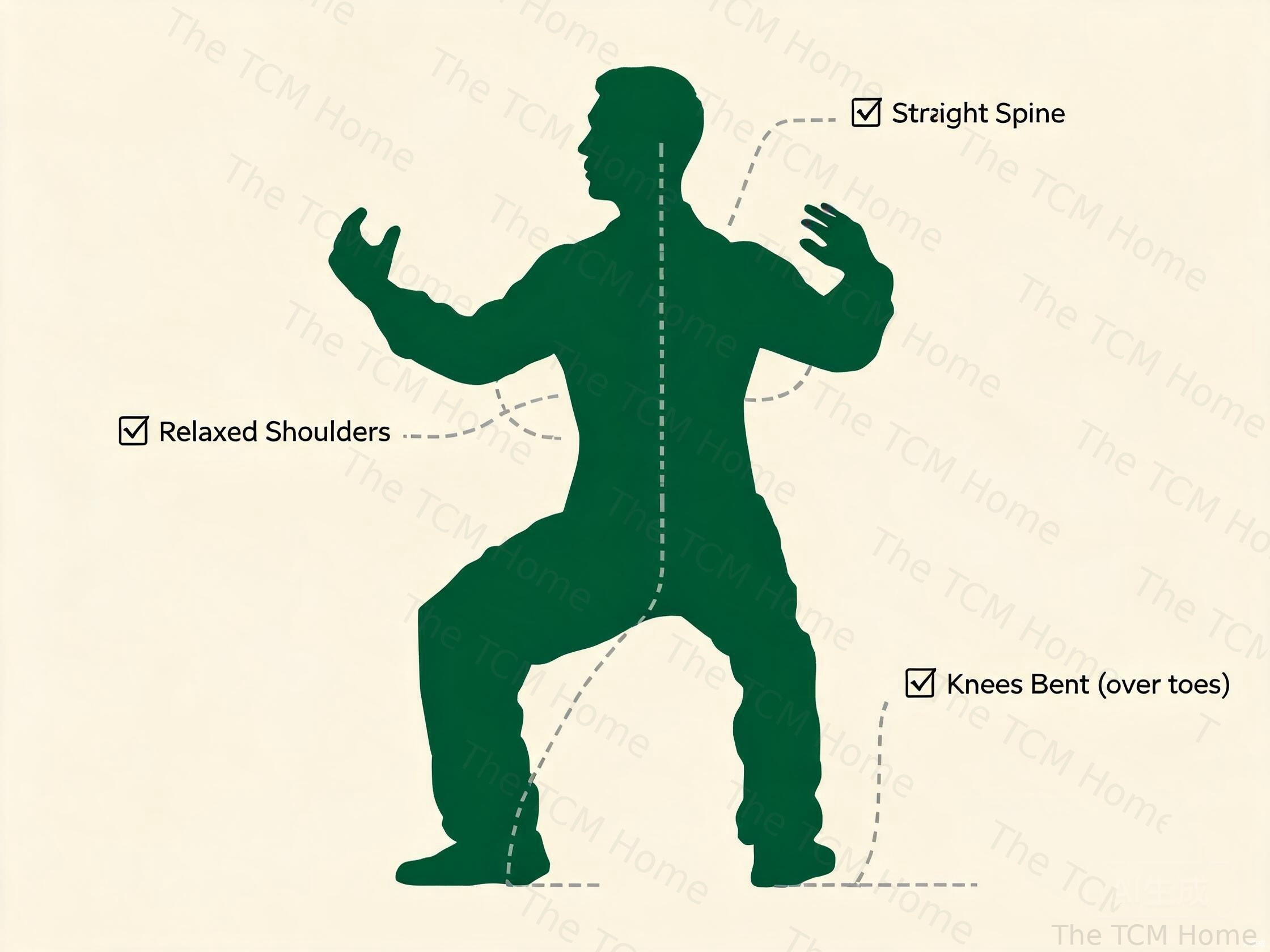
The simplest way to understand the relationship is this: tai chi is a form of qigong, but not all qigong is tai chi. Qigong is the broad, ancient family of Chinese energy practices, encompassing hundreds of exercises, some static, some moving, some seated, some standing. Tai chi is one specific member of that family, a choreographed sequence of movements with martial-arts origins. Think of qigong as the genus and tai chi as a particularly famous species within it.
Origins and History
Qigong: The Older, Broader Art
Qigong's roots reach back at least 4,000 years. The term itself is modern, coined in the mid-20th century, but the practices it describes are ancient. Evidence of qigong-like movements appears on jade carvings from the Shang dynasty (c. 1600 BCE), and the practices developed across Daoist, Buddhist, Confucian, and medical traditions. Different lineages cultivated qigong for different purposes: Daoists for spiritual immortality, Buddhists for meditation, martial artists for power, and physicians for healing.
The word qigong breaks down as qi (vital energy or breath) and gong (skill or work cultivated over time). So qigong literally means "the skill of cultivating energy through practice." This broad definition encompasses an enormous range: standing meditation (zhan zhuang), seated breathing, the Eight Brocades, Five Animal play, healing sound practices, and much more.
Tai Chi: The Martial Offshoot
Tai chi, more fully taijiquan ("supreme ultimate fist"), is far younger, originating in 17th-century China as a martial art. The Chen family village in Henan province is generally credited with the first codified style, developed by Chen Wangting around 1660. From Chen style branched the Yang, Wu, Hao, and Sun styles, each adapting the art to different physiques and temperaments.
Crucially, tai chi was created as a fighting art whose training method, slow, soft, internal, happened to be profoundly healthful. Its martial purpose shaped its form: every movement in a tai chi sequence has a combative application, a block, a strike, a throw, even if modern practitioners rarely use them. This martial DNA is why tai chi involves weight shifting, stepping, and whole-body coordination to a degree that most qigong does not.
If qigong is like learning scales and arpeggios on a piano, fundamental, repeatable, building blocks of skill, then tai chi is like learning a specific sonata, a composed piece that uses those fundamentals in a flowing, purposeful sequence. You can play the sonata without first mastering scales, but the scales make everything easier and deeper.
Core Principles Compared
Despite their different origins, tai chi and qigong share most of their internal principles. Both rest on the same foundations:
- Song (relaxation): Releasing unnecessary tension while maintaining structure.
- Dantian focus: Centering awareness in the lower abdomen, the body's energy center.
- Abdominal breathing: Slow, nose-based breathing into the belly.
- Yi leading qi: The mind (intention) guides the energy, which guides the body.
- Yin-yang balance: Every movement contains complementary opposites, full and empty, rising and sinking, advancing and retreating.
The difference is emphasis. Qigong tends to focus more directly on the breath and the cultivation of qi, with movement serving as a vehicle for energy work. Tai chi emphasizes the integration of breath, body, and mind through complex movement, with the martial structure providing the framework within which qi is cultivated.
Movement Style: The Visible Difference
If you watched someone practicing qigong and someone practicing tai chi side by side, you could tell them apart within seconds.
Qigong movements are typically simpler and more repetitive. A single exercise might repeat one motion, like raising and lowering the arms, 8 to 12 times. The feet often stay planted or move minimally. The pace is slow, the range of motion comfortable, and the focus is clearly internal: the practitioner may close their eyes or gaze softly inward. Many qigong exercises are performed standing in one place; some are even seated.
Tai chi movements are choreographed into a form, a long sequence of distinct postures that flow one into the next without pause. The feet move constantly, stepping forward, backward, and sideways, and weight shifts from leg to leg in complex patterns. The arms trace large, varied arcs. The practitioner moves through space, often following a specific floor pattern. The eyes are open and engaged, following the lead hand. The whole body is involved in a continuous, athletic, though gentle, coordination.
Difficulty and Learning Curve
Qigong: Accessible from Day One
Qigong's great strength is its accessibility. A single exercise like "Separating Heaven and Earth" or "Pushing the Wave" can be learned from a brief demonstration and practiced immediately with benefit. There is no long sequence to memorize, no complex footwork, no concern about getting the order wrong. A beginner can derive real stress relief and energy from a 10-minute qigong session on their first day.
This makes qigong an excellent entry point for people who are elderly, recovering from illness, very stressed, or simply short on time. The learning curve is gentle and the early rewards are immediate.
Tai Chi: A Slower, Deeper Learning
Tai chi asks more of the beginner. The 24-form, the most common beginner sequence, contains 24 distinct movements that must be memorized in order, each with its own footwork, arm pattern, and weight distribution. Learning the basic choreography typically takes 3 to 6 months of regular practice. Refining the movements, coordinating the breath, and developing the internal feeling of qi can take years.
This steeper curve is not a flaw; it is the source of tai chi's depth. The complexity demands sustained attention, which is itself meditative. The weight shifting builds balance and leg strength that qigong's gentler movements do not. The choreography gives the mind a long, absorbing task that, once learned, becomes a flowing meditation in motion. Tai chi rewards patience with a richness that simpler practices cannot match.
Health Benefits: Overlap and Specialization
Because both arts share core principles, their health benefits overlap considerably. Both have been shown in research to reduce stress and anxiety, lower blood pressure, improve mood, enhance sleep, and increase overall well-being. Both cultivate qi and, in TCM terms, nourish the body's internal organs and meridians.
Where they diverge is in their specialized strengths:
- Tai chi is superior for balance and fall prevention. The constant weight shifting and single-leg loading train the proprioceptive and vestibular systems more intensively than most qigong. This is why virtually all fall-prevention research uses tai chi rather than qigong.
- Tai chi builds more leg strength and cardiovascular endurance (modestly, at slow speeds) because of its larger, lower stances and continuous whole-body movement.
- Qigong is superior for direct energy cultivation and organ-specific work. Many qigong exercises target specific organs (e.g., Lung sounds, Liver-stretching movements) or meridians, something tai chi does more diffusely.
- Qigong is more accessible for acute illness, frailty, or severe stress, when the demands of tai chi would be too much. Seated qigong can be practiced by almost anyone.
- Qigong produces quicker stress relief for many people, because its simpler movements are easier to perform when the mind is agitated.
Which Should You Choose? A Goal-Based Guide
The right choice depends on your primary goal. Here is a practical guide:
- Your goal is stress relief or quick calm: Start with simple qigong. Movements like "Opening the Chest" or "Abdominal Breathing" can lower stress in minutes and require no instruction to begin.
- Your goal is better balance or fall prevention: Choose tai chi. Its weight-shifting and single-leg postures are precisely what the research shows prevents falls.
- Your goal is energy cultivation or working with a specific organ system: Choose qigong. Its targeted exercises (e.g., Six Healing Sounds, Five Animal qigong) address specific organs and meridians directly.
- Your goal is a long-term, deepening practice and moving meditation: Choose tai chi. The form's complexity gives a lifetime of refinement and a flowing meditative state qigong's simpler movements cannot fully replicate.
- Your goal is gentle rehab or you have limited mobility: Start with qigong, particularly seated or supported forms, and progress to tai chi as strength and balance allow.
- Your goal is martial skill: Choose tai chi, ideally a traditional style (Chen, Yang) with a teacher who teaches applications.
Quick Comparison Table
For at-a-glance reference, here is how the two arts compare across key dimensions:
- Origin: Qigong, ancient (4,000+ years), diverse traditions. Tai chi, 17th-century martial art (Chen village).
- Purpose: Qigong, health, healing, spiritual cultivation. Tai chi, originally martial combat; now primarily health and meditation.
- Structure: Qigong, individual repeatable exercises. Tai chi, choreographed sequence (form) of 24 to 108 movements.
- Footwork: Qigong, mostly stationary or minimal stepping. Tai chi, constant stepping and weight shifting.
- Learning time: Qigong, minutes to days for a single exercise. Tai chi, 3 to 6 months for basic choreography of the 24-form.
- Physical demand: Qigong, low to very low; can be seated. Tai chi, low to moderate; requires standing and leg strength.
- Best for balance: Tai chi.
- Best for quick stress relief: Qigong.
- Best for organ-specific work: Qigong.
- Best for long-term depth: Tai chi.
Can You Practice Both?
Not only can you practice both, but doing so is one of the most rewarding combinations in Chinese internal arts. The two complement each other almost perfectly:
- Qigong as warm-up: Ten minutes of qigong before a tai chi form settles the breath, gathers qi in the dantian, and warms the joints. Many tai chi teachers begin every class with qigong.
- Qigong for specific needs: If you have a particular concern (poor sleep, digestive trouble, lung congestion), a targeted qigong exercise can address it directly, while tai chi provides general balance and health.
- Standing qigong (zhan zhuang) for structure: The static standing postures of qigong build the rooted, relaxed structure that tai chi movement requires. Many advanced tai chi practitioners spend significant time in standing qigong.
- Tai chi as the main practice: Once warmed up and centered, the tai chi form becomes the richer, more demanding main practice that integrates everything.
A common and effective daily structure: 10 minutes of qigong (breathing and a simple movement), 20 minutes of tai chi (a short form), and 5 minutes of standing or seated qigong meditation to close. This gives the practitioner the accessibility of qigong, the depth of tai chi, and the meditative stillness of qigong, all in 35 minutes.
More important than choosing tai chi or qigong is choosing to practice consistently and, ideally, with a qualified teacher. Five minutes of either art, done daily with attention, will transform your health far more than the "right" art practiced rarely. Begin with what attracts you, what feels doable and enjoyable, and let the practice itself guide your next steps. The mountain has many paths, and they all lead up.
A Final Word
The question "tai chi or qigong?" is, in the end, a false choice. They are sister arts, born of the same understanding that the body, breath, and mind, coordinated through slow attentive practice, can cultivate health, calm, and vitality that no pill or machine can match. Qigong offers a gentle, immediate door into that understanding. Tai chi offers a long, rich path through it. Whichever you choose, or both, you are entering a tradition that has sustained human well-being for thousands of years, and that has lost none of its power in the modern world. The only wrong choice is not to begin.
Frequently Asked Questions
Is tai chi a form of qigong?
Yes. Tai chi is properly considered a form of qigong, since both cultivate qi through coordinated breath, movement, and intention. The relationship is often described as: all tai chi is qigong, but not all qigong is tai chi. Tai chi is a specific, choreographed martial-art-derived subset of the much broader qigong family, which also includes standing meditation, seated breathing, and simple repetitive health exercises.
Which is easier to learn, tai chi or qigong?
Qigong is generally easier to start. A single qigong exercise can be learned in minutes and practiced on its own. Tai chi requires memorizing a sequence of movements (a form) that can take months, and the transitions and weight shifts add complexity. For someone seeking immediate, accessible stress relief, qigong is the gentler entry point. Tai chi rewards the extra effort with deeper balance, coordination, and a richer long-term practice.
Can I practice both tai chi and qigong together?
Absolutely, and many practitioners do. The two complement each other beautifully. Qigong is often used as a warm-up before a tai chi form, and the principles learned in qigong, breath, relaxation, intention, directly enhance tai chi. A common structure is 10 minutes of qigong to settle and gather energy, followed by 20 minutes of tai chi, ending with a few minutes of standing qigong meditation to integrate.
Which is better for anxiety, tai chi or qigong?
Both work well, but qigong may suit acute anxiety better because its simpler movements are easier to perform when the mind is agitated, and many qigong exercises are done standing still, which is less demanding than tai chi's weight shifts. For chronic anxiety with physical tension, tai chi's flowing movement can release stored stress more thoroughly. The best choice is the one you will actually do consistently; trying a short session of each is the surest way to know.
Educational content only. Not medical advice. This article is for educational and informational purposes only and is not a substitute for professional medical advice, diagnosis, or treatment. Always consult a qualified healthcare provider before beginning any new exercise program, especially if you have a medical condition. Read our full disclaimer →