Key Takeaways
- In TCM, sleep requires yang energy to descend and gather inward so yin can govern; tai chi's slow downward-flowing movements facilitate exactly this transition.
- Unlike vigorous exercise, which raises cortisol and body temperature, tai chi lowers heart rate, reduces cortisol, and shifts the nervous system into parasympathetic dominance, the state needed for sleep.
- Six gentle movements, practiced 30 minutes before bed for 15 to 20 minutes, form a complete evening wind-down routine.
- Combining tai chi with acupressure points such as Anmian and Shenmen, and a warm foot soak, amplifies the sleep-inducing effect.
- Most people notice improved sleep onset and depth within 2 to 4 weeks of consistent evening practice.
Why Sleep Eludes Us
Sleep is supposed to be the most natural thing in the world. Yet for millions, the moment the head touches the pillow, the mind switches on: replaying the day, planning tomorrow, cataloguing worries. The body, exhausted, lies tense and wakeful. This mismatch, a tired body with an awake mind, is the essence of modern insomnia.
The conventional advice, dark room, cool temperature, no screens, is sound but addresses only the environment. It does little for the internal state of arousal that keeps the nervous system stuck in "on." What is needed is a way to actively shift the body and mind from the yang activity of the day into the yin receptivity of night. This is precisely what an evening tai chi practice provides.
The TCM View: Yang Descends, Yin Governs
Traditional Chinese Medicine frames sleep in terms of the cyclical movement of yin and yang. During the day, yang energy is active, outward, and ascending; we are alert, engaged, and physically active. As evening arrives, yang should begin to descend and withdraw inward, allowing yin, the quiet, receptive, inward principle, to take over. When yin governs, the shen (spirit) settles into the heart, and sleep comes naturally.
Insomnia, in this framework, is a failure of yang to descend. It stays high and active, often as a kind of "empty fire" rising from overwork, stress, or late-night stimulation, agitating the heart and disturbing the shen. The classic signs, a mind that will not stop, heat in the face or chest, restlessness, reflect yang that has not settled. The remedy is to gently guide yang downward and inward, nourishing yin so it can take its rightful place at night.
Tai chi is exceptionally well suited to this task. Its movements are slow, continuous, and largely downward-flowing, the arms often sinking, the weight settling into the feet. The deep abdominal breathing draws energy down into the dantian, the body's center, anchoring the shen. Practiced in the evening, tai chi becomes a physical ritual of descent, a way of actively guiding the day's yang energy down into storage so that yin can govern the night.
Multiple randomized trials have found tai chi improves sleep in older adults and in people with chronic conditions. A 2016 meta-analysis of 11 trials concluded that tai chi significantly improved sleep quality (measured by the Pittsburgh Sleep Quality Index) and reduced sleep latency. Benefits appear comparable to those of cognitive behavioral therapy for insomnia in some studies, with the added advantage of improving physical function and mood.
Why Tai Chi Beats Vigorous Evening Exercise
Conventional fitness advice often warns against evening exercise, and for good reason: vigorous activity raises heart rate, body temperature, and cortisol, all of which delay sleep. A run or weight session at 9 pm can leave you wired until midnight.
Tai chi operates by the opposite mechanism. Its slow movements do not raise the heart rate significantly; in fact, heart rate typically drops during practice. Cortisol, the stress hormone that peaks in the morning and should fall at night, is measurably reduced. The parasympathetic nervous system, responsible for rest and digestion, becomes dominant. Body temperature gently decreases as the breath slows. In every physiological measure that matters for sleep, tai chi moves the body in the right direction, making it one of the few exercises genuinely suitable for the hour before bed.
The 6-Movement Evening Routine
The following six movements form a complete evening wind-down. They emphasize downward and inward motion, gentle opening of the chest to release the day's accumulated tension, and continuous abdominal breathing to anchor the mind. Practice them slowly, with each movement lasting 6 to 10 seconds, in a dim, quiet space, about 30 minutes before you intend to sleep.
Movement 1: Settling the Breath (Jing Qi)
The opening establishes presence and begins the descent of energy.
- Stand with feet shoulder-width apart, knees softly bent, arms relaxed at the sides. Let the shoulders drop away from the ears. Imagine a thread lifting the crown of the head so the spine lengthens.
- Rest the tongue gently behind the upper front teeth. Close the eyes halfway, gazing softly at the floor a meter ahead.
- Take six slow breaths through the nose, each lasting about 8 seconds. On each inhale, feel the lower abdomen expand; on each exhale, feel it soften and the body settle a fraction lower into the feet.
- With each exhale, silently repeat the word "song" (relax), letting the body release any held tension, especially in the jaw, shoulders, and lower back.
Movement 2: Sinking the Arms (Chen Bi)
A slow raising and lowering of the arms that mirrors the descent of yang energy.
- From the settled stance, slowly raise both arms forward and upward, palms facing down, to shoulder height. Inhale through this rise, about 6 seconds. The arms feel as if lifting through warm water.
- Turn the palms to face downward and slowly press the arms back down to the sides, exhaling for 6 seconds. As the arms descend, consciously feel energy sinking with them, down through the body, into the legs, and out through the feet into the earth.
- Repeat 8 to 10 times. Keep the movement continuous, the breath slow and quiet, the mind focused on the sensation of sinking.
Why it helps: The repeated downward motion gives the body a physical metaphor for the descent of yang. The slow breathing entrains the nervous system into parasympathetic dominance.
Movement 3: Opening the Chest, Releasing the Day (Kai Xiong)
This movement releases the contracted, hunched posture that accumulates from a day of work and screens.
- Raise both hands in front of the chest, palms facing the body, elbows bent and relaxed, hands about shoulder-width apart.
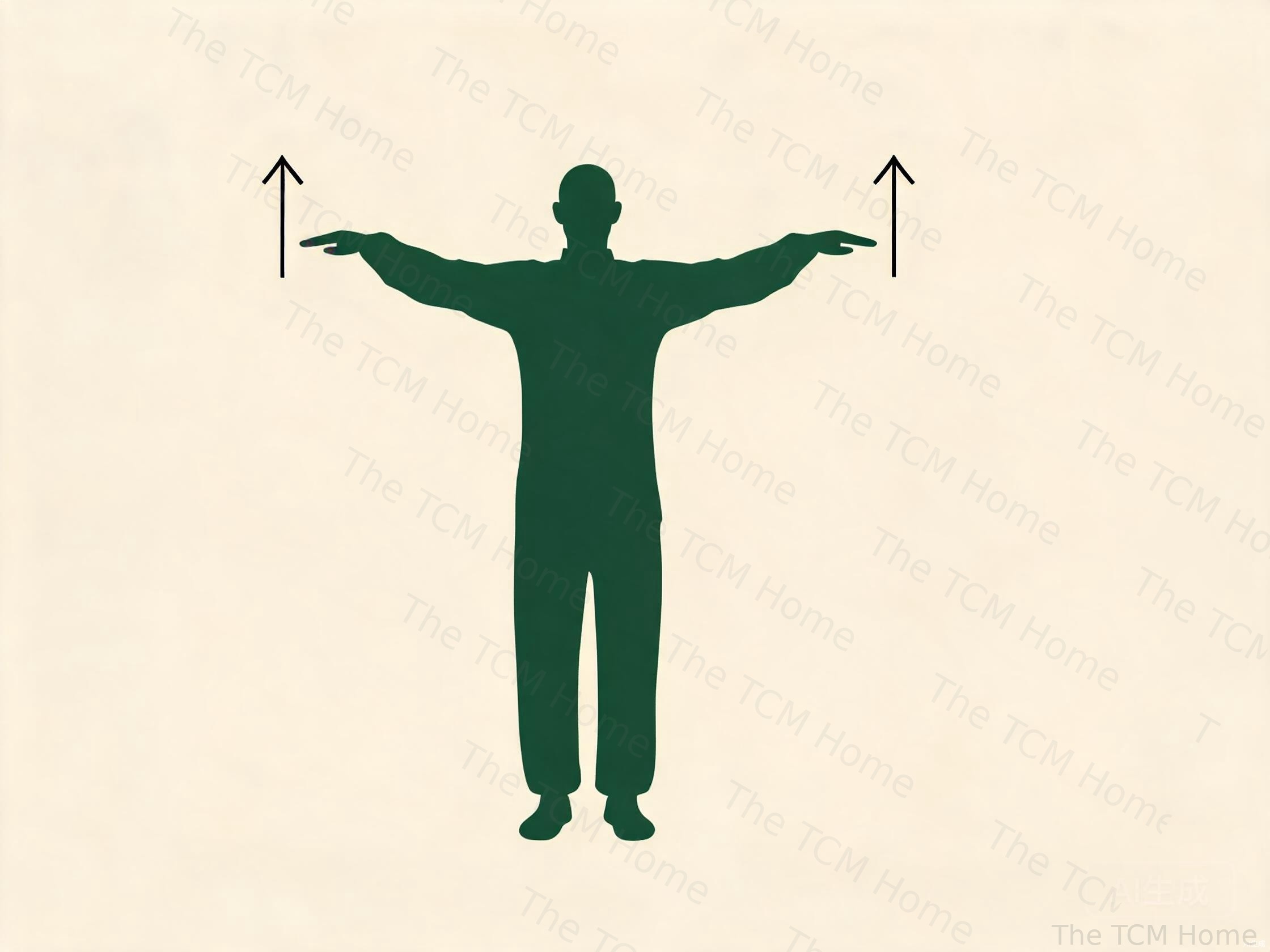
- Inhale and slowly open the arms outward to the sides, palms turning forward, until they extend at shoulder height. Feel the chest broaden and the breath fill the expanded ribs. As you open, imagine releasing the day's accumulated concerns, letting them flow outward with the arms.
- Exhale and slowly bring the hands back together in front of the chest, palms facing the body. Feel the chest soften without collapsing.
- Repeat 8 to 12 times, matching breath exactly to movement.
Movement 4: Cloud Hands (Yun Shou)
The flowing, meditative movement that quiets the mind through continuous, hypnotic motion.
- Stand with feet wider than shoulder-width, toes forward, knees soft. Raise both hands in front of the chest, palms facing the body, the right hand slightly higher than the left.
- Shift weight slowly onto the right leg, turning the waist gently right. The right hand circles down and across to the left while the left hand circles up and across to the right, as if two clouds drift past each other.
- When the weight reaches the right leg, step the left foot half a step to the left, placing it down with no weight.
- Shift weight onto the left leg, turning the waist left, continuing the hand circles so the right hand rises on the right and the left hand descends on the left.
- Continue shifting side to side, stepping slowly across the floor, for 2 to 3 minutes. The hands never stop; the breath flows with them. If the mind wanders to tomorrow's tasks, gently return it to the circling hands.
Why it helps: Cloud Hands gives the busy mind a single absorbing focus that crowds out the rumination keeping you awake. The continuous gentle motion is deeply hypnotic and calming.
Movement 5: Drawing Qi Down (Yin Qi Xia Xing)
A movement specifically designed to draw energy downward, away from the head and into the lower body, where it belongs at night.
- Stand with feet shoulder-width apart, knees soft. Raise both hands, palms facing up, in front of the body to the level of the forehead, as if gathering energy from above.
- Slowly turn the palms to face downward and draw them down the front of the body, palms passing over the face, chest, abdomen, and finally to the sides of the hips. Exhale through this long descent, about 8 seconds. Feel energy being drawn down with the hands, out of the busy head, into the calm lower body.
- Pause briefly at the bottom, then raise the hands again, palms up, inhaling for 6 seconds.
- Repeat 8 to 10 times. Each repetition should feel more settling than the last, the mind growing quieter, the body heavier.
Movement 6: Closing and Storing (Shou Shi)
The final movement gathers and stores the settled energy, sealing the calm before sleep.
- Bring the feet to shoulder-width apart, weight even. Let the arms hang at the sides.
- Slowly raise both hands, palms up, in front of the body to the lower abdomen (dantian), inhaling gently.
- Turn the palms to face the abdomen and rest them there, one hand over the other, palms warm against the belly. Stand quietly for 1 to 2 minutes, breathing naturally, feeling the warmth and stillness gathered in the center.
- Bow the head slightly in acknowledgment of the practice, then move gently and quietly toward bed.
The goal of an evening practice is calm, not exercise. Keep the stances high, the movements slow, and the effort minimal. If a movement feels energizing rather than settling, slow it down further or simplify it. The routine should leave you feeling heavy, warm, and quiet, never invigorated. Avoid practicing immediately after a large meal; wait at least an hour.
Timing: When to Practice
The ideal window is 30 to 60 minutes before your intended sleep time. This allows the parasympathetic shift to take hold and the body temperature to begin its natural nighttime drop, without leaving you so freshly moved that sleep is delayed. A sample evening schedule:
- 60 minutes before bed: Begin dimming lights. Stop screens, or switch devices to night mode. A warm foot soak for 10 minutes draws energy downward and warms the feet, which promotes sleep onset.
- 40 minutes before bed: Tai chi routine (15 to 20 minutes).
- 20 minutes before bed: Acupressure points (below), reading something calm, or quiet sitting.
- Bedtime: Lights out, room cool and dark.
Combining with Acupressure Points
Tai chi and acupressure complement each other powerfully for sleep. After your tai chi routine, while the body is settled and warm, hold these three points gently for 1 to 2 minutes each:
- Anmian ("Peaceful Sleep"): Located in the soft depression just behind the ear, between the earlobe and the base of the skull. Press gently with the index finger in a slow circular motion. This point is specifically used for insomnia and restlessness.
- Shenmen ("Spirit Gate"), HT7: On the inner wrist, at the crease, on the little-finger side. Press gently with the thumb. This point calms the shen, quiets the mind, and is one of the most-used points for anxiety and insomnia.
- Yongquan ("Gushing Spring"), KD1: On the sole of the foot, in the depression when the toes are curled, about one-third of the way from the toes to the heel. Press or rub firmly. This is the lowest point on the body and strongly draws descending energy downward, anchoring yang and nourishing yin.
Combining the downward flow of tai chi with these points creates a layered ritual of descent, each element reinforcing the body's signal that it is time to let go and sleep.
What to Expect
Unlike sleeping pills, tai chi does not knock you out on the first night. Its effect is cumulative, rebuilding the body's natural ability to shift into sleep. Most people notice:
- Within the first week: Feeling more relaxed at bedtime, falling asleep somewhat more easily.
- Within 2 to 4 weeks: Noticeably shorter sleep onset, fewer nighttime awakenings, and deeper sleep.
- Within 1 to 3 months: A reliable wind-down ritual that the body recognizes, so simply beginning the practice starts the descent into sleepiness.
The practice also tends to improve the quality of waking life, less daytime fatigue, steadier mood, better focus, because the sleep it produces is deeper and more restorative. In this way the evening routine pays dividends across the whole day, a quiet gift from a few minutes of slow movement before bed.
Sleep, in the end, is a surrender, a letting go that cannot be forced but can be invited. Tai chi is an invitation: a way of showing the body, through slow motion and slower breath, that the day is done, the work is set down, and it is safe now to descend into rest. Practiced patiently, night after night, it rebuilds the bridge between effort and ease, between the yang of doing and the yin of being, until crossing that bridge becomes, once again, the most natural thing in the world.
Frequently Asked Questions
When should I practice tai chi for better sleep?
Practice about 30 to 60 minutes before your intended bedtime. This gives the body time to settle into the parasympathetic state the movements induce, without leaving you so energized from movement that sleep is delayed. Avoid practicing immediately after a heavy meal; wait at least an hour after eating. A 15 to 20 minute session is ideal for most people.
Can tai chi cure insomnia?
Tai chi can significantly improve sleep quality and is supported by research for mild to moderate insomnia, particularly the sleep-onset type where the mind will not quiet. Studies show regular tai chi practice increases sleep duration, reduces wakefulness after sleep onset, and improves subjective sleep quality. However, chronic or severe insomnia often has multiple causes and may require medical evaluation; tai chi is best used as a complementary practice alongside proper sleep hygiene and professional care.
Why does tai chi help you sleep better than regular exercise?
Vigorous evening exercise can delay sleep by raising body temperature, heart rate, and cortisol. Tai chi, by contrast, lowers heart rate, reduces cortisol, and shifts the nervous system into parasympathetic dominance, the exact state needed for sleep. It also gives the busy mind a focus, which interrupts the rumination that keeps many people awake. This makes tai chi one of the few exercises genuinely suitable for the hours before bed.
Should I combine tai chi with other sleep practices?
Yes. Tai chi combines powerfully with acupressure points like Anmian (behind the ear) and Shenmen (on the wrist), with a warm foot soak to draw energy downward, and with simple sleep hygiene such as dimming lights and avoiding screens. Stacking these gentle practices in the hour before bed creates a reliable wind-down ritual that signals the body it is time to sleep.
Educational content only. Not medical advice. This article is for educational and informational purposes only and is not a substitute for professional medical advice, diagnosis, or treatment. If you experience chronic insomnia, loud snoring with pauses in breathing, or persistent daytime sleepiness, consult a healthcare provider, as these may indicate an underlying sleep disorder. Read our full disclaimer →